
Flame-Retardant Plastics: UL94 Ratings, Material Selection and DEYU Solutions
Flame-retardant plastic guide covering UL94 HB, V-2, V-1, V-0, 5VB and 5VA ratings, material thickness, halogen-free routes, resin selection and practical flame-retardant compound development.
Buyer and engineer FAQ
Questions engineers often ask about this material route
Where can modified plastic with a flame-retardant plastic requirement be used?
Typical fields include electrical enclosures, battery parts, connectors, appliance housings and industrial covers. For this article, DEYU would first confirm the working environment, wall thickness, expected lifetime and whether DGK-PP WPP-V0 halogen-free flame-retardant PP, DGK-PC FR3000 flame-retardant PC matches the part geometry or needs formulation adjustment.
What are the main performance indicators for the "flame-retardant plastic" target?
Focus on UL94 rating, GWFI/GWIT when needed, CTI, mechanical retention, color stability and flame-retardant precipitation. Buyers should ask for data on molded parts, not only pellet data, because gate position, filler orientation and thickness can change the final value.
What should engineers watch during injection molding or processing?
Avoid excessive residence time, use moderate screw speed and confirm the rating at the actual wall thickness. Start from the base-resin processing window, then adjust by molded-part resistance, appearance and mechanical data.
What details help DEYU recommend DGK-PP WPP-V0 halogen-free flame-retardant PP, DGK-PC FR3000 flame-retardant PC more accurately?
Send the current resin or grade, drawing or photo, wall thickness, annual quantity, target standard, failure mode and required color. If a reference grade already passed one test but failed in production, include both data sets.
For a precise recommendation, share the part drawing, base resin, target performance, processing method and test standard with DEYU.
Short Answer
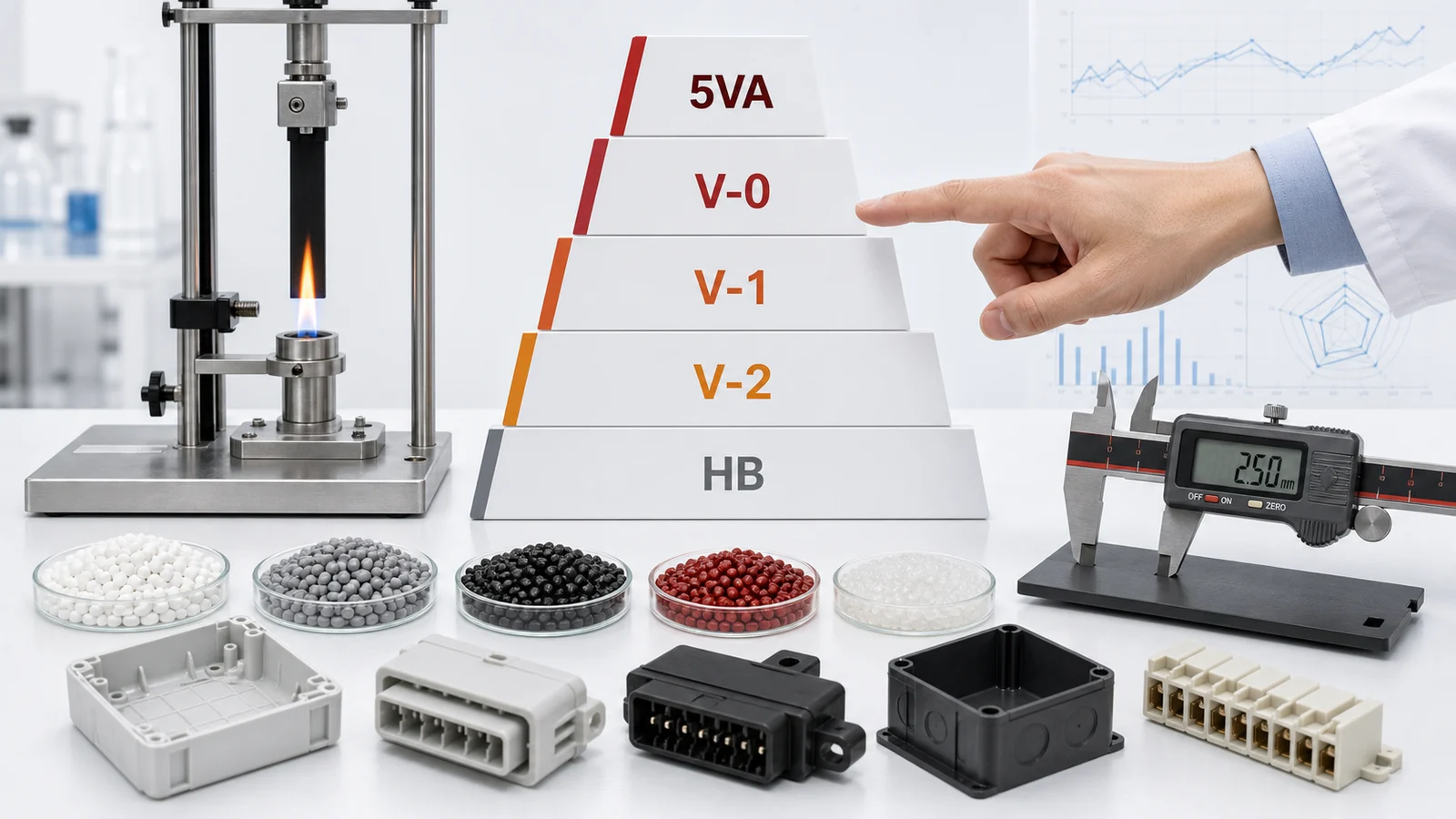
Flame-retardant plastics are classified mainly by burning behavior under defined test conditions. In commercial plastic material selection, UL94 ratings such as HB, V-2, V-1, V-0, 5VB and 5VA are commonly used. HB is a horizontal burning classification, while V-2, V-1 and V-0 are vertical burning classifications. V-0 is usually more demanding than V-1 and V-2 at the same thickness. 5VB and 5VA belong to more severe 5V testing conditions and are used when higher flame resistance is required.
Flame rating cannot be discussed without thickness. A material that reaches V-0 at 3.0 mm may not reach V-0 at 1.5 mm or 0.8 mm. A material that passes a standard test bar may still fail in a real molded part with thin walls, ribs, weld lines, screw bosses or sharp corners.
Common plastics suitable for flame-retardant modification include PP, ABS, PC/ABS, PC, PA6, PA66, PBT, PET, PPS, PPO/PPE, TPU and selected TPE systems. Yuyao Deyu DEYU plastics develops DGK flame-retardant compounds according to resin type, UL94 target, thickness, color, mechanical performance, halogen-free requirement, glass fiber reinforcement, electrical performance and real-part validation. Existing related product directions include DGK-PP WPP-V0 halogen-free flame-retardant PP and DGK-PC FR3000 flame-retardant PC.
Introduction: Flame Retardancy Is Not Only “V-0 or Not”
Many customers ask a simple question: “Can this material be flame-retardant?” In practice, this question is not enough. Flame-retardant plastic selection must define flame rating, test thickness, base resin, halogenated or halogen-free direction, color, mechanical strength, impact toughness, glass fiber reinforcement, heat resistance, electrical properties, molding process and final product application.
For example, a customer may ask for V-0 PP, but the real questions should be:
- V-0 at 3.0 mm, 1.5 mm or 0.8 mm?
- Black, white, natural or custom color?
- Halogen-free or halogenated?
- Injection molding or extrusion?
- Does the part need impact strength?
- Does it need glass fiber reinforcement?
- Is it used in a connector, housing, appliance part, battery component or outdoor electrical part?
A flame-retardant material is not only a material that self-extinguishes in a laboratory test. It must also maintain usable strength, toughness, flowability, color stability, dimensional stability and production consistency.
1. How Are Flame-Retardant Plastic Grades Classified?
HB: Horizontal Burning Classification
HB is usually considered a lower flame-retardant classification in UL94 material selection. It evaluates burning behavior in a horizontal position.
HB materials may be used in low-risk parts or applications where strict vertical flame resistance is not required. They are easier to achieve and usually have less impact on mechanical properties and cost than high flame-retardant grades, but they are not suitable for high-risk electrical components.
V-2: Vertical Burning with Flaming Drip Allowed
V-2 is a vertical burning classification. Compared with HB, it is more demanding because the specimen is tested vertically.
V-2 materials must stop burning within the required time, but flaming drips that ignite the cotton below may be allowed under the classification. V-2 can be suitable when the part does not require the stricter no-flaming-drip requirement of V-0 or V-1.
V-1: Better Flame Resistance Than V-2
V-1 is stricter than V-2 in terms of dripping behavior. It allows longer afterflame time than V-0 but does not allow flaming drips that ignite the cotton. V-1 may be used when V-0 is not necessary or when mechanical performance, cost and flame rating need a middle balance.
V-0: Common High Requirement for Electrical Parts
V-0 is one of the most commonly requested flame-retardant grades in electrical and electronic applications. Compared with V-1 and V-2, it requires shorter afterflame time and no flaming drips that ignite the cotton.
When customers say “flame-retardant plastic”, they often mean V-0. But V-0 must always be linked to a specific thickness. V-0 at 3.0 mm is easier than V-0 at 1.5 mm, and V-0 at 1.5 mm is easier than V-0 at 0.8 mm. Thin-wall V-0 usually requires more careful formulation design.
5VB and 5VA: Higher Flame Resistance Requirements
5VB and 5VA are more severe than ordinary V-0, V-1 and V-2 vertical burning tests. They are considered when the application requires stronger flame resistance. 5VA is generally stricter than 5VB because plaque specimens must not burn through.
5V-rated materials are not necessary for every product. They are usually selected only when the application or customer standard requires this level.
VTM Ratings for Thin Materials
For very thin films or sheet-like materials, VTM ratings may be used. These ratings are different from standard V ratings for injection-molded bars and should not be confused with ordinary V-0, V-1 or V-2 ratings for thicker molded materials.
2. Why Thickness Must Be Specified
Thickness is one of the most important factors in flame-retardant plastic selection. The same material may show different flame ratings at different thicknesses.
For example:
- a material may reach V-0 at 3.0 mm
- the same material may only reach V-1 or V-2 at 1.5 mm
- it may fail V-0 at 0.8 mm
- a thin-wall part may burn differently from a standard test bar
This is why datasheets often state flame rating together with thickness, such as UL94 V-0 at 3.0 mm, UL94 V-0 at 1.5 mm or UL94 V-0 at 0.8 mm.
Customers should avoid asking only “Is it V-0?” The correct question is “At what thickness is it V-0?” This is especially important for thin-wall housings, connectors, battery parts, charging equipment, electrical boxes, appliance parts, snap-fit structures and parts with ribs and weld lines.
3. Main Flame-Retardant Routes
Halogenated Flame-Retardant Systems
Halogenated systems are widely used because they are efficient and mature. They are often combined with synergists to improve flame-retardant performance.
Advantages include high flame-retardant efficiency, easier V-0 performance in many resins, lower additive loading compared with some halogen-free systems, better flowability in selected formulations and cost-effectiveness for certain applications.
Risks include halogen-free restrictions, smoke or corrosion concerns, customer compliance requirements and the need to balance color and mechanical properties. This route is suitable when high efficiency and cost control are important and halogen-free is not required.
Halogen-Free Phosphorus-Nitrogen Systems
Halogen-free flame-retardant systems are increasingly used in electrical, electronics, appliance and export-oriented products.
They can meet halogen-free requirements and can be used in PP, PA, PBT, PC/ABS, TPU and other systems. However, higher additive loading may be needed, impact strength may decrease, moisture sensitivity may increase, surface precipitation may occur and the processing window must be controlled.
Halogen-free flame retardancy is not simply replacing one additive. It requires full system balance.
Mineral Flame-Retardant Systems
Mineral flame retardants such as magnesium hydroxide and aluminum hydroxide can be used in selected systems, especially where low smoke and halogen-free direction are required.
They are halogen-free and suitable for selected wire, cable and polyolefin applications. But high loading is often required, mechanical properties may decrease, flowability may become poor, density increases and surface quality may be affected.
Inherently Flame-Resistant Resins
Some engineering plastics have better inherent flame resistance than general-purpose plastics. Examples include PC, PPS, PEI, PPO/PPE blends and some high-performance engineering plastics.
These resins can reduce flame-retardant additive burden and offer better heat resistance and dimensional stability, but they may cost more and still need formulation balance for thin-wall V-0, impact, color or chemical resistance.
4. Which Materials Are Suitable for Flame-Retardant Modification?
PP Flame-Retardant Materials
PP is lightweight, low-cost and chemically resistant, but it is flammable without modification. It is one of the most common flame-retardant modified plastics.
Suitable directions include halogenated flame-retardant PP, halogen-free flame-retardant PP, glass fiber reinforced flame-retardant PP, anti-static flame-retardant PP and colored flame-retardant PP.
Applications include electrical housings, appliance components, battery peripheral parts, industrial covers, junction boxes, flame-retardant trays and automotive non-structural parts. Key challenges include impact strength, thin-wall V-0, color stability, surface precipitation, flowability and halogen-free compatibility.
ABS Flame-Retardant Materials
ABS has good appearance, processability and impact performance. Flame-retardant ABS is widely used in housings and appliance parts.
It is suitable for electronic housings, appliance shells, switch panels, instrument housings, office equipment parts and industrial control housings. Key challenges include impact retention, surface gloss, color stability, flame-retardant efficiency and processing stability.
PC/ABS Flame-Retardant Materials
PC/ABS is one of the most practical materials for flame-retardant housings. It balances impact strength, heat resistance, appearance and processability.
It is often used for electrical housings, charging equipment parts, communication equipment covers, appliance components, battery-related housings, automotive electronic housings and industrial control equipment. PC/ABS is often preferred when ABS alone cannot meet heat, impact or flame-retardant requirements.
PC Flame-Retardant Materials
PC has relatively good inherent flame resistance compared with many general-purpose plastics. It is suitable for transparent, translucent, high-impact and heat-resistant applications.
Suitable directions include transparent flame-retardant PC, black or colored flame-retardant PC, UV-resistant flame-retardant PC, anti-static flame-retardant PC and light-diffusing flame-retardant PC. Key challenges include stress cracking, color and transparency, hydrolysis resistance, thin-wall flame rating, scratch resistance and processing temperature.
PA6 and PA66 Flame-Retardant Materials
PA6 and PA66 are widely used in connectors, electrical structures, industrial parts and automotive components. Flame-retardant nylon is one of the most important engineering flame-retardant material categories.
Suitable directions include halogenated flame-retardant PA, halogen-free flame-retardant PA, glass fiber reinforced flame-retardant PA, red phosphorus flame-retardant PA in selected systems, anti-static flame-retardant PA and carbon fiber reinforced flame-retardant PA.
Key challenges include moisture absorption, mechanical balance, glass fiber interaction, color stability, flame retardant precipitation, CTI and electrical properties and processing temperature.
PBT, PET, PPS and PPO/PPE
PBT and PET are commonly used in electrical and electronic parts because of dimensional stability, heat resistance and electrical properties. They are common in connectors, relay parts, switch components, motor parts, coil bobbins and insulation parts.
PPS has excellent heat resistance, chemical resistance, dimensional stability and inherent flame resistance. It is suitable for high-temperature electrical and industrial applications.
PPO/PPE blends are widely used in electrical and electronic applications because of dimensional stability, low water absorption and flame-retardant potential.
TPU, TPE and POM
TPU and TPE are flexible materials. Flame-retardant modification is possible but more difficult because flexibility, elasticity and flame retardancy must be balanced.
POM has excellent wear resistance, low friction and dimensional stability, but flame-retardant modification is more difficult than many other plastics. Processing safety, decomposition risk, odor and mechanical balance must be evaluated carefully. POM is usually not the first choice when strong flame retardancy is required.
5. Material Selection Table
| Base Resin | Flame-Retardant Difficulty | Common Target | Main Advantages | Main Risks | Typical Applications |
|---|---|---|---|---|---|
| PP | Medium to high | HB, V-2, V-0 | Low cost, light weight | Impact, precipitation, thin-wall V-0 | Trays, covers, battery parts |
| ABS | Medium | V-0 | Appearance, processability | Impact and gloss balance | Housings, appliance shells |
| PC/ABS | Medium | V-0, thin-wall V-0 | Impact, heat, appearance | Cost, hydrolysis, color | Electrical housings, charging parts |
| PC | Low to medium | V-0 | Impact, transparency, heat | Stress cracking, cost | Transparent covers, LED parts |
| PA6/PA66 | Medium | V-0 | Strength, heat, structure | Moisture, CTI, color | Connectors, electrical structures |
| PBT/PET | Medium | V-0 | Dimensional stability | Hydrolysis, warpage | Connectors, relay parts |
| PPS | Low to medium | V-0, high-temp FR | Heat, chemical resistance | Cost, brittleness | High-temp electrical parts |
| PPO/PPE | Medium | V-0 | Low water absorption | Flow, cost | Housings, battery parts |
| TPU/TPE | High | V-0 or cable-grade FR | Flexibility | Migration, flexibility loss | Cables, sleeves, soft parts |
| POM | High | Special evaluation | Wear, low friction | Processing and stability risk | Selected wear parts only |
6. How to Choose the Correct Flame-Retardant Material
For electrical housings, recommended materials include PC/ABS, ABS, PC and flame-retardant PP. Selection should focus on V-0 thickness, impact strength, appearance, heat resistance, color and cost. PC/ABS is often balanced when impact and flame retardancy are both important.
For connectors and electrical structural parts, recommended materials include flame-retardant PA66, PA6, PBT and PPS for high-temperature applications. Selection should focus on V-0 at required thickness, CTI, heat resistance, dimensional stability, glass fiber reinforcement and moisture conditioning.
For battery and charging equipment parts, recommended materials include flame-retardant PC/ABS, flame-retardant PP, flame-retardant PA, PBT or PPS where higher heat resistance is required. Selection should consider flame rating, heat resistance, impact strength, dimensional stability, electrical safety, halogen-free requirement and outdoor UV requirement if applicable.
For transparent or light-diffusing flame-retardant parts, PC is usually more suitable than many general-purpose resins when transparency and flame retardancy are both required.
For flexible flame-retardant parts, TPU, TPE, EVA-based systems and flexible PVC where applicable may be considered. The formulation must balance flexibility, migration, low-temperature flexibility, surface feel and cable or sleeve requirements.
7. Common Mistakes in Flame-Retardant Plastic Selection
Only Asking “Can It Reach V-0?”
This is incomplete. The correct questions are: V-0 at what thickness, what color, what resin, what mechanical performance and what application?
Ignoring Real Part Structure
Standard test bars are not the same as real molded parts. Thin walls, ribs, weld lines, holes and sharp corners can affect burning behavior.
Ignoring Mechanical Performance
Some flame-retardant systems reduce impact strength or make the material brittle. For housings and structural parts, mechanical reliability is as important as flame rating.
Ignoring Color and Appearance
White and light-colored flame-retardant materials are more difficult than black materials. Color stability, yellowing and surface precipitation must be considered.
Ignoring Halogen-Free Requirements
Some industries or customers require halogen-free materials. The flame-retardant route must be confirmed at the beginning.
8. DEYU DGK Flame-Retardant Material Platform
Yuyao Deyu DEYU plastics provides customized DGK flame-retardant plastic solutions.
DEYU can support:
- DGK-PP flame-retardant series
- DGK-PP halogen-free flame-retardant series
- DGK-ABS flame-retardant series
- DGK-PC/ABS V-0 series
- DGK-PC transparent flame-retardant series
- DGK-PA6 flame-retardant series
- DGK-PA66 flame-retardant reinforced series
- DGK-PBT flame-retardant series
- DGK-PPS high-temperature flame-retardant series
- DGK-PPO/PPE flame-retardant series
- DGK-TPU flame-retardant series
- anti-static flame-retardant materials
- UV-resistant flame-retardant materials
- glass fiber reinforced flame-retardant materials
- colored flame-retardant materials
DEYU can adjust base resin, UL94 target, test thickness, halogenated or halogen-free direction, flame-retardant package, glass fiber content, impact strength, flowability, heat resistance, color, surface appearance, CTI and electrical properties, UV resistance, anti-static or conductive function, wear resistance and molding process.
To develop a suitable flame-retardant material, DEYU recommends customers provide target resin, flame rating requirement, required test thickness, part wall thickness, product application, color requirement, halogen-free requirement if any, impact strength requirement, heat resistance requirement, glass fiber or reinforcement requirement, electrical performance requirement, outdoor UV requirement, current material problem, part drawing or sample and customer test standard.
Conclusion
Flame-retardant plastic grades are commonly classified by burning behavior under defined conditions, such as HB, V-2, V-1, V-0, 5VB and 5VA. In practical material selection, V-0 is widely used for electrical and electronic parts, while 5VA and 5VB are used for higher flame-resistance requirements. However, every flame rating must be linked to thickness.
Many plastics can be modified for flame retardancy, including PP, ABS, PC/ABS, PC, PA6, PA66, PBT, PET, PPS, PPO/PPE, TPU and TPE. Each resin has different advantages and limitations. A mature flame-retardant plastic solution should not only pass a flame test. It should also maintain strength, toughness, appearance, dimensional stability, processing reliability and real-part safety.