
High-Toughness Plastics vs High-Rigidity Plastics: Selection Requirements and DEYU Solutions
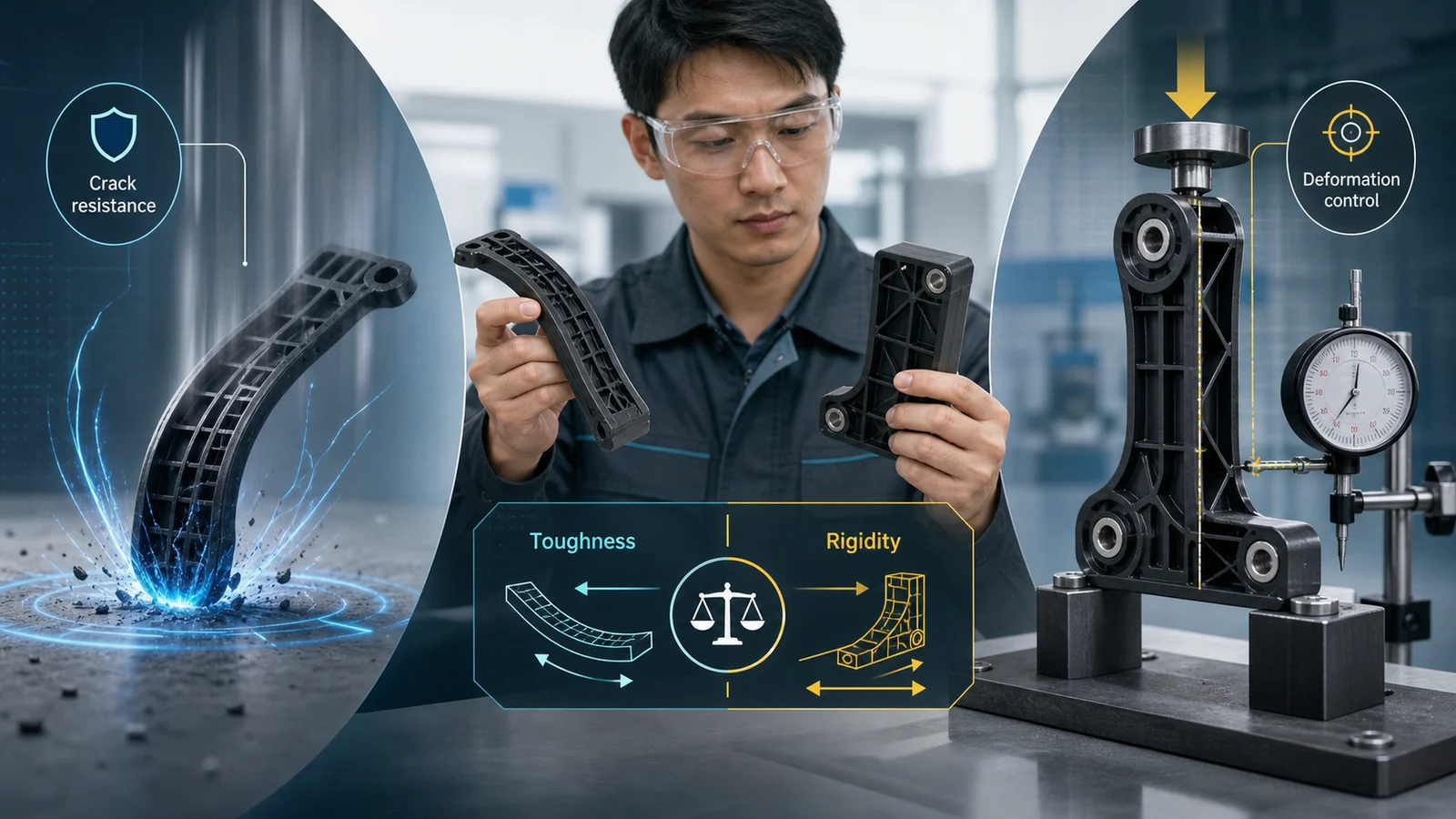
High-toughness plastics focus on impact resistance, crack resistance, snap-fit reliability, drop performance and low-temperature toughness. High-rigidity plastics focus on stiffness, dimensional stability, load-bearing ability, deformation control and structural support.
Buyer and engineer FAQ
Questions engineers often ask about this material route
Where can modified plastic with a low-temperature resistant plastic requirement be used?
Typical fields include cold-chain containers, outdoor buckles, freezer parts, winter equipment and impact-prone housings. For this article, DEYU would first confirm the working environment, wall thickness, expected lifetime and whether DGK-PP 66D impact modified low-temperature PP matches the part geometry or needs formulation adjustment.
What are the main performance indicators for the "low-temperature resistant plastic" target?
Focus on notched impact at the service temperature, ductile-brittle transition, flexibility and dimensional change. Buyers should ask for data on molded parts, not only pellet data, because gate position, filler orientation and thickness can change the final value.
What should engineers watch during injection molding or processing?
Avoid sharp gates and high residual stress; validate parts at -20°C, -30°C or the real service temperature. Start from the base-resin processing window, then adjust by molded-part resistance, appearance and mechanical data.
What details help DEYU recommend DGK-PP 66D impact modified low-temperature PP more accurately?
Send the current resin or grade, drawing or photo, wall thickness, annual quantity, target standard, failure mode and required color. If a reference grade already passed one test but failed in production, include both data sets.
For a precise recommendation, share the part drawing, base resin, target performance, processing method and test standard with DEYU.
Short Answer
High-toughness plastics and high-rigidity plastics are not the same.
High-toughness plastics are designed to resist cracking, breaking, impact, drop, bending deformation, snap-fit failure, screw boss cracking and low-temperature brittle fracture. Their key indicators include impact strength, elongation, notch resistance, low-temperature impact, fatigue resistance and real-part drop performance.
High-rigidity plastics are designed to resist deformation under load. Their key indicators include flexural modulus, tensile modulus, stiffness, dimensional stability, creep resistance, heat deflection temperature, glass fiber or carbon fiber reinforcement and structural support.
In simple terms, high toughness means the part is less likely to crack, while high rigidity means the part is less likely to deform. A tough material may be flexible but not stiff enough. A rigid material may be strong but brittle.
For high-impact PP parts that need low-temperature toughness, DEYU’s existing DGK-PP 66D impact modified low-temperature PP can be used as a reference product direction, while other DGK formulations can be customized around the part’s real failure mode.
Why Toughness and Rigidity Are Often Confused
In plastic material selection, many customers say they need a stronger material. But stronger may mean different things.
Some parts must not break when dropped. Some parts must not deform under load. Some clips need to bend without breaking. Some brackets must hold shape under pressure. Some housings must survive impact. Some gears must keep tooth accuracy. Some connectors must resist insertion force. Some elevator accessories, bearing parts and mechanical components must maintain dimensional stability over long service life.
These are different material targets. If the part cracks, the material may need higher toughness. If the part bends or loses shape, the material may need higher rigidity. If the part both cracks and deforms, it usually needs a balanced toughened-reinforced solution.
The first question should not be whether the material is strong. The correct question is: what failure are we trying to solve?
What Is High-Toughness Plastic?
High-toughness plastic refers to a material that can absorb energy and resist crack propagation under impact, bending, drop, assembly, vibration or low-temperature conditions.
High-toughness plastics are important when the part must:
- survive drop testing
- resist screw boss cracking
- avoid snap-fit breakage
- withstand cold assembly
- maintain impact resistance after aging
- bend without brittle fracture
- resist notch sensitivity
- survive repeated assembly and disassembly
Common indicators include notched impact strength, unnotched impact strength, elongation at break, low-temperature impact strength, drop test performance, snap-fit cycle testing, screw boss cracking test, weld line impact strength and fatigue performance.
Common high-toughness routes include high-impact ABS, impact-modified PP, PC/ABS alloy, toughened PA6, toughened PA66, impact-modified POM, TPU and TPE flexible systems, elastomer toughening and POE, EPDM, SEBS, MBS, acrylic or nylon-specific impact modifiers.
What Is High-Rigidity Plastic?
High-rigidity plastic refers to a material that resists bending, deformation, warpage, creep and dimensional change under load.
High-rigidity plastics are important when the part must:
- support load
- maintain shape
- reduce deformation
- resist creep
- maintain dimensional accuracy
- support assembly positioning
- replace metal in selected structures
- keep gear tooth accuracy
- keep bracket stiffness
- maintain flatness or straightness
Common indicators include flexural modulus, tensile modulus, flexural strength, tensile strength, heat deflection temperature, creep resistance, warpage control, dimensional stability, shrinkage, fiber reinforcement level and load deformation test.
Common high-rigidity routes include glass fiber reinforced PP, glass fiber reinforced PA6 or PA66, long glass fiber reinforced PP or PA, carbon fiber reinforced PA/POM/PPS, mineral-filled PP, talc-filled PP, glass fiber reinforced PBT, PPS reinforced compounds, PPA and high-temperature reinforced engineering plastics.
Core Difference: Crack Resistance vs Deformation Resistance
| Item | High-toughness plastic | High-rigidity plastic |
|---|---|---|
| Main purpose | Resist cracking and impact | Resist deformation and bending |
| Main failure solved | Breakage, cracking, snap-fit failure | Warpage, bending, creep, loss of shape |
| Key index | Impact strength, elongation, notch resistance | Flexural modulus, tensile modulus, HDT |
| Typical modification | Elastomer, rubber phase, impact modifier | Glass fiber, carbon fiber, mineral filler |
| Risk | May become softer or less stiff | May become brittle or notch-sensitive |
| Suitable parts | Clips, housings, covers, drop-resistant parts | Brackets, supports, load-bearing parts |
| Design focus | Energy absorption | Structural support |
| Common mistake | Too soft after over-toughening | Too brittle after over-reinforcement |
The two properties are often in conflict. Adding elastomer improves toughness but may reduce rigidity. Adding glass fiber improves rigidity but may reduce impact strength or increase notch sensitivity. Many real projects therefore require an impact-balanced reinforced material rather than a pure high-toughness or pure high-rigidity material.
When to Choose High-Toughness Plastic
Choose high-toughness plastic when the main problem is cracking after drop testing, snap-fit breakage during assembly, screw boss cracking after tightening, winter brittleness, housing corner cracking, weld line failure, repeated assembly and disassembly or the need to absorb impact energy.
Recommended directions:
| Application direction | Material options |
|---|---|
| Appearance housings | High-impact ABS, PC/ABS, impact-modified PC/ABS |
| Low-cost large parts | Impact-modified PP, low-temperature toughened PP, UV-resistant toughened PP |
| Structural clips and automotive parts | Toughened PA6, toughened PA66, impact-balanced reinforced nylon |
| Flexible impact absorption | TPU, TPE, SEBS-based elastomer systems |
| Precision moving parts | Impact-modified POM, POM impact plus wear-resistant balance |
When to Choose High-Rigidity Plastic
Choose high-rigidity plastic when the main problem is bending under load, insufficient bracket support, deformation after assembly, unstable flatness, long-term creep, dimensional change after heating, gear accuracy loss, connector deformation under insertion force or partial metal replacement.
Recommended directions:
| Application direction | Material options |
|---|---|
| Cost-sensitive structural parts | Glass fiber reinforced PP, talc-filled PP, long glass fiber PP |
| High-strength engineering parts | Glass fiber reinforced PA66, glass fiber reinforced PA6, carbon fiber reinforced PA |
| Precision dimensional stability | Reinforced POM, glass fiber reinforced PBT, reinforced PPS |
| High-temperature rigidity | Reinforced PPS, reinforced PPA, reinforced PEEK where required |
When Toughness and Rigidity Must Coexist
Many parts need both toughness and rigidity. Automotive clips must bend during assembly but keep locking force. Electrical housings must pass drop testing but maintain shape. Battery brackets must resist load and impact. Industrial covers must be stiff but not brittle. Elevator accessories must maintain dimensions and reduce cracking. Bearing cages need dimensional stability and fatigue resistance.
In these cases, the best solution is not simply adding more glass fiber or more elastomer. It requires a balanced formulation.
Common balanced routes include impact-balanced glass fiber reinforced PA66, toughened glass fiber reinforced PP, PC/ABS alloy with impact and rigidity balance, POM wear-resistant impact-balanced material, PA66 plus glass fiber plus impact modifier, PP plus talc plus elastomer balance and carbon fiber reinforced materials with toughness adjustment.
Technical Route: Improving Toughness
Elastomer Toughening
Elastomers such as POE, EPDM, SEBS and special nylon tougheners can improve impact performance and low-temperature toughness. The risk is lower stiffness, lower heat resistance, possible surface softness and possible flow change.
Rubber Phase Optimization
ABS and some impact-modified polymers use rubber phase design to absorb impact energy. This improves impact, crack resistance and housing reliability, but UV aging, heat resistance and surface gloss must be controlled.
Alloy Toughening
PC/ABS, PA/ABS, PP/EPDM and other alloys use resin blending to balance toughness with heat resistance, appearance and processing. Compatibility must be controlled, otherwise phase separation may reduce performance.
Technical Route: Improving Rigidity
Glass Fiber Reinforcement
Glass fiber is the most common rigidity-improving route. It increases modulus, strength, heat deformation resistance and shrinkage control. Risks include impact loss, warpage from fiber orientation, fiber exposure and weld line weakness.
Carbon Fiber Reinforcement
Carbon fiber provides high stiffness, dimensional stability, conductivity and lightweight performance. It also brings higher cost, brittleness risk, dark color and possible surface roughness.
Mineral and Talc Filling
Mineral fillers improve rigidity and dimensional stability at lower cost. They may reduce impact strength, increase density and change surface or flow behavior.
Long Fiber Reinforcement
Long glass fiber systems can provide better structural reinforcement than short fiber systems in selected applications. They are useful for impact-rigidity balance and metal replacement, but processing and fiber length retention must be controlled.
Customer Case 1: High-Toughness ABS Housing Solving Drop Cracking
A customer used standard ABS for an industrial device housing. The surface appearance was good, but the housing cracked at corners during drop testing. Screw bosses whitened, weld lines were weak and drop test results were unstable.
| Item | Original ABS | DEYU DGK high-toughness ABS |
|---|---|---|
| Notched impact strength | 14 kJ/m2 | 29 kJ/m2 |
| Drop test at 1.2 m | 5 failures / 10 samples | 0 failures / 10 samples |
| Screw boss cracking after assembly | 4 failures / 20 samples | 0 failures / 20 samples |
| Flexural modulus | 2,250 MPa | 2,050 MPa |
| Surface appearance | Good | Good |
The customer needed toughness, not rigidity. If glass fiber had been added to increase stiffness, corner cracking could have become worse. The correct route was high-toughness ABS with controlled impact modification.
Customer Case 2: High-Rigidity PA66 Bracket Solving Load Deformation
A customer used ordinary PA66 for a mechanical support bracket. The part did not crack, but it deformed under load after long-term use.
| Item | Original PA66 | DEYU DGK-PA66 high-rigidity reinforced material |
|---|---|---|
| Tensile strength | 78 MPa | 132 MPa |
| Flexural modulus | 2,600 MPa | 7,800 MPa |
| Load deformation after 72 hours | 1.35 mm | 0.32 mm |
| Heat deformation under assembly load | Visible | Significantly reduced |
| Assembly cracking | Not obvious | Not observed in validation |
This project did not need higher toughness first. The main failure was deformation. A reinforced high-rigidity PA66 solution reduced creep and improved dimensional stability.
Customer Case 3: Balanced Toughness and Rigidity for Automotive Clip
An automotive customer used a rigid reinforced nylon clip. It had good locking force but broke during cold assembly. When the customer changed to a toughened nylon, the clip no longer broke, but locking force decreased.
| Item | Rigid PA66-GF clip | Toughened PA66 trial | DEYU balanced PA66 |
|---|---|---|---|
| Flexural modulus | 6,800 MPa | 2,400 MPa | 4,900 MPa |
| Notched impact at -30 deg C | 2.4 kJ/m2 | 7.5 kJ/m2 | 6.2 kJ/m2 |
| Cold assembly failure | 6 / 20 | 0 / 20 | 0 / 20 |
| Locking force | 100% reference | 72% reference | 91% reference |
| Removal cycle life | 6 cycles | 14 cycles | 18 cycles |
The final solution was neither pure toughness nor pure rigidity. The customer needed reinforced-toughened nylon that could bend during assembly while maintaining locking force.
Customer Case 4: High-Rigidity PP Cover with Impact Balance
A customer used ordinary PP for a large equipment cover. Impact resistance was acceptable, but the cover warped after assembly and lost flatness. A mineral-filled PP trial improved stiffness but made the cover brittle during transport.
| Item | Ordinary PP | Mineral-filled PP trial | DEYU balanced PP |
|---|---|---|---|
| Flexural modulus | 1,350 MPa | 2,850 MPa | 2,350 MPa |
| Drop test | 0 / 10 failures | 4 / 10 failures | 0 / 10 failures |
| Flatness deviation | 2.8 mm | 1.1 mm | 1.3 mm |
| Corner cracking in transport | Not obvious | Frequent | Significantly reduced |
| Surface appearance | Good | Acceptable | Good |
For large PP covers, the material cannot be only tough or only rigid. It must balance stiffness, warpage, impact, surface and flowability.
DEYU DGK Material Platform
Yuyao Deyu DEYU plastics provides customized DGK high-toughness, high-rigidity and toughness-rigidity balanced solutions for PP, ABS, PC/ABS, PA6, PA66, POM, PBT, PPS, TPU, TPE and other resin systems.
High-toughness directions include DGK-ABS high-toughness series, DGK-PP low-temperature toughened series, DGK-PC/ABS high-impact series, DGK-PA6 toughened series, DGK-PA66 impact-balanced series, DGK-POM impact-modified series, DGK-TPU low-temperature impact series and DGK-TPE flexible impact series.
High-rigidity directions include DGK-PP glass fiber reinforced series, DGK-PP talc-filled high-rigidity series, DGK-PA66 glass fiber reinforced series, DGK-PA6 reinforced series, DGK-PBT glass fiber reinforced series, DGK-PPS reinforced series, DGK-POM reinforced series, DGK-PA66 carbon fiber reinforced series and DGK-PPA high-temperature reinforced series.
DEYU can adjust base resin, impact modifier, glass fiber, carbon fiber, mineral filler, toughener dosage, compatibilizer, flexural modulus, notched impact, tensile strength, heat resistance, creep, warpage, shrinkage, flowability, surface, color, flame retardancy, anti-static or conductive function, wear resistance and UV resistance.
Information Needed for Material Selection
To select the right material, DEYU recommends providing the current material, product application, main failure mode, whether the part cracks or deforms, impact test temperature, load condition, part thickness, screw boss or snap-fit structure, required modulus or stiffness, required impact strength, heat resistance target, molding process, drawing or sample, color, flame-retardant requirement, UV requirement, wear or anti-static requirement and customer test standard.
Conclusion
High-toughness and high-rigidity plastics solve different engineering problems. High toughness focuses on crack resistance, energy absorption, low-temperature reliability, snap-fit safety and drop performance. High rigidity focuses on deformation control, stiffness, dimensional stability, creep resistance and load-bearing capability.
A tough material is not always rigid. A rigid material is not always tough. In many real projects, the best answer is a balanced formulation designed around the real part failure mode.