
How Transparent Antistatic Materials Balance Clarity and Permanent ESD Performance
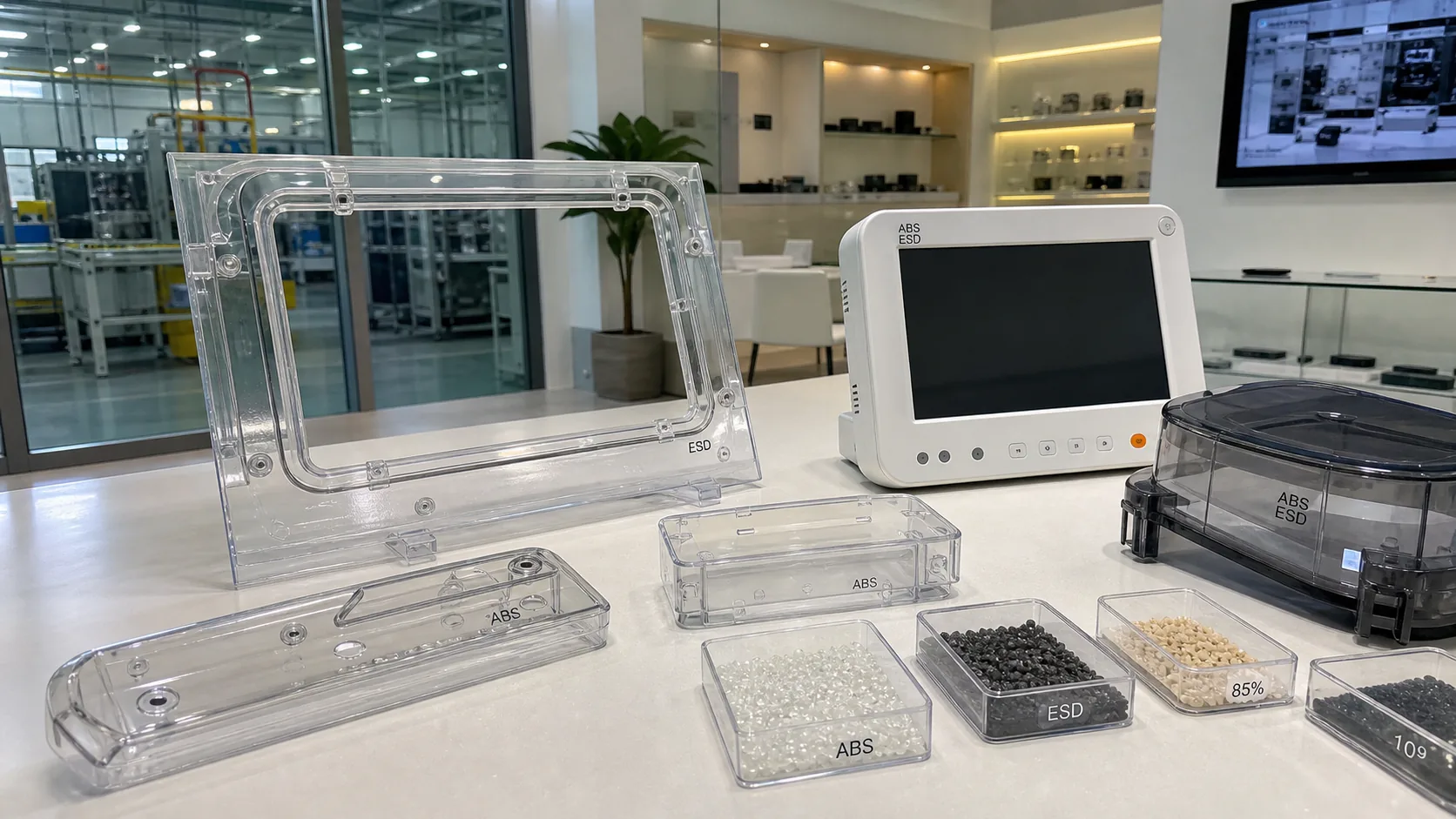
Transparent antistatic parts must keep high light transmission, often above 85%, while holding stable surface resistivity around 10^8-10^10 Ω·sq. This guide explains the material principle, molding window and three validation cases.
Material validation notes
How Transparent Antistatic Materials Balance Clarity and Permanent ESD Performance
Why is transparent antistatic plastic harder than black conductive plastic?
Black conductive fillers are efficient but block light. Transparent antistatic systems must build a dissipative path while matching refractive index and controlling nanoscale dispersion.
What process variable most affects haze?
Moisture and excessive melt temperature are the first checks. In the AOI case, better drying and lower melt temperature reduced haze from 12.3% to 6.1%.
How should permanence be validated?
Use alcohol wipe, water wash, low-humidity and full-part resistance mapping rather than only measuring one molded plaque.
Is DGK-ABS KJD890TM suitable for thin-wall transparent parts?
Its MFI of 46.4 g/10 min supports thin-wall filling, but gate, pressure and mold temperature still need part-level tuning.
In semiconductor packaging and testing, medical equipment windows, optical inspection instruments and smart-home transparent panels, materials must satisfy two requirements that often conflict. The part needs high light transmission, typically above 85%, for visual observation and optical detection accuracy, while also providing permanent antistatic performance, usually surface resistivity of 10^8-10^10 Ω·sq, to prevent dust attraction or breakdown of sensitive components.
This contradiction between transparency and antistatic stability has been a long-term technical problem in engineering plastic modification. This article starts from the material principle and then uses three real process-tuning cases to explain selection logic and optimization routes for transparent antistatic materials.
The case material is DGK-ABS KJD890TM transparent antistatic ABS. For application field coverage, see the related guide on 20 typical uses of DGK-ABS KJD890TM.
Technical Principle: Why Transparency and Antistatic Performance Conflict
Common static-dissipative engineering plastics normally use two routes. Conductive fillers such as carbon black or carbon fiber are mature and cost controllable, and surface resistivity can remain in the 10^3-10^6 Ω range, but the material becomes black and opaque. Coated antistatic agents can give a transparent part short-term antistatic behavior, but the surface layer decays after wiping, washing or humidity change.
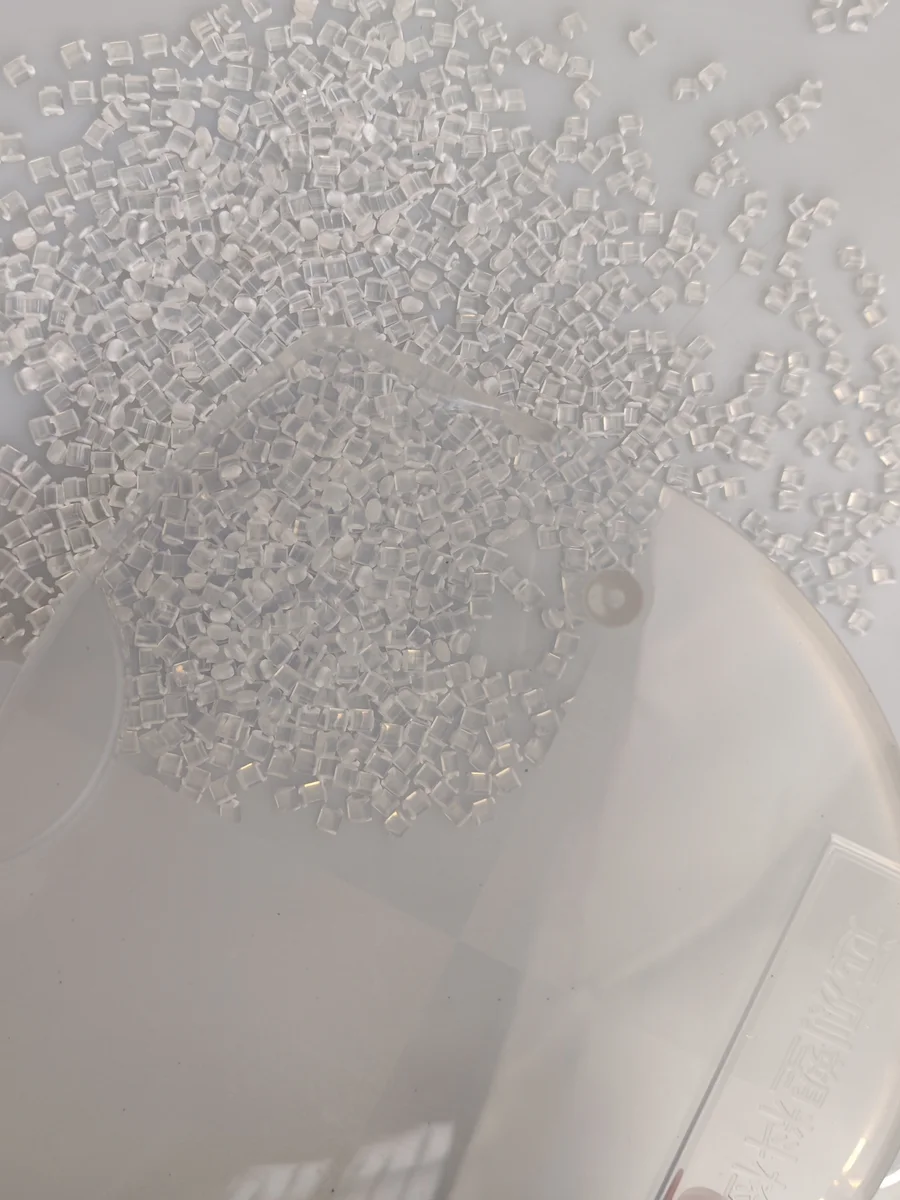
The core route for transparent antistatic materials is a polymeric permanent antistatic agent. The antistatic component is melt-blended with the base resin in polymer form, forming a sub-microscopic conductive network inside the resin. This provides a stable static-dissipation path while keeping visible-light scattering low. Unlike small-molecule antistatic agents that migrate to the surface and depend on ambient humidity, the polymeric system is anchored in the matrix, so repeated washing or long storage does not cause obvious resistance drift.
Transparency is mainly controlled by two factors. First is refractive-index matching between the antistatic phase and the base resin: a large difference increases interface scattering, raising haze and reducing transmission. Second is dispersed-phase particle size. According to Rayleigh scattering, when a dispersed phase is larger than roughly one tenth of visible wavelength, about 38 nm, scattering rises sharply. Nanoscale dispersion is therefore required for high light transmission.
Typical Challenges During Process Tuning
Challenge 1: haze and white fog. Excessive injection temperature or shear can cause macroscopic phase separation between antistatic agent and matrix, enlarging dispersed particles to micron scale and increasing light scattering. Insufficient drying leaves moisture that vaporizes at high temperature and forms microbubbles, also increasing haze.
Challenge 2: uneven surface resistance. During injection molding, the antistatic phase may orient along melt flow. Poor gate design or unstable filling speed can create concentration differences across the part, appearing as local antistatic failure.
Challenge 3: warpage and dimensional instability. Adding antistatic components changes crystallization behavior or shrinkage of the base resin. If mold temperature or holding pressure is not controlled, uneven cooling shrinkage can warp the part.
Case 1: Semiconductor AOI Transparent Window
Project background: a semiconductor equipment manufacturer needed a transparent antistatic window for automatic optical inspection equipment. The requirement was light transmission above 85% at 2 mm, surface resistivity of 10^8-10^10 Ω·sq and haze below 8%. The original imported transparent antistatic PC sheet required machining, with high cost and long lead time.
Initial issue: after trial injection with DGK-ABS KJD890TM, transmission was 84.2%, close to target, but haze reached 12.3%, far above the 8% limit. The surface showed slight white fog and reduced AOI camera image clarity.
Cause analysis: drying was only 70°C for 2 h, with material moisture around 0.15%, higher than the below-0.05% target for transparent ABS. Barrel temperature was also high, 230°C in the front zone and 225°C at the nozzle, near the upper thermal limit of the antistatic component, causing partial thermal oxidation and larger dispersed particles.
Process Tuning Data
| Process parameter | Initial setting | Optimized setting | Basis |
|---|---|---|---|
| Drying temperature | 70°C | 85°C | Recommended process |
| Drying time | 2 h | 4.5 h | Moisture <0.05% |
| Barrel temperature rear/mid/front | 200/220/230°C | 190/200/205°C | Lower degradation risk |
| Nozzle temperature | 225°C | 200°C | Reduce nozzle overheating |
| Mold temperature | 50°C | 70°C | Improve filling |
| Injection speed | Medium | Medium-high | Shorter high-temperature residence |
Result Comparison
| Performance | Initial trial | Optimized | Target | Standard |
|---|---|---|---|---|
| Transmission (2 mm) | 84.2% | 86.5% | >85% | ASTM D1003 |
| Haze (2 mm) | 12.3% | 6.1% | <8% | ASTM D1003 |
| Surface resistivity | 3×10^9 Ω·sq | 5×10^9 Ω·sq | 10^8-10^10 Ω·sq | GB/T 1401 |
| Appearance | Slight white fog | Clear | No visible defect | Visual |
Conclusion: by increasing drying to 85°C for 4.5 h and lowering injection temperature into the 195-210°C window, haze fell from 12.3% to 6.1% and transmission rose to 86.5%. The material met the AOI window requirement and was then used in window parts for three AOI production lines, with over 20,000 delivered parts and zero static-related failures.
Case 2: Medical Monitor Transparent Panel
Project background: a domestic medical device brand developed a new portable monitor. The front panel needed transparent antistatic material for display visibility and dust control around touch operation. The key requirement was that the panel must retain antistatic performance after more than 500 wipes with 75% alcohol in ICU use.
Initial issue: the first route used ordinary transparent ABS with a sprayed antistatic coating. Initial surface resistivity was 3×10^9 Ω·sq, but after 50 alcohol wipes it rose to 2×10^11 Ω·sq, and after 100 wipes it exceeded 10^12 Ω·sq. The part lost antistatic function, a typical failure mode of surface-coated systems.
Material switch and validation: the customer changed to DGK-ABS KJD890TM transparent antistatic ABS. Its polymeric permanent antistatic agent is anchored in the resin and does not rely on surface migration.
Alcohol Wipe Test Data
| Wipe cycles | Surface resistivity | Transmission (2 mm) | Appearance |
|---|---|---|---|
| 0 | 4.2×10^9 | 86.3% | Clear |
| 50 | 4.5×10^9 | 86.1% | No change |
| 100 | 4.8×10^9 | 85.8% | No change |
| 300 | 5.3×10^9 | 85.5% | Minor scratches |
| 500 | 5.8×10^9 | 85.2% | Micro wear |
| 1000 | 6.5×10^9 | 84.8% | Normal wear |
Data interpretation: after 500 alcohol wipes, resistance changed only from 4.2×10^9 to 5.8×10^9 Ω·sq, less than 0.2 order of magnitude. This is far better than the more-than-three-order decay of the sprayed coating. Even after 1000 wipes, resistance remained in the 10^9 Ω·sq level, matching the 3-5 year life-cycle requirement of medical equipment.
Conclusion: the wipe resistance of the polymeric permanent antistatic system allows monitor panels to maintain antistatic function through the whole product life. The solution has been used in three monitor models, with cumulative shipments above 50,000 units and no customer complaints related to antistatic failure.
Case 3: Robot Vacuum Transparent Dust Bin
Project background: a smart-appliance brand developed a new robot vacuum. The transparent dust bin had to let users see fill level and prevent dust from sticking to the wall due to static generated by high-speed airflow. Wall thickness was only 1.2 mm, making it a thin-wall transparent part with very high flow and molding-stability requirements.
Initial issue: a domestic transparent antistatic ABS caused two problems. First, filling was difficult and the 1.2 mm thin-wall area often showed short shots and flow marks, with yield only 62%. Second, surface resistance was uneven: near the gate it was 5×10^8 Ω·sq, while the far thin-wall end rose to 3×10^10 Ω·sq, causing local antistatic failure.
Cause analysis: the original material had melt flow rate of only 12 g/10 min at 220°C/10 kg, creating high flow resistance in the thin-wall cavity. The antistatic phase also oriented during filling, and the far end became effectively diluted.
Material switch and process optimization: the customer changed to DGK-ABS KJD890TM, whose MFI reaches 46.4 g/10 min at 220°C/10 kg. The higher flow fits thin-wall, complex and long-flow transparent injection parts.
Key Process Parameter Changes
| Parameter | Original | Optimized |
|---|---|---|
| MFI (220°C/10 kg) | 12 g/10 min | 46.4 g/10 min |
| Injection temperature | 220°C | 205°C |
| Mold temperature | 60°C | 70°C |
| Injection pressure | 100 MPa | 85 MPa |
| Holding pressure | 80 MPa | 65 MPa |
| Cooling time | 25 s | 18 s |
Result Comparison
| Performance | Original | DGK-ABS KJD890TM | Improvement |
|---|---|---|---|
| Thin-wall filling completeness | 62% | 98% | +36% |
| Resistance uniformity range | 2.5 orders | 0.4 orders | Large improvement |
| Injection cycle | 42 s | 32 s | -24% |
| Part yield | 62% | 94% | +32% |
| Transmission (1.2 mm) | 84% | 87% | +3% |
Conclusion: high-flow transparent antistatic ABS solved thin-wall filling and, by reducing injection and holding pressure, lowered flow-orientation effects of the antistatic phase. Yield rose from 62% to 94%, cycle time dropped by 24% and total cost fell by about 18%. The material has been used in two flagship robot vacuum models, with more than 300,000 dust bins delivered.
Technical Summary and Selection Advice
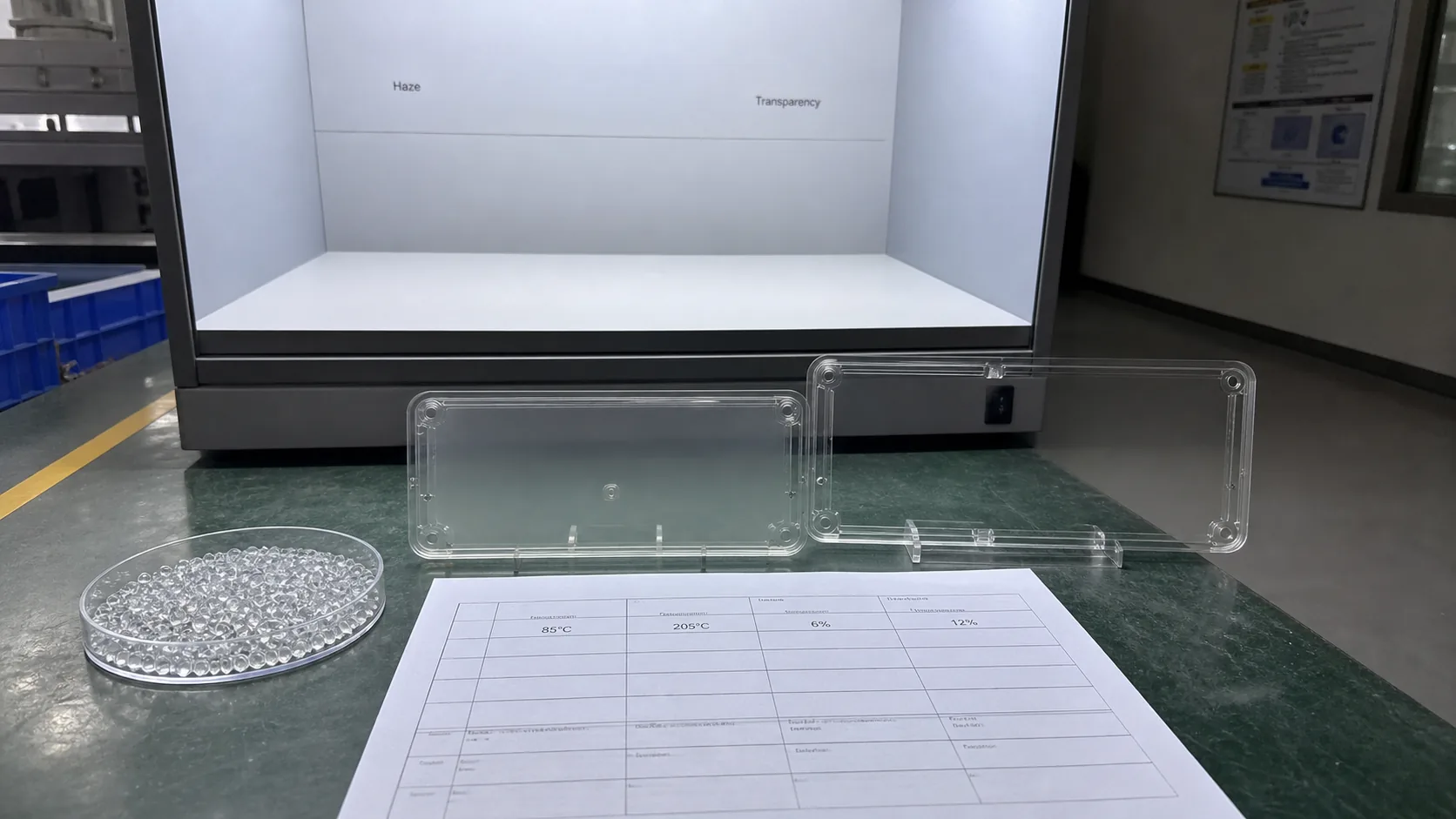
Material level: choose a polymeric permanent antistatic system so antistatic performance does not decay after wiping, washing or low-humidity storage. DGK-ABS KJD890TM balances about 85% transmission at 2 mm, surface resistivity of 10^8-10^10 Ω·sq and MFI of 46.4 g/10 min.
Process level: validated starting windows are drying at 85°C for 4-5 h, injection temperature of 195-210°C and mold temperature around 70°C. Too high a temperature increases haze through thermal degradation; too low a temperature creates short-shot risk.
Validation level: before mass production, run alcohol wipe testing for permanent antistatic behavior, low-humidity testing for humidity-independent stability, and full-size resistance uniformity scanning for batch consistency.
Core Performance Summary
| Property | Test standard | Typical value |
|---|---|---|
| Transmission (2 mm) | ASTM D1003 | ~85% |
| Surface resistivity | GB/T 1401 / IEC 61340-5-1 | 10^8-10^10 Ω·sq |
| MFI (220°C/10 kg) | GB/T 3682 | 46.4 g/10 min |
| Izod notched impact (23°C) | GB/T 1843 | 12.3 kJ/m² |
| HDT (0.45 MPa) | GB/T 1633 | 85°C |
| Density | GB/T 1033 | 1.105 g/cm³ |
The DGK-ABS KJD890TM transparent antistatic ABS used in these cases was developed by Yuyao Deyu Plastic Technology Co., Ltd. It has been commercialized in semiconductor windows, medical panels and smart-appliance transparent parts. Technical data and samples are available through official DEYU channels.