
How to Evaluate the Weathering Grade of UV-Resistant Plastics: Testing Standards, Key Indicators, and Selection Guide
A UV-resistant plastic should be judged by the weathering standard, exposure energy and retained properties, not by the phrase “UV-resistant” alone.
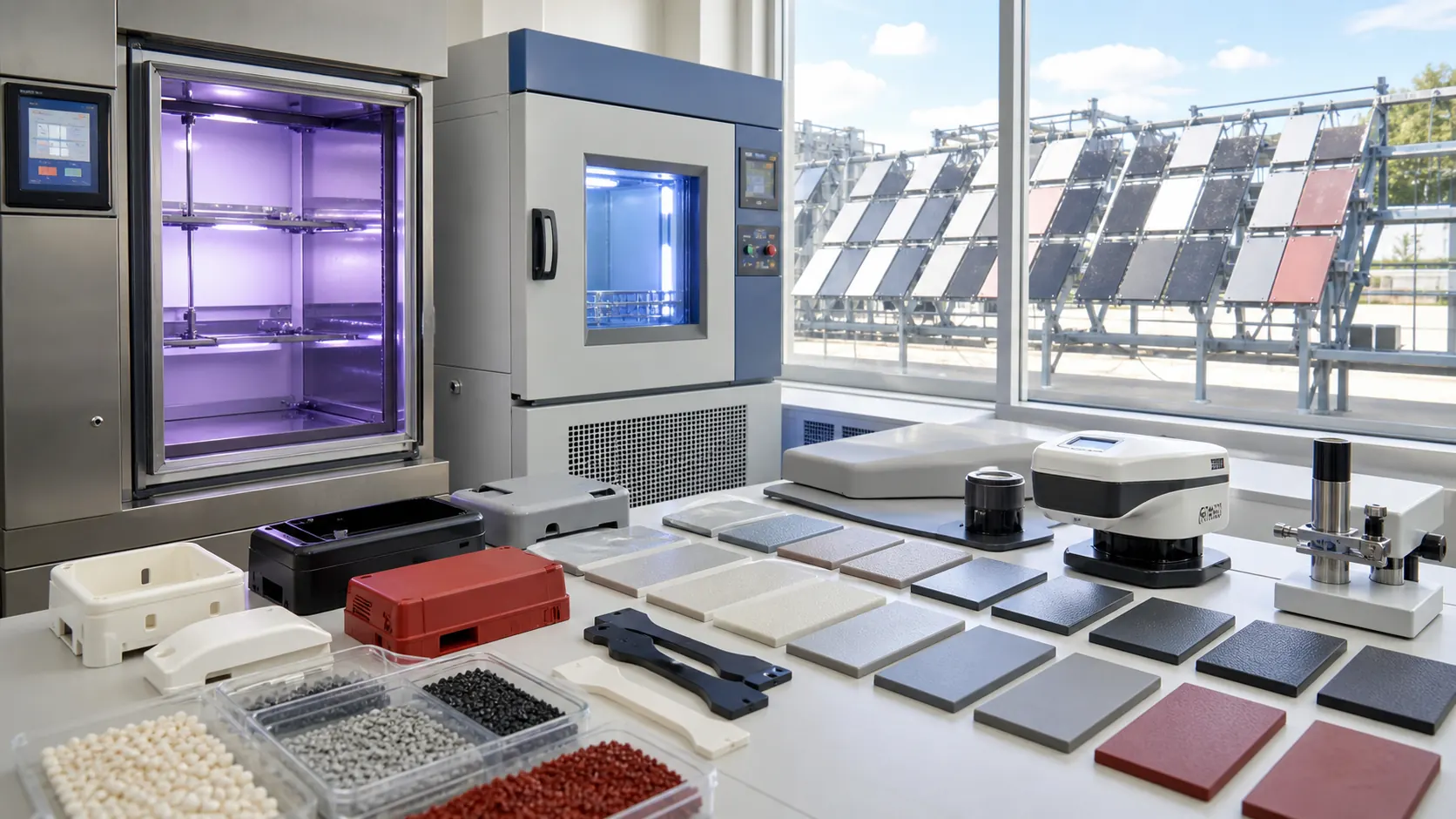
This guide explains how xenon aging, fluorescent UV aging and outdoor exposure relate to color, gloss, impact strength and surface cracking.
The practical decision depends on resin, pigment, wall thickness, application location and whether testing is done on plaques or molded parts.
DEYU helps define a validation route that matches the customer’s real outdoor environment and acceptance criteria.
Buyer and engineer FAQ
Questions engineers often ask about this material route
Where can ABS / ASA / PA / PC / PC/ABS / POM / PP / TPE / TPU with a UV-resistant plastic requirement be used?
Typical fields include outdoor clips, covers, housings, liners, sheets, equipment shells and exposed appearance parts. For this article, DEYU would first confirm the working environment, wall thickness, expected lifetime and whether UV-resistant plastics, DGK-ABS R165UV UV-resistant ABS matches the part geometry or needs formulation adjustment.
What are the main performance indicators for the "UV-resistant plastic" target on ABS / ASA / PA / PC / PC/ABS / POM / PP / TPE / TPU?
Focus on color change, gloss retention, tensile retention, impact retention and weathering hours. Buyers should ask for data on molded parts, not only pellet data, because gate position, filler orientation and thickness can change the final value.
What should engineers watch during injection molding or processing?
For ABS / ASA / PA / PC / PC/ABS / POM / PP / TPE / TPU, a practical starting window is 210-245°C melt / 50-80°C mold. Avoid overheating pigments or HALS systems, use stable black or color packages and validate outdoor aging. Final parameters should follow part thickness, gate design and the actual machine.
What details help DEYU recommend UV-resistant plastics, DGK-ABS R165UV UV-resistant ABS more accurately?
Send the current resin or grade, drawing or photo, wall thickness, annual quantity, target standard, failure mode and required color. If a reference grade already passed one test but failed in production, include both data sets.
For a precise recommendation, share the part drawing, base resin, target performance, processing method and test standard with DEYU.
Procurement Summary
The weathering grade of a UV-resistant plastic cannot be judged only by the phrase “UV-resistant.” A reliable evaluation should combine:
For material selection, compare the broader UV-resistant plastics platform with DGK-ABS R165UV UV-resistant ABS when the target part needs outdoor appearance retention, post-aging impact retention, and validated injection molding performance.
aging test standard; exposure time or energy; color difference; gloss retention; impact strength retention; tensile property retention; surface cracking or chalking; real-part drop or assembly test after aging.
For buyers, the most practical question is not “How many years can this plastic last outdoors?” The better question is:
Under which aging standard was it tested? How many hours or how much exposure energy? What property was retained after aging? Was the test done on a standard sample or final molded part? What color and wall thickness were tested? Is the application semi-outdoor, long-term outdoor, automotive exterior, electrical housing, or cold-region outdoor use?
A material with good initial impact strength may still fail outdoors if its post-aging impact retention is poor. A material that keeps color but becomes brittle is also not a qualified outdoor material.
1. What Does “Weathering Grade” Actually Mean?
In engineering selection, weathering grade usually means the material’s ability to retain appearance and mechanical performance after sunlight, oxygen, heat, moisture, and temperature cycling.
The key point is retention, not initial value.
Important indicators include:
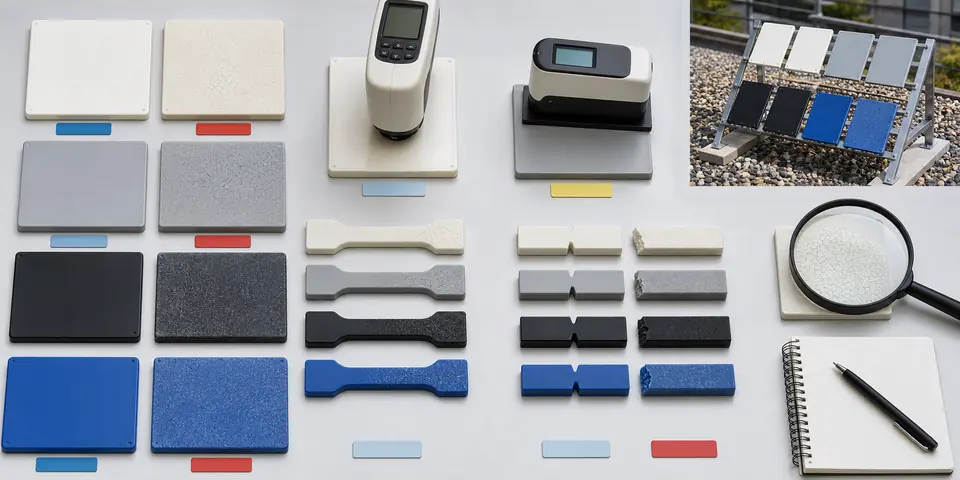
color difference after aging, usually expressed as ΔE; gloss retention; surface chalking; surface cracking; notched impact retention; tensile strength retention; elongation retention; drop test after aging; screw boss or snap-fit reliability after aging.
For outdoor parts, the final judgement should be based on both appearance retention and mechanical retention.
2. Common Weathering Test Standards
2.1 Xenon Arc Aging
Common standards:
ISO 4892-2; ASTM G155.
Xenon arc aging better simulates full-spectrum sunlight. It is often used for automotive exterior parts, outdoor housings, colored parts, and products where color and gloss retention are important.
Typical evaluation:
ΔE color difference; gloss retention; surface cracking; impact after aging; appearance comparison.
2.2 Fluorescent UV Aging
Common standards:
ISO 4892-3; ASTM G154.
Fluorescent UV aging is widely used for comparing UV resistance between formulations. It is common in material development, outdoor plastic screening, and quality comparison.
Typical evaluation:
yellowing; surface chalking; gloss loss; impact retention; cracking tendency.
2.3 Outdoor Exposure Test
Outdoor exposure is closer to real use but takes longer and is affected by climate, season, angle, humidity, pollution, and location.
It is useful for:
building materials; outdoor electrical housings; garden tools; agricultural parts; charging equipment covers; long-term outdoor products.
2.4 UL 746C f1 / f2 Direction
For some electrical plastic parts, UL 746C outdoor suitability ratings may be relevant.
In simplified purchasing language:
f1 generally indicates better suitability for both UV and water exposure; f2 indicates more limited outdoor exposure suitability.
This should not replace product-level testing, but it is useful for electrical housings and certified components.
3. How to Read Aging Hours Correctly
Many suppliers say “tested for 500 hours” or “tested for 1000 hours,” but aging hours alone are not enough.
You need to confirm:
test standard; lamp type; irradiance; black panel temperature; water spray or condensation cycle; sample color; sample thickness; property tested after aging.
For example, 1000 hours under different standards or different irradiance settings may not represent the same severity.
A professional specification should avoid saying only “1000 hours UV resistance.” It should specify the method and the acceptance criteria.
Better wording:
After ISO 4892-2 xenon arc aging for the agreed exposure condition, ΔE ≤ target value, gloss retention ≥ target value, and notched impact retention ≥ target value.
4. Key Evaluation Indicators
| Indicator | What It Shows | Why It Matters |
|---|---|---|
| ΔE color difference | Color change after aging | Important for appearance parts |
| Gloss retention | Surface gloss stability | Important for housings and covers |
| Chalking | Surface powdering | Indicates surface degradation |
| Cracking | Surface or structural aging | High-risk failure mode |
| Impact retention | Toughness after aging | More important than initial impact for outdoor parts |
| Tensile retention | Strength after aging | Important for structural parts |
| Elongation retention | Brittleness change | Helps judge aging embrittlement |
| Drop test after aging | Real housing reliability | Useful for covers and tool shells |
| Screw boss test after aging | Assembly reliability | Important for housings |
| Dimensional stability | Warpage after aging | Important for large parts |
A UV-resistant material should not be accepted only because the color looks stable. Mechanical retention must also be checked.
5. Material-Level Weathering Comparison
| Material | Weathering Direction | Selection Notes |
|---|---|---|
| PP | Needs UV stabilization | Good cost, but oxidation and impact loss must be controlled |
| ABS | Needs strong UV modification | Good impact and appearance, but ordinary ABS ages faster outdoors |
| ASA | Better weathering foundation | Preferred for long-term outdoor colored parts |
| PC/ABS | Good housing material | Needs balance of UV, impact, heat, and flame retardancy |
| PC | Good impact, transparent option | Yellowing and stress cracking must be checked |
| PA6 / PA66 | Good strength | UV, moisture, heat aging, and impact retention must be tested together |
| POM | Good dimensional and wear behavior | Outdoor stability requires special formulation |
| TPU / TPE | Flexible systems | UV aging must be tested with elasticity retention |
For long-term outdoor color stability, ASA is usually stronger than ABS. For cost-sensitive semi-outdoor parts, UV-resistant ABS or UV-stabilized PP may be enough after validation.
6. Application-Based Weathering Grade Guide
Semi-Outdoor Covers
Examples:
covered equipment; indirect sunlight; short outdoor storage.
Recommended direction:
UV-resistant ABS; UV-stabilized PP; PC/ABS with UV package.
Key test:
color difference; gloss retention; drop test after aging.
Long-Term Outdoor Housings
Examples:
charging equipment covers; outdoor electrical boxes; garden tool shells; agricultural components.
Recommended direction:
ASA; UV-resistant ASA; UV-resistant PC/ABS; UV-stabilized PP with impact balance.
Key test:
xenon arc aging; impact retention; surface cracking; screw boss strength after aging.
Automotive Exterior Parts
Recommended direction:
ASA; ASA/PC alloy; weather-resistant PC/ABS; UV-resistant reinforced materials.
Key test:
xenon arc aging; color and gloss retention; heat aging; low-temperature impact after aging.
Outdoor Electrical Components
Recommended direction:
UV + flame-retardant PC/ABS; UV + flame-retardant PP; FR ASA where suitable; UV-resistant PA / PBT for connectors.
Key test:
flame rating after formulation validation; UV aging; impact retention; CTI or glow wire when required.
7. Common Mistakes in Judging UV Resistance
Mistake 1: Only Asking Whether UV Additive Was Added
UV resistance depends on the full formulation, not one additive.
Mistake 2: Only Looking at Initial Mechanical Data
Outdoor parts should compare mechanical data before and after aging.
Mistake 3: Treating Black and White Materials the Same
Black materials are often easier to stabilize. White and light-colored parts need stricter yellowing and ΔE control.
Mistake 4: Ignoring Wall Thickness
Thin-wall parts age and crack differently from thick parts.
Mistake 5: Replacing Real-Part Testing With Test Bar Data
Standard bars are useful, but final housings, screw bosses, snap-fits, and corners should be tested after aging.
8. Customer Case 1: UV-Resistant ABS for Semi-Outdoor Housing
Original Situation
A customer used ordinary ABS for a semi-outdoor industrial housing. Initial appearance was good, but after outdoor storage, the surface faded and the corners cracked during handling.
Original Data
| Item | Ordinary ABS |
|---|---|
| Initial notched impact | 18 kJ/m² |
| Notched impact after UV aging | 9 kJ/m² |
| Color difference after aging | ΔE 5.6 |
| Gloss retention | 54% |
| Drop test after aging | 4 failures / 10 samples |
DEYU Improvement Plan
DEYU recommended a DGK UV-resistant ABS formulation.
Focus:
UV stabilizer package; rubber phase protection; weather-resistant pigment; impact retention; surface gloss control.
Final Result
| Item | Ordinary ABS | DEYU UV-Resistant ABS |
|---|---|---|
| Initial notched impact | 18 kJ/m² | 21 kJ/m² |
| Notched impact after UV aging | 9 kJ/m² | 16 kJ/m² |
| Color difference after aging | ΔE 5.6 | ΔE 2.4 |
| Gloss retention | 54% | 76% |
| Drop test after aging | 4 failures / 10 | 0–1 failure / 10 |
Case Conclusion
For semi-outdoor housings, UV-resistant ABS can be a practical choice if post-aging impact and color retention are validated.
9. Customer Case 2: ASA for Long-Term Outdoor Colored Housing
Original Situation
A customer used UV-resistant ABS for a light gray outdoor housing. After longer exposure, color change and gloss loss were still visible.
Original Data
| Item | UV-Resistant ABS |
|---|---|
| Initial notched impact | 22 kJ/m² |
| Notched impact after UV aging | 15 kJ/m² |
| Color difference after aging | ΔE 3.8 |
| Gloss retention | 68% |
| Surface chalking | Slight |
DEYU Improvement Plan
DEYU recommended a DGK weather-resistant ASA compound because the customer prioritized long-term outdoor appearance stability.
Focus:
ASA weather-resistant base; weather-resistant pigment; UV stabilizer package; impact balance; low-warpage adjustment.
Final Result
| Item | UV-Resistant ABS | DEYU Weather-Resistant ASA |
|---|---|---|
| Initial notched impact | 22 kJ/m² | 20 kJ/m² |
| Notched impact after UV aging | 15 kJ/m² | 18 kJ/m² |
| Color difference after aging | ΔE 3.8 | ΔE 1.6 |
| Gloss retention | 68% | 84% |
| Surface chalking | Slight | Not obvious |
Case Conclusion
For long-term outdoor and light-colored parts, ASA usually provides stronger weathering stability than UV-resistant ABS.
10. DEYU DGK UV-Resistant Material Platform
DEYU plastics can develop UV-resistant and weather-resistant compounds according to resin, color, exposure condition, and validation standard.
Solution Directions
DGK-PP UV-resistant series; DGK-ABS UV-resistant series; DGK-ASA weather-resistant series; DGK-PC/ABS UV-resistant series; DGK-PC UV-resistant transparent series; DGK-PA66 UV-resistant reinforced series; DGK-POM outdoor stability series; DGK-TPU / TPE weather-resistant flexible series; UV + flame-retardant materials; UV + antistatic materials; UV + wear-resistant materials; UV + low-warpage materials.
Information Buyers Should Provide
base resin; application environment; indoor, semi-outdoor, or outdoor use; expected exposure time; color and gloss requirement; aging test method; target ΔE; impact retention target; part thickness; flame retardancy requirement; UV, antistatic, wear, or low-temperature requirement; sample part or drawing; customer acceptance standard.
Conclusion
The weathering grade of UV-resistant plastics should be judged by test method and property retention, not by the phrase “UV-resistant.” A complete evaluation should include aging standard, exposure condition, color difference, gloss retention, impact retention, cracking, chalking, and real-part performance after aging.
For semi-outdoor cost-sensitive products, UV-resistant ABS or UV-stabilized PP may be sufficient after validation. For long-term outdoor, light-colored, or appearance-sensitive parts, ASA or UV-resistant ASA is often a stronger material direction. For electrical or structural components, UV resistance must be checked together with flame retardancy, impact strength, dimensional stability, and assembly reliability.
DEYU plastics provides DGK UV-resistant and weather-resistant modified plastics for PP, ABS, ASA, PC/ABS, PC, PA, POM, TPU, TPE, and other systems. The recommended approach is to define the outdoor condition and acceptance standard first, then choose the material route.