
Wear-Resistant Plastic Materials: Additives, Mechanisms and DEYU Solutions
Wear-resistant plastic material guide covering PTFE, MoS2, graphite, silicone, aramid fiber, carbon fiber, glass fiber, UHMWPE, lubricants and mineral fillers for gears, sliders, bushings and moving parts.
Buyer and engineer FAQ
Questions engineers often ask about this material route
Where can modified plastic with a wear-resistant plastic requirement be used?
Typical fields include gears, rollers, bushings, sliding blocks, guide rails and low-noise moving parts. For this article, DEYU would first confirm the working environment, wall thickness, expected lifetime and whether DGK-POM TF90M PTFE wear-resistant POM, DGK-PA6 G25MS MoS2 reinforced wear-resistant PA6 matches the part geometry or needs formulation adjustment.
What are the main performance indicators for the "wear-resistant plastic" target?
Focus on friction coefficient, wear depth, PV value, noise, dimensional stability and mating material compatibility. Buyers should ask for data on molded parts, not only pellet data, because gate position, filler orientation and thickness can change the final value.
What should engineers watch during injection molding or processing?
Dry PA grades correctly, control glass or aramid fiber orientation and validate wear on the real mating surface. Start from the base-resin processing window, then adjust by molded-part resistance, appearance and mechanical data.
What details help DEYU recommend DGK-POM TF90M PTFE wear-resistant POM, DGK-PA6 G25MS MoS2 reinforced wear-resistant PA6 more accurately?
Send the current resin or grade, drawing or photo, wall thickness, annual quantity, target standard, failure mode and required color. If a reference grade already passed one test but failed in production, include both data sets.
For a precise recommendation, share the part drawing, base resin, target performance, processing method and test standard with DEYU.
Short Answer
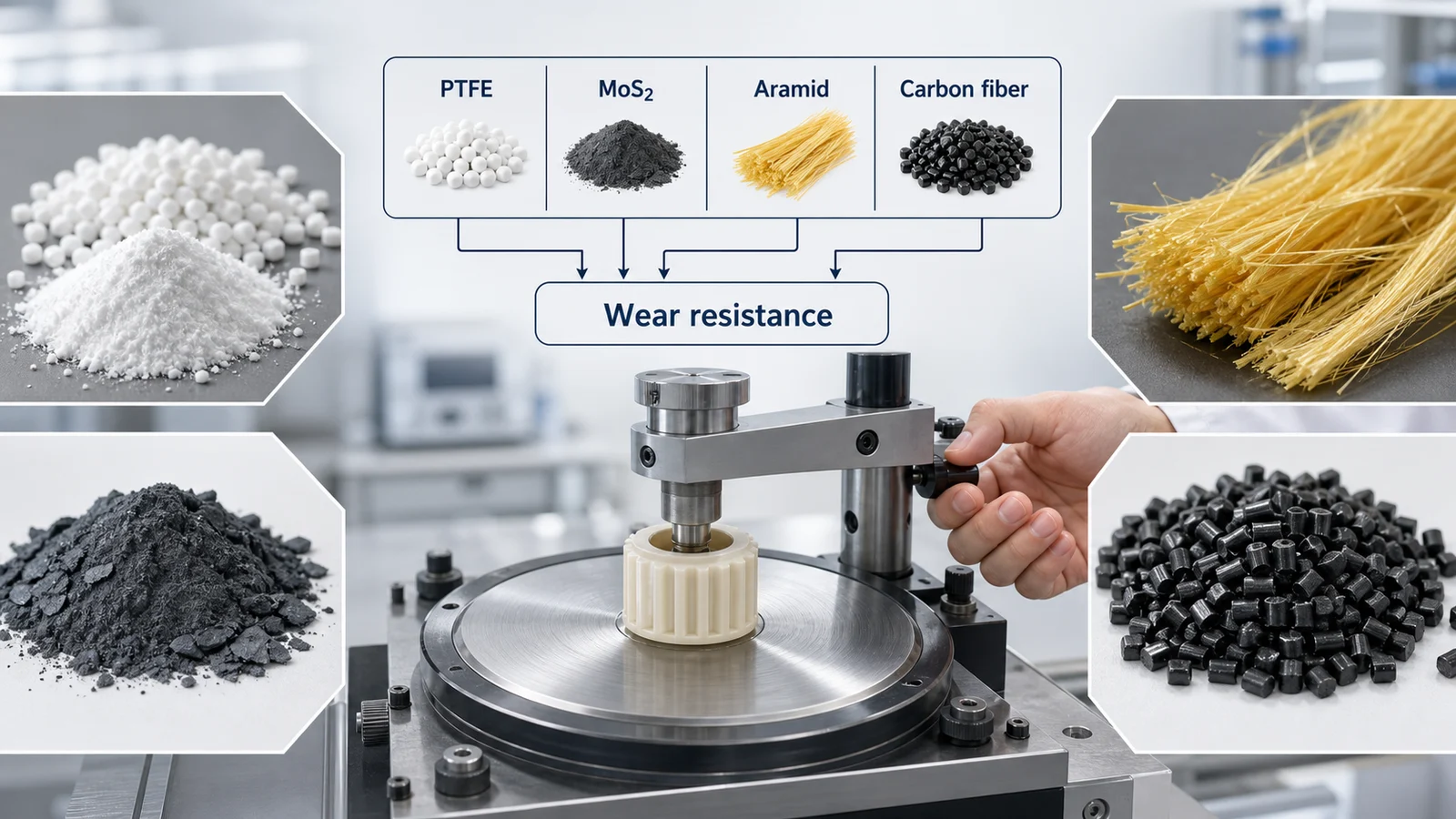
Wear-resistant plastic materials are usually developed by combining a suitable base resin with one or more wear-resistant additives. Common additives include PTFE, silicone, MoS2, graphite, aramid fiber, carbon fiber, glass fiber, UHMWPE, internal lubricants, waxes, ceramic fillers and mineral fillers.
Each additive has a different function. PTFE mainly reduces friction and improves self-lubrication. MoS2 improves boundary lubrication and load-bearing wear resistance. Graphite provides solid lubrication and can also support conductivity. Aramid fiber helps form a wear-resistant fiber network. Carbon fiber improves stiffness, dimensional stability and conductive wear-resistant performance. UHMWPE and silicone systems improve low-friction sliding and reduce noise.
A successful wear-resistant material is not made by adding one universal wear additive. It must be designed according to resin, load, speed, mating material, temperature, lubrication condition, noise requirement, dimensional tolerance and service environment. Yuyao Deyu DEYU plastics provides DGK-POM TF90M PTFE wear-resistant POM and DGK-PA6 G25MS MoS2 reinforced wear-resistant PA6, with customized DGK wear-resistant compounds based on POM, PA6, PA66, PPS, PEEK, PP, PC/ABS, TPU and other systems.
Introduction: Wear Resistance Is Not Only About Hardness
Many customers think that a wear-resistant plastic should simply be harder or stronger. In reality, wear resistance is a system property. It depends on friction coefficient, surface temperature, load, sliding speed, mating material, contact pressure, lubrication condition, surface roughness, filler dispersion, part structure and long-term stability.
A plastic material may have high hardness but poor wear performance. A softer material may have good low-friction sliding in a specific application. A fiber-reinforced material may resist deformation but damage the mating surface. A self-lubricating material may reduce noise and friction but lose stiffness if the additive is excessive.
Therefore, wear-resistant plastic development must answer several questions:
- What is the base resin?
- Is the part sliding, rotating, rolling or rubbing?
- What is the mating material: metal, plastic, rubber, ceramic or coating?
- Is the environment dry, lubricated, dusty, wet, hot or cold?
- Is low friction more important, or load-bearing wear resistance?
- Does the part need low noise, high stiffness, conductivity or dimensional stability?
Only after these questions are clear can the correct wear-resistant additive be selected.
1. PTFE: Low Friction and Self-Lubrication
PTFE is one of the most common additives for wear-resistant plastics. It has an extremely low friction coefficient and excellent self-lubricating behavior.
PTFE can reduce friction coefficient, improve self-lubrication, reduce stick-slip, lower sliding noise, reduce heat generation during movement, improve wear resistance in dry sliding and protect the mating surface in selected applications.
PTFE is commonly used in POM/PTFE, PA/PTFE, PC/PTFE, PPS/PTFE, PEEK/PTFE, PP/PTFE and selected flexible TPU/PTFE systems. Typical applications include gears, sliders, bushings, rollers, guide rails, valve parts, moving housings, low-noise sliding parts and precision mechanical components.
PTFE is not always better at higher content. Excessive PTFE may reduce tensile strength, impact strength, weld line strength, surface quality, molding stability and dimensional strength. For example, POM compounded with PTFE is suitable for low-friction gears, sliders and bushings, but the PTFE content must be balanced with strength and molding requirements.
DEYU uses PTFE when the customer needs low friction, low noise, self-lubrication and smoother sliding. DGK-POM/PTFE and DGK-PA/PTFE series can be customized according to friction, wear rate, strength, color and molding process.
2. MoS2: Boundary Lubrication and Load-Bearing Wear Resistance
Molybdenum disulfide, or MoS2, is a layered solid lubricant. Its layered structure helps reduce shear resistance between sliding surfaces.
MoS2 can reduce friction under boundary lubrication, improve wear resistance under load, reduce adhesive wear, improve sliding stability, support metal-to-plastic sliding applications and reduce friction heat in selected conditions.
MoS2 is commonly used in PA6/MoS2, PA66/MoS2, POM/MoS2, PPS/MoS2, PEEK/MoS2 and other engineering plastics requiring load-bearing wear performance. Typical applications include sliders, bushings, guide blocks, gears, bearing cages, mechanical supports, wear pads and industrial moving parts.
MoS2 must be well dispersed. If the content is too high or dispersion is poor, it may cause lower impact strength, weaker weld lines, black or dark color, surface defects, poor mechanical balance and processing instability. MoS2 is more suitable when the part needs stable sliding under load, especially in PA and POM systems.
DEYU uses MoS2 when the customer needs load-bearing wear resistance, stable sliding and lower friction heat. DGK-PA6/MoS2 and DGK-PA66/MoS2 materials can be developed for industrial sliders, guide blocks and wear-resistant nylon components.
3. Graphite: Solid Lubrication and Conductive Wear Resistance
Graphite is another layered solid lubricant. It can reduce friction and, in some systems, also support electrical or thermal conductivity.
Graphite can improve dry sliding behavior, support wear resistance under moderate load, provide dark color stability, support conductive or static-control requirements and improve thermal dissipation in selected systems.
Graphite can be used in POM/graphite, PA/graphite, PPS/graphite, PEEK/graphite, PTFE/graphite systems and carbon-based hybrid wear-resistant compounds. It is useful for bearings, sliding blocks, seals, industrial moving parts, conductive wear-resistant components and selected high-temperature sliding parts.
Graphite usually makes the material black or dark gray. High loading may reduce toughness, affect surface quality and change processing behavior. DEYU mainly uses graphite in black or dark wear-resistant materials, especially where solid lubrication and conductivity are both useful.
4. Silicone and Silicone-Based Lubricants
Silicone-based additives are often used to improve surface slip, reduce friction and lower noise in moving plastic parts.
Silicone can improve surface lubricity, reduce squeaking noise, reduce friction coefficient, improve demolding, improve sliding feel and reduce stick-slip in selected applications.
It can be used in PP, ABS, PC/ABS, PA, POM, TPU, TPE and other appearance or low-noise parts. Typical applications include automotive interior sliding parts, buttons, switches, clips, hinges, low-noise housings and consumer product moving parts.
Silicone must be selected carefully because it may affect paintability, printing, bonding, surface appearance, migration behavior and long-term stability. For appearance parts, silicone type and dosage must be controlled carefully.
5. Aramid Fiber: High-End Wear Resistance and Surface Protection
Aramid fiber is a high-performance fiber used in wear-resistant compounds. It is especially valuable when the material needs wear resistance without excessively damaging the mating surface.
Aramid fiber can improve long-term wear resistance, form a fiber-reinforced wear network, reduce material loss under sliding, protect the mating surface better than some hard fillers and improve wear stability under repeated movement.
Aramid fiber can be used in PA66/aramid, PA6/aramid, POM/aramid, PPS/aramid, PEEK/aramid and hybrid systems with PTFE, MoS2 or silicone. Typical applications include gears, sliders, bushings, guide rails, wear plates, industrial moving parts, automotive mechanical components and low-wear precision parts.
Aramid fiber needs good dispersion and compatibility. Poor dispersion may cause fiber clusters, surface defects and unstable mechanical properties. DEYU can combine aramid fiber with PTFE, MoS2 or other lubricating systems to balance wear resistance, friction and mechanical performance.
6. Carbon Fiber: Stiffness, Stability and Conductive Wear Resistance
Carbon fiber is not only a reinforcement additive. In wear-resistant plastics, it can improve stiffness, dimensional stability, thermal behavior and sometimes conductivity.
Carbon fiber can increase stiffness, reduce deformation under load, improve dimensional stability, reduce shrinkage, support conductive or ESD performance, improve heat deformation resistance and improve wear stability in structural sliding parts.
Carbon fiber is commonly used in PA66/CF, PA6/CF, POM/CF, PPS/CF, PPA/CF, PEEK/CF and PC/ABS/CF. Applications include structural sliders, conductive wear-resistant parts, precision brackets, gears, industrial mechanical parts, automotive functional components and high-stiffness moving parts.
Carbon fiber can also create risks: higher brittleness, lower impact strength, rougher surface, higher mold wear, abrasion against the mating surface, anisotropic shrinkage and higher cost. It is suitable when the part needs wear resistance plus stiffness or conductivity, but it must be balanced carefully.
7. Glass Fiber: Strength and Rigidity, But Not Always Low-Wear
Glass fiber is widely used to improve strength, stiffness and heat resistance. It can improve structural durability, but it is not always a pure wear-resistant additive.
Glass fiber can increase strength, stiffness, heat deformation resistance, dimensional stability and deformation resistance under load. It is commonly used in PA6/GF, PA66/GF, PBT/GF, PPS/GF, PP/GF and PC/GF.
In sliding applications, glass fiber can be abrasive and may damage the mating surface if the formulation is not balanced. Possible risks include higher friction, mating surface wear, fiber exposure, poor surface smoothness, weld line weakness and anisotropic shrinkage.
DEYU uses glass fiber when structural strength is needed. For sliding parts, glass fiber is often combined with PTFE, silicone, MoS2 or aramid fiber to balance strength and friction.
8. UHMWPE and PE-Based Lubricating Additives
Ultra-high molecular weight polyethylene, or UHMWPE, is often used as a lubricating and wear-reducing additive.
UHMWPE can reduce friction, improve sliding performance, reduce surface wear, improve scratch resistance in selected systems, reduce noise and improve dry sliding behavior. It can be used in PP, PA, POM, ABS, PC/ABS, TPU, TPE and other sliding or appearance parts.
Compatibility must be controlled. Poor dispersion can cause surface defects, phase separation or unstable mechanical properties. DEYU uses UHMWPE or PE-based lubricating systems when smoother sliding, lower noise and moderate wear improvement are required without using heavy solid lubricants.
9. Waxes, Lubricants and Processing Aids
Waxes and internal lubricants are often used to improve processing and surface sliding. They can improve flowability, reduce friction, improve demolding, improve surface slip, reduce processing torque and improve filler dispersion.
However, lubricants may migrate, reduce bonding, affect printing or painting and weaken mechanical properties if added excessively. They are usually auxiliary additives, not the main wear-resistant solution for high-load applications.
10. Ceramic and Mineral Fillers
Ceramic powders, mineral fillers, talc, calcium carbonate and other inorganic fillers can improve hardness, dimensional stability and cost performance in selected systems.
They can increase hardness, improve dimensional stability, reduce shrinkage, improve heat resistance and reduce cost in some systems. But mineral and ceramic fillers may increase brittleness and friction. They may also damage mating surfaces under sliding. Therefore, they are not always suitable for precision sliding parts unless combined with lubricating additives.
11. Additive Comparison
| Additive Type | Main Function | Advantages | Risks | Suitable Applications |
|---|---|---|---|---|
| PTFE | Low friction, self-lubrication | Excellent sliding, low noise | Too much reduces strength | Gears, sliders, bushings |
| MoS2 | Boundary lubrication | Good under load | Dark color, dispersion risk | PA/POM sliders, guide blocks |
| Graphite | Solid lubrication, conductivity | Wear plus conductive potential | Dark color, toughness loss | Bearings, conductive sliding parts |
| Silicone | Surface slip, low noise | Smooth sliding, noise reduction | Migration, painting issues | Interior parts, buttons, clips |
| Aramid fiber | High-end wear resistance | Wear network, mating surface protection | Dispersion challenge | PA/POM high-wear parts |
| Carbon fiber | Stiffness, conductivity, stability | High stiffness, dimensional control | Brittleness, rough surface | Conductive structural wear parts |
| Glass fiber | Strength, rigidity | High structural support | May abrade mating surface | Load-bearing parts |
| UHMWPE | Lubrication, smooth sliding | Low friction, noise reduction | Compatibility risk | Sliding and consumer parts |
12. How to Choose the Right Wear-Resistant Additive
If low friction is the main target, PTFE, silicone, UHMWPE or graphite may be considered. Suitable materials include POM/PTFE, PA/PTFE, PP/silicone, TPU/UHMWPE and PPS/PTFE.
If load-bearing wear resistance is the main target, MoS2, aramid fiber, carbon fiber, glass fiber plus lubricant or PTFE plus reinforcing fiber may be more suitable. Suitable materials include PA66/aramid, PA6/MoS2, POM/PTFE, PPS/CF/PTFE and PEEK/CF/PTFE.
If low noise is the main target, PTFE, silicone, UHMWPE and selected wax systems are common options. Suitable materials include POM/PTFE, PA/PTFE, ABS/silicone, PP/silicone and TPE/UHMWPE.
If conductivity and wear resistance are both required, carbon fiber, graphite, conductive carbon systems, PTFE plus a conductive network or carbon fiber plus a lubricating system can be used.
If mating surface protection is important, PTFE, aramid fiber, silicone and UHMWPE are usually safer directions. Hard fillers such as glass fiber and ceramic powder should be used carefully because they may increase wear on the opposite surface.
13. DEYU DGK Wear-Resistant Material Platform
Yuyao Deyu DEYU plastics provides customized DGK wear-resistant compound solutions.
DEYU can support:
- DGK-POM/PTFE low-friction series
- DGK-POM aramid wear-resistant series
- DGK-POM carbon fiber conductive wear-resistant series
- DGK-PA6/MoS2 wear-resistant series
- DGK-PA66 aramid high-wear-resistant series
- DGK-PA66/PTFE self-lubricating series
- DGK-PA66 carbon fiber wear-resistant series
- DGK-PPS/PTFE high-temperature wear-resistant series
- DGK-PEEK/CF/PTFE high-performance wear-resistant series
- DGK-PP silicone low-friction series
- DGK-TPU low-friction wear-resistant series
DEYU can adjust base resin, PTFE content, MoS2 content, aramid fiber content, carbon fiber content, silicone system, UHMWPE system, graphite content, glass fiber content, friction direction, wear rate, mechanical strength, impact strength, surface appearance, molding flowability, part tolerance, color and cost.
To develop a suitable material, DEYU recommends customers provide base resin or current material, part application, mating material, load, sliding speed, temperature, dry or lubricated condition, noise requirement, wear failure mode, current material problem, target life, part drawing or sample, test method and whether conductivity, flame retardancy or color is required.
Conclusion
Common wear-resistant additives for plastics include PTFE, MoS2, graphite, silicone, aramid fiber, carbon fiber, glass fiber, UHMWPE, waxes, lubricants, ceramic fillers and mineral fillers. Each additive solves a different problem.
PTFE is suitable for low friction and self-lubrication. MoS2 is suitable for boundary lubrication and loaded sliding. Graphite is useful for solid lubrication and conductive wear-resistant systems. Silicone and UHMWPE are suitable for smooth sliding and low noise. Aramid fiber is valuable for high-end wear resistance and mating surface protection. Carbon fiber is suitable for stiffness, dimensional stability and conductive wear-resistant applications. Glass fiber improves strength but must be balanced carefully in sliding systems.
A mature wear-resistant plastic solution should not rely on a single additive. It should balance friction, wear rate, strength, toughness, mating surface protection, molding stability, cost and real service conditions. For gears, sliders, bushings, rollers, guide rails, bearings, seals and industrial moving parts, DEYU can support formulation development, small-batch trials and real-part validation.