
Weather-Resistant ABS for Outdoor Device Housings and Appearance Parts
An application-focused guide for engineers selecting weather-resistant ABS for outdoor device housings, sensor enclosures, control panels and visible appearance parts. It explains why standard ABS yellows, chalks, cracks and loses impact strength outdoors, then maps the DEYU route: HALS + UVA stabilization, impact-retention technology, UV-stable pigments, ASA alternatives for premium appearance, and validation data based on ΔE, gloss retention, cracking and field failure rate.
Buyer and engineer FAQ
Questions engineers often ask about this material route
Where can ABS / ASA with a UV-resistant plastic requirement be used?
Typical fields include outdoor clips, covers, housings, liners, sheets, equipment shells and exposed appearance parts. For this article, DEYU would first confirm the working environment, wall thickness, expected lifetime and whether UV-resistant plastics product list, UV-Resistant ABS Pellets DGK-ABS R165UV, Flame-Retardant UV-Resistant ASA Pellets DGK-ASA FR801UV matches the part geometry or needs formulation adjustment.
What are the main performance indicators for the "UV-resistant plastic" target on ABS / ASA?
Focus on color change, gloss retention, tensile retention, impact retention and weathering hours. Buyers should ask for data on molded parts, not only pellet data, because gate position, filler orientation and thickness can change the final value.
What should engineers watch during injection molding or processing?
For ABS / ASA, a practical starting window is 210-245°C melt / 50-80°C mold. Avoid overheating pigments or HALS systems, use stable black or color packages and validate outdoor aging. Final parameters should follow part thickness, gate design and the actual machine.
What details help DEYU recommend UV-resistant plastics product list, UV-Resistant ABS Pellets DGK-ABS R165UV, Flame-Retardant UV-Resistant ASA Pellets DGK-ASA FR801UV more accurately?
Send the current resin or grade, drawing or photo, wall thickness, annual quantity, target standard, failure mode and required color. If a reference grade already passed one test but failed in production, include both data sets.
For a precise recommendation, share the part drawing, base resin, target performance, processing method and test standard with DEYU.
Background / Problem
Acrylonitrile-butadiene-styrene (ABS) is one of the most widely used engineering thermoplastics. It offers an exceptional balance of properties: high impact strength, good stiffness, excellent surface finish, ease of processing, and cost-effectiveness. For device housings, enclosures, and appearance parts, ABS is often the material of choice because it delivers the combination of mechanical performance and aesthetic quality that consumers and industrial users expect.
Related DEYU references for this ABS outdoor-housing topic: UV-resistant plastics product list and UV-resistant ABS application selection guide.
From consumer electronics and medical device housings to industrial control panels, instrument enclosures, and outdoor sensors, ABS is ubiquitous. It can be molded into complex shapes with sharp details, accepts a wide range of colors and surface textures, and provides the durability needed for everyday use. However, for outdoor applications, standard ABS has a critical limitation: poor weathering resistance.
ABS contains polybutadiene rubber —the component that gives ABS its excellent impact strength. But this same polybutadiene is also the material’s Achilles—heel when it comes to outdoor exposure. The double bonds in the butadiene units are highly susceptible to photo-oxidative degradation. When exposed to UV radiation from sunlight, these double bonds break down, triggering a chain reaction that leads to:
Color change (yellowing) —visible degradation of the material’s appearance
Surface chalking and gloss loss —the smooth, glossy surface becomes dull and powdery
Brittleness and cracking —the material loses its impact resistance and becomes prone to fracture
Loss of mechanical properties —tensile strength and elongation decline
An ABS part that looks perfect indoors can show visible yellowing after just a few months of outdoor exposure. Within one to two years, unprotected ABS in direct sunlight can suffer significant degradation, with surface cracking, embrittlement, and loss of impact strength. This makes standard ABS unsuitable for outdoor applications without dedicated UV stabilization.
For outdoor device housings and appearance parts, the stakes are particularly high. These components are often:
Visible and aesthetic —color and gloss retention are critical for brand identity and user perception
Functional —housings protect sensitive electronics and mechanisms
Subject to mechanical loads —impact from handling, installation, and environmental factors
Exposed to UV, temperature extremes, and moisture —a challenging combination of environmental stressors
Technical Difficulty / Why It Happens
The Photo-Oxidation Mechanism in ABS
The photodegradation of ABS is primarily driven by the photo-oxidation of the polybutadiene moiety. The polybutadiene rubber phase contains carbon-carbon double bonds that are highly reactive under UV irradiation.
When UV radiation (particularly wavelengths below 300 nm) reaches the ABS surface:
Initiation —UV energy breaks the double bonds in the polybutadiene phase, creating free radicals
Propagation —these free radicals react with atmospheric oxygen to form peroxy radicals, which abstract hydrogen from other polymer chains
Chain scission —the polymer backbone breaks, reducing molecular weight and crosslinking the rubber phase
Surface degradation —the degraded surface layer becomes brittle and develops micro-cracks
The photo-oxidation of the ABS blend takes place predominantly at the ABS component. The butadiene fraction in the ABS polymer appears to be a primary target for radiation-induced degradation. FTIR analysis has confirmed that oxidation of ABS resins progresses from their butadiene parts due to the impact of ultraviolet rays.
The Consequences of Photodegradation
The consequences of UV exposure on ABS are both aesthetic and mechanical:
| Degradation Effect | Cause | Impact on Part |
|---|---|---|
| Yellowing / color change | Formation of chromophores in the degraded polybutadiene phase | Unacceptable for appearance parts; brand identity compromised |
| Gloss loss / chalking | Surface erosion and degradation of the surface layer | Loss of premium aesthetic appearance |
| Surface cracking | Brittle degraded surface layer develops micro-cracks | Pathways for moisture ingress; reduced protection |
| Brittleness / loss of impact strength | Crosslinking and chain scission in the rubber phase | Parts crack under impact; safety risk |
| Loss of mechanical properties | Molecular weight reduction from chain scission | Reduced load-bearing capacity |
The degradation is surface-driven —the UV damage is concentrated in the outer layer of the part. However, this thin degraded surface layer can act like a sharp notch, precipitating bulk mechanical failure. A housing that looks slightly yellowed on the surface may already be compromised in its ability to protect the electronics inside.
Why ABS Is More UV-Sensitive Than Many Other Plastics
ABS is particularly vulnerable to UV degradation compared to many other engineering plastics because of its chemical structure:
The polybutadiene rubber phase contains unsaturated double bonds that are inherently unstable under UV
The styrene component is also susceptible to photo-oxidation, though to a lesser extent
The acrylonitrile component provides some resistance but does not protect the rubber phase
In contrast, ASA (acrylonitrile-styrene-acrylate) —a close relative of ABS —replaces the polybutadiene rubber with acrylic rubber, which lacks the vulnerable double bonds. This makes ASA inherently 10 times more weather-resistant than ABS. However, ASA typically has lower impact strength and higher cost than ABS, and for many applications, properly UV-stabilized ABS offers the best balance of properties.
The Challenge of Stabilizing ABS
Stabilizing ABS against UV degradation requires a carefully balanced additive package. The stabilizers must:
Protect the polybutadiene phase —the primary site of photo-oxidation
Prevent discoloration —maintain the original color of the part
Preserve mechanical properties —maintain impact strength and ductility
Be compatible —not migrate to the surface or cause blooming
Be durable —provide protection throughout the expected service life
Research has shown that the combination of a hindered amine light stabilizer (HALS) and a benzotriazole UV absorber dramatically outperforms either component alone. This synergistic blend provides a level of impact strength retention many times that of unstabilized ABS and also protects the polymer from discoloration.
DEYU Material Direction
DEYU addresses the challenges of outdoor ABS housings and appearance parts through a comprehensive stabilization strategy that targets both aesthetic and mechanical performance.
1. Synergistic UV Stabilization System
DEYU uses a combination of HALS and UV absorbers to provide robust protection:
Hindered amine light stabilizers (HALS) —scavenge free radicals generated during photo-oxidation, protecting both the surface and the bulk of the material
Benzotriazole UV absorbers —absorb harmful UV radiation before it reaches the polymer backbone, protecting the surface layer
Synergistic blend —the combination provides significantly better protection than either component alone
For demanding outdoor applications, DEYU can also use high molecular weight HALS that offer low volatility and high migration resistance, ensuring long-term protection without blooming.
2. Impact Retention Technology
DEYU's formulations are designed to maintain impact strength even after UV exposure. The rubber phase is protected by the stabilizer package, preventing the crosslinking and embrittlement that typically occur in unstabilized ABS.
3. Color Stability
DEYU uses UV-stable pigment systems and color-stabilizing additives to prevent yellowing and fading. This is particularly important for light-colored housings where color change is most visible.
4. Material Family Overview
| DEYU Series | Base Resin | UV Stabilization | Key Features | Typical Applications |
|---|---|---|---|---|
| DGK-ABS-UV201 | ABS | Standard HALS + UVA | Good UV resistance, cost-effective | Moderate outdoor exposure, colored housings |
| DGK-ABS-UV301 | ABS | Enhanced HALS + UVA | High UV resistance, excellent color stability | Demanding outdoor housings, appearance parts |
| DGK-ABS-UV401 | ABS | Premium HALS + high-MW UVA | Maximum weatherability, long-term protection | Critical outdoor equipment, extreme environments |
| DGK-ASA-501 | ASA | Inherent UV resistance + HALS | Superior weatherability (10× ABS), high gloss | Premium outdoor appearance parts, automotive exterior |
Reference Product Data
Below is representative data for DEYU's weather-resistant ABS compounds for outdoor housings and appearance parts:
| Property | Test Method | DGK-ABS-UV201 | DGK-ABS-UV301 | DGK-ASA-501 | Standard ABS (unmodified, reference) |
|---|---|---|---|---|---|
| Base Resin | —/td> | ABS | ABS | ASA | ABS |
| UV Stabilization | —/td> | HALS + UVA | Enhanced HALS + UVA | Inherent + HALS | None |
| Density | ASTM D1505 | 1.04—.06 g/cm³ | 1.04—.06 g/cm³ | 1.06—.08 g/cm³ | 1.04—.06 g/cm³ |
| MFR (220°C/10kg) | ASTM D1238 | 15—0 g/10min | 12—8 g/10min | 10—5 g/10min | 15—5 g/10min |
| Tensile Strength (Yield) | ASTM D638 | 40—5 MPa | 40—5 MPa | 42—8 MPa | 40—0 MPa |
| Flexural Modulus | ASTM D790 | 2000—400 MPa | 2000—400 MPa | 2100—600 MPa | 2000—500 MPa |
| Notched Impact (23°C) | ASTM D256 | 250—00 J/m | 250—00 J/m | 200—50 J/m | 200—50 J/m |
| Notched Impact (-20°C) | ASTM D256 | 100—50 J/m | 100—50 J/m | 80—20 J/m | 80—50 J/m |
| HDT (0.45 MPa) | ASTM D648 | 95—00°C | 95—00°C | 95—00°C | 90—00°C |
| HDT (1.8 MPa) | ASTM D648 | 85—0°C | 85—0°C | 85—0°C | 80—0°C |
| UV Stability —ΔE (xenon arc, 1000h) | ASTM G155 | 2.0—.0 | 1.0—.0 | 0.5—.0 | >5.0 (severe yellowing) |
| UV Stability —ΔE (xenon arc, 2000h) | ASTM G155 | 3.5—.5 | 2.0—.0 | 1.0—.5 | Severe degradation |
| Impact Retention (2000h UV) | Internal | >60% | >75% | >85% | <30% |
| Gloss Retention (60°, 2000h UV) | ASTM D523 | >50% | >70% | >85% | <20% |
| Typical Applications | —/td> | Moderate outdoor housings | Demanding outdoor housings | Premium outdoor appearance | Indoor use only |
Note: Values are representative. Actual data depends on specific grade and formulation.
Customer Debugging / Validation Scenario —DEYU Internal Customer Data
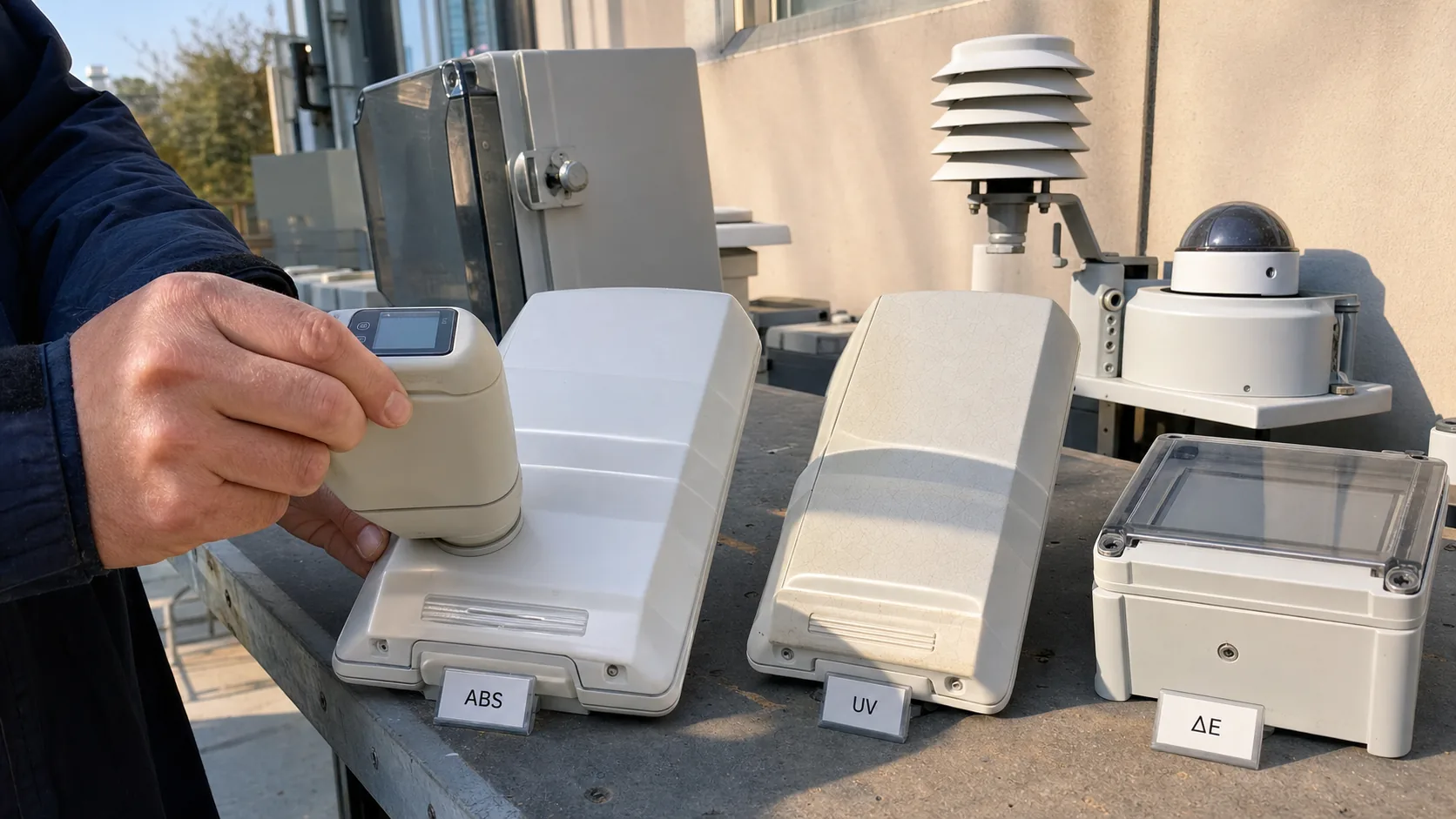
Scenario: Outdoor Sensor Housing —Yellowing and Cracking After One Season
Background: A manufacturer of outdoor environmental sensors used a commercially available ABS compound for sensor housings. The housings were installed outdoors in a temperate climate with moderate UV exposure and seasonal temperature variations.
After 12 months of service, the housings showed:
Visible yellowing (ΔE > 4.0) —unacceptable for the white/light gray color requirement
Surface chalking and gloss loss
Micro-cracking at corners and mounting points
Reduced impact strength —housings cracked during maintenance
Root Cause Analysis
DEYU's internal analysis of the failed housings revealed:
| Factor | Finding |
|---|---|
| UV stabilizer level | Inadequate —the material had minimal UV stabilization |
| Polybutadiene degradation | Significant —FTIR analysis confirmed oxidation of the butadiene phase |
| Surface degradation | 100—50 microns —sufficient to cause micro-cracking at stress points |
| Impact strength reduction | >60% loss —the material became brittle |
The material had adequate initial properties but lacked the UV stabilization needed for outdoor service.
Trial Setup —DEYU Internal Validation
Trial quantity: 500 sensor housings (injection molded)
Monthly production: 2,000 units
Test duration: 12 months outdoor exposure (temperate climate)
Comparison: Incumbent ABS vs. DEYU DGK-ABS-UV301
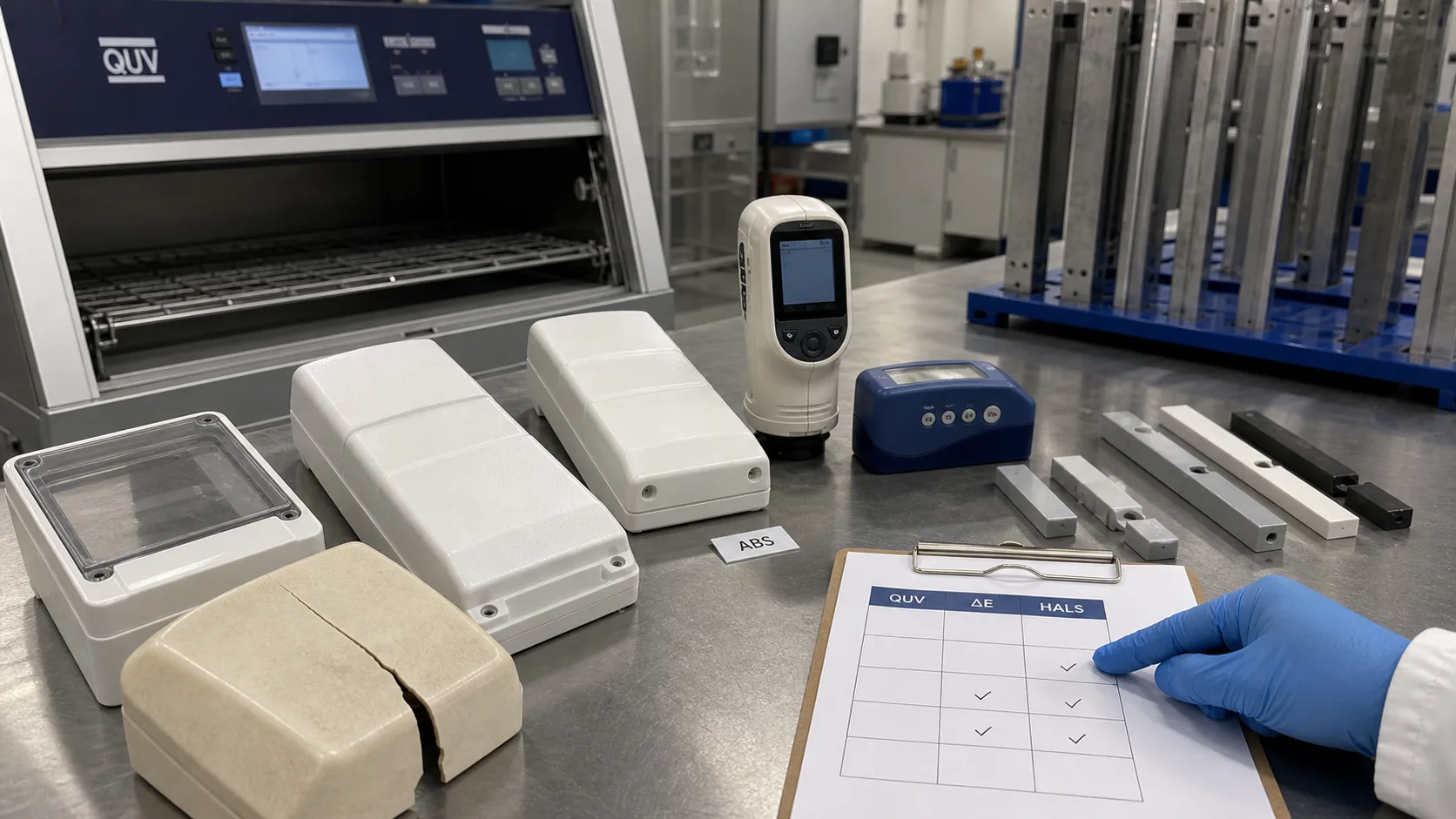
Validation Metrics —DEYU Internal Test Data
| Parameter | Incumbent ABS | DEYU DGK-ABS-UV301 | Test Method |
|---|---|---|---|
| Trial quantity | 250 pcs | 250 pcs | —/td> |
| Initial ΔE | —/td> | —/td> | CIE Lab |
| ΔE after 6 months | 3.2 | 1.2 | CIE Lab |
| ΔE after 12 months | 4.8 (failed) | 1.8 | CIE Lab |
| Initial notched impact (23°C) | 280 J/m | 280 J/m | ASTM D256 |
| Impact retention (12 months) | 35% | 78% | ASTM D256 |
| Gloss retention (60°, 12 months) | 25% | 72% | ASTM D523 |
| Surface cracking (12 months) | Visible at corners | None | Visual inspection |
| Surface chalking (12 months) | Visible | None | Visual inspection |
| Field failure rate (12 months) | 6.5% | 0.3% | Customer data |
Result Interpretation —DEYU Internal Analysis
DEYU's internal validation revealed that:
The incumbent material failed due to inadequate UV stabilization. The polybutadiene phase underwent photo-oxidation, leading to yellowing, chalking, embrittlement, and loss of impact strength.
DEYU DGK-ABS-UV301 succeeded because:
The synergistic HALS + UVA stabilization package protected both the surface and the bulk of the material
The stabilizers prevented polybutadiene degradation, maintaining impact strength
Color stability was maintained through 12 months of outdoor exposure
The key insight: ABS requires dedicated UV stabilization for outdoor use —standard grades are not suitable for outdoor service without modification.
Direction After Trial —DEYU Customer Recommendation
Based on DEYU's internal validation results, the customer:
Converted full production to DEYU DGK-ABS-UV301 for all outdoor sensor housings
Adopted DEYU DGK-ASA-501 for premium appearance applications requiring maximum color stability
Updated material specification to require ΔE ≤2.5 after 12 months for light-colored housings
Implemented incoming quality control testing for UV stabilizer content
Suitable Applications
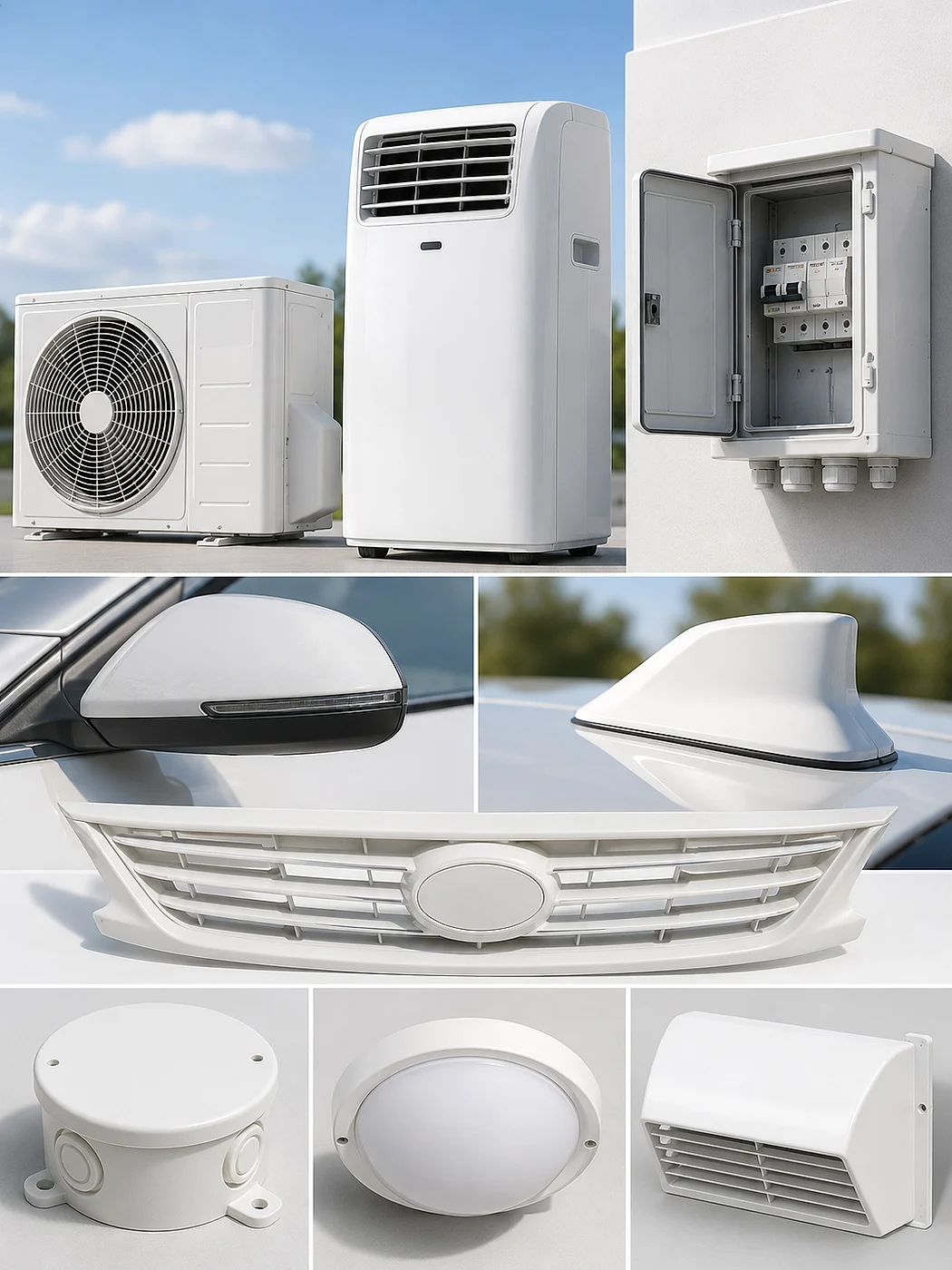
DEYU's weather-resistant ABS compounds for outdoor housings and appearance parts are suitable for:
| Application Category | Specific Components | Key Requirements | Recommended Grade |
|---|---|---|---|
| Outdoor Sensors | Environmental sensor housings, camera housings, monitoring equipment | UV resistance, color stability, impact resistance | DGK-ABS-UV301 |
| Industrial Controls | Control panels, operator interfaces, instrument enclosures | Aesthetic quality, UV stability, mechanical strength | DGK-ABS-UV301 |
| Consumer Electronics | Outdoor speaker housings, IoT device enclosures, smart home sensors | Color retention, surface quality, durability | DGK-ABS-UV301 |
| Medical Equipment | Portable device housings, outdoor medical enclosures | UV resistance, cleanability, impact strength | DGK-ABS-UV201 |
| Telecom Infrastructure | Outdoor cabinets, antenna housings, base station enclosures | Long-term weatherability, structural integrity | DGK-ABS-UV401 |
| Automotive Appearance | Interior/exterior trim, mirror housings, decorative parts | Color stability, gloss retention, UV resistance | DGK-ASA-501 |
| Building Automation | Outdoor controllers, access control housings, security cameras | UV stability, impact resistance, weatherability | DGK-ABS-UV301 |
What Buyers Should Provide
To ensure optimal material selection for outdoor ABS housings and appearance parts, DEYU recommends buyers provide:
Part drawings / 3D models —geometry, wall thickness, critical features (ribs, bosses, corners, mounting points)
Service environment —geographic location, UV intensity, temperature range (min/max), humidity
Color requirements —light colors are more sensitive to yellowing; dark colors absorb more heat
Aesthetic requirements —gloss level, color tolerance (ΔE), surface finish
Expected service life —how many years the housing must maintain appearance and function
Performance requirements —impact strength, stiffness, HDT
Testing and certification requirements —UV standard (ASTM G154, G155), UL rating, IP rating
Current material and failure data —what material is used and what issues are observed
Production volume —for cost optimization
DEYU can support with:
Material recommendations based on your specific environmental and aesthetic requirements
Small-batch validation trials —molded housings or test plaques for weathering testing
Color matching —custom color formulations with UV-stable pigment systems
Processing optimization —injection molding parameters to optimize part quality and surface appearance
Conclusion
Outdoor device housings and appearance parts made from ABS present a unique challenge: the material's excellent impact strength comes from a polybutadiene rubber phase that is inherently vulnerable to UV degradation. Without dedicated stabilization, ABS parts yellow, chalk, crack, and lose their mechanical properties within months to a few years of outdoor exposure.
The key technical challenges are:
Polybutadiene photo-oxidation —the primary degradation mechanism that drives both aesthetic and mechanical failure
Color stability —yellowing is unacceptable for appearance parts
Impact retention —the rubber phase must be protected to maintain toughness
Surface quality —gloss and surface finish must be preserved
DEYU's approach addresses these challenges through:
Synergistic UV stabilization —HALS + UV absorbers for comprehensive protection
Impact retention technology —maintaining toughness through UV exposure
Color-stable formulations —preventing yellowing and fading
Application-specific grades —tailored to different levels of UV exposure and aesthetic requirements
Comprehensive validation —testing matched to actual service environments
For engineers and buyers who need ABS housings and appearance parts that maintain their color, gloss, and mechanical integrity outdoors, DEYU offers validated, production-ready solutions backed by comprehensive weathering testing and application-specific support.
For specific grade recommendations and trial samples, please contact DEYU with your application details and performance requirements.