
Antistatic vs Conductive Plastics: How to Distinguish Them and Choose the Right Material for Industrial Applications
The difference between antistatic plastics and conductive plastics is not simply whether the material can “conduct electricity.” The real difference is the target resistance range, discharge speed, application risk, and validation method.
Buyer and engineer FAQ
Questions engineers often ask about this material route
Where can ABS / PA / PC / PC/ABS / PE / POM / PP / TPU with a antistatic plastic requirement be used?
Typical fields include clear covers, electronic packaging, dust-control parts, trays and clean-area components. For this article, DEYU would first confirm the working environment, wall thickness, expected lifetime and whether antistatic plastics platform matches the part geometry or needs formulation adjustment.
What are the main performance indicators for the "antistatic plastic" target on ABS / PA / PC / PC/ABS / PE / POM / PP / TPU?
Focus on stable surface resistance, dust attraction, transparency or color, humidity sensitivity and long-term antistatic decay. Buyers should ask for data on molded parts, not only pellet data, because gate position, filler orientation and thickness can change the final value.
What should engineers watch during injection molding or processing?
For ABS / PA / PC / PC/ABS / PE / POM / PP / TPU, a practical starting window is 210-245°C melt / 50-80°C mold. Avoid over-drying antistatic systems, confirm resistance after conditioning and after part cleaning. Final parameters should follow part thickness, gate design and the actual machine.
What details help DEYU recommend antistatic plastics platform more accurately?
Send the current resin or grade, drawing or photo, wall thickness, annual quantity, target standard, failure mode and required color. If a reference grade already passed one test but failed in production, include both data sets.
For a precise recommendation, share the part drawing, base resin, target performance, processing method and test standard with DEYU.
Procurement Summary
The difference between antistatic plastics and conductive plastics is not simply whether the material can “conduct electricity.” The real difference is the target resistance range, discharge speed, application risk, and validation method.
For practical material matching, DEYU usually starts from the antistatic plastics platform or the conductive plastics compound platform, then adjusts resistance range, resin system, color, impact strength, flowability, flame retardancy or wear resistance around the real molded part.
In engineering selection:
antistatic plastics are mainly used to reduce static accumulation, dust attraction, and light sticking; static dissipative plastics are used when controlled discharge is required, especially in ESD handling; conductive plastics are used when faster charge transfer is needed, such as powder handling, industrial trays, conductive rollers, mechanical moving parts, or grounding-related plastic components.
The wrong selection often causes two problems:
using a material that is not conductive enough, so dust, powder, or ESD problems remain; using a material that is too conductive, causing unnecessary cost, black color limitation, reduced impact strength, lower flowability, or surface quality issues.
A professional buyer should define the resistance target, base resin, color, mechanical performance, processing method, testing standard, and actual failure mode before asking for a quotation.
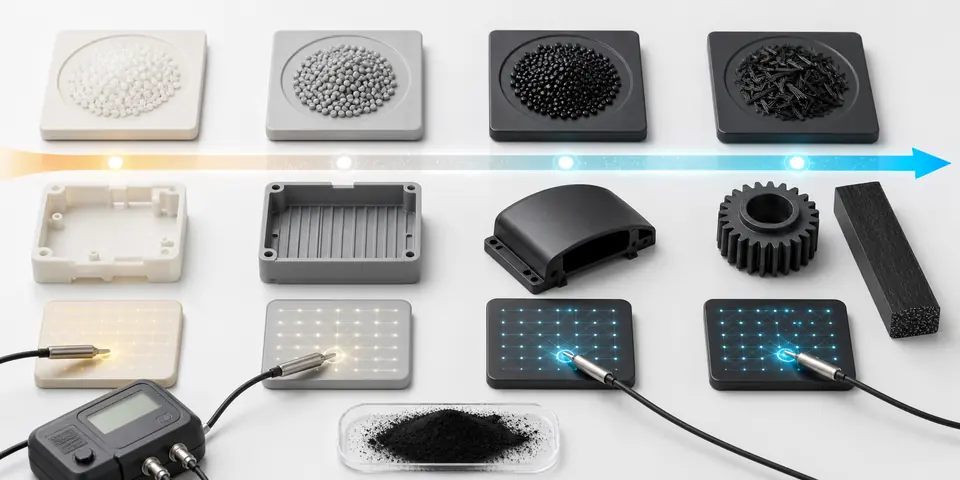
1. Resistance Range Is the First Selection Boundary
| Material Level | Typical Surface Resistance Direction | Main Purpose | Typical Applications |
|---|---|---|---|
| Antistatic | 10⁹–10¹² Ω | Reduce static accumulation and dust adhesion | Housings, covers, boxes, packaging parts |
| Static dissipative | 10⁶–10⁹ Ω | Controlled discharge | ESD trays, fixtures, electronic handling parts |
| Conductive | 10³–10⁶ Ω | Faster charge transfer | Powder equipment, rollers, conductive trays, mechanical parts |
| High conductive | 10²–10³ Ω direction | Strong conductive pathway | Special grounding-related or industrial components |
These ranges are common engineering directions, not universal guarantees. The final value depends on resin, filler system, part thickness, gate position, humidity, testing method, and whether the measurement is made on a test specimen or the final molded part.
For procurement, the key point is not “the lower the better.” The correct target is the range that solves the problem without damaging mechanical performance, appearance, processing, or cost.
2. When to Choose Antistatic Plastics
Antistatic plastics are suitable when the main issue is mild static accumulation or dust attraction rather than fast electrical conduction.
Typical Problems
dust accumulates on the housing surface; plastic covers need less cleaning; packaging parts attract light dust; operators notice light static during handling; the product needs colored, white, gray, or light-colored appearance; the application does not require strict conductive grounding.
Suitable Materials
antistatic PP compound; antistatic ABS compound; antistatic PC/ABS compound; antistatic PC compound; antistatic PMMA compound; antistatic POM compound; antistatic nylon compound.
Technical Route
For colored or appearance-sensitive parts, permanent antistatic systems are usually more suitable than high-loading conductive carbon black. This route can help reduce surface static while keeping gray, white, blue, or other custom colors more feasible.
Purchasing Target
A common target is 10⁹–10¹² Ω. If the product is used near electronic components, the buyer may need a static dissipative range instead of a basic antistatic range.
3. When to Choose Static Dissipative Plastics
Static dissipative plastics sit between antistatic and conductive materials. They are often the most appropriate choice for ESD handling because they allow controlled discharge instead of uncontrolled rapid discharge.
Typical Problems
ESD warning events occur during handling; electronic components need safer transport; fixtures or trays need controlled discharge; dust must be reduced, but strong conductivity is not necessary; the material must keep impact strength and dimensional stability.
Suitable Applications
ESD trays; electronic component boxes; assembly fixtures; cleanroom handling parts; automation positioning parts; semiconductor packaging carriers.
Technical Route
Possible routes include permanent dissipative systems, conductive masterbatch with controlled dosage, low-loading conductive carbon systems, or carbon nanotube systems depending on performance target.
Purchasing Target
A common target is 10⁶–10⁹ Ω. For ESD applications, the buyer should confirm the testing standard, humidity condition, and whether surface resistance or volume resistance is required.
4. When to Choose Conductive Plastics
Conductive plastics are used when static must be transferred more quickly or when ordinary antistatic systems cannot solve the problem.
Typical Problems
powder strongly adheres to plastic surfaces; lightweight parts stick during feeding; film or sheet release is unstable; industrial trays require faster charge transfer; wear powder accumulates around moving parts; the part needs grounding-related function; black industrial appearance is acceptable.
Suitable Materials
conductive PP compound; conductive ABS compound; conductive POM compound; conductive nylon compound; conductive PC/ABS compound; conductive PE compound; conductive PPS compound; conductive TPU compound.
Technical Route
Conductive carbon black and conductive masterbatch are common cost-effective routes. Carbon nanotubes may be used when lower filler loading or better mechanical retention is needed. Carbon fiber is suitable when conductivity and rigidity must coexist.
Purchasing Target
A common target is 10³–10⁶ Ω. For special industrial parts, 10²–10³ Ω direction may be considered, but the buyer should also check impact strength, flowability, warpage, surface quality, and cost.
5. Technical Route Comparison
| Route | Suitable Level | Color Feasibility | Main Advantage | Main Limitation |
|---|---|---|---|---|
| Migratory antistatic agent | Basic antistatic | Good | Low cost | Humidity-dependent, limited durability |
| Permanent antistatic system | Antistatic / dissipative | Good | Better color and long-term stability | Usually not for very low resistance |
| Conductive carbon black | Dissipative / conductive | Mainly black | Cost-effective and mature | May reduce impact and flowability |
| Conductive masterbatch | Adjustable | Depends on system | Flexible dosage and easier trial | Carrier compatibility required |
| Carbon nanotubes | Dissipative / conductive | Dark | Lower loading in selected systems | Higher cost, dispersion difficulty |
| Carbon fiber | Conductive + reinforcement | Black/dark | Conductivity plus rigidity | Higher cost, brittleness risk |
| Hybrid conductive network | Multi-functional | Depends on route | Balances conductivity with wear, FR, UV, rigidity | Requires customized formulation |
6. Application Scenario Guide
6.1 Dust-Sensitive Covers and Housings
Recommended direction:
antistatic plastics or static dissipative plastics.
Typical resins:
ABS; PP; PC/ABS; PC; PMMA.
Key selection points:
surface appearance; color stability; dust reduction; impact retention; UV resistance if used outdoors.
DEYU recommendation logic:
For gray, white, or colored housings, DEYU usually considers permanent antistatic compounds first. Conductive carbon black is not the first choice unless low resistance is required.
6.2 ESD Trays and Electronic Handling Parts
Recommended direction:
static dissipative plastics.
Typical resins:
PP; PC/ABS; ABS; POM; PA.
Key selection points:
10⁶–10⁹ Ω target direction; stable resistance on final parts; clean surface; low dust adhesion; impact strength; dimensional stability.
DEYU recommendation logic:
DEYU may use controlled conductive masterbatch, permanent dissipative systems, or low-loading conductive networks depending on tray color, thickness, molding process, and ESD requirement.
6.3 Powder Handling Equipment
Recommended direction:
conductive plastics.
Typical resins:
PP; ABS; PE; POM; PA; PPS.
Key selection points:
10³–10⁶ Ω target direction; powder release; surface smoothness; wear resistance; cleaning method; chemical resistance; black color acceptance.
DEYU recommendation logic:
For powder adhesion, ordinary antistatic material may not be enough. DEYU usually evaluates conductive carbon black, conductive masterbatch, or hybrid conductive wear-resistant routes.
6.4 Mechanical Moving Parts
Recommended direction:
conductive + wear-resistant plastics.
Typical resins:
POM; PA6; PA66; PPS; PP.
Key selection points:
surface resistance; wear rate; friction coefficient; noise; dimensional stability; mating material; lubrication condition.
DEYU recommendation logic:
For gears, sliders, bushings, rollers, and guide rails, conductivity must be balanced with wear resistance. A simple conductive filler addition may reduce wear performance or increase brittleness if not adjusted.
6.5 Electrical Housings and Industrial Covers
Recommended direction:
antistatic, static dissipative, or conductive plastics depending on risk level.
Typical resins:
ABS; PC/ABS; PC; PP; PA.
Key selection points:
flame retardancy; impact strength; surface resistance; UV resistance; color; molding flowability; assembly reliability.
DEYU recommendation logic:
For outdoor or electrical parts, DEYU often evaluates combined solutions such as antistatic + UV, conductive + flame retardant, or static dissipative + high impact PC/ABS.
7. Professional Purchasing Checklist
Before buying antistatic or conductive plastics, confirm the following points.
7.1 Electrical Requirement
surface resistance or volume resistance; target resistance range; testing standard; testing humidity and temperature; test specimen or final molded part; initial value or value after aging.
7.2 Resin and Processing
base resin; injection molding or extrusion; part thickness; flow length; gate position; mold temperature; whether shrinkage or warpage is already a problem.
7.3 Mechanical Requirement
impact strength; tensile strength; flexural modulus; wear resistance; friction coefficient; low-temperature impact; creep resistance; fatigue resistance.
7.4 Appearance and Color
black, natural, gray, white, or custom color; gloss or matte surface; surface smoothness; fiber exposure; powder contamination risk; cleaning method.
7.5 Additional Functions
flame retardancy; UV resistance; low temperature resistance; wear resistance; low friction; high rigidity; low warpage; chemical resistance.
A complete inquiry should include both electrical and mechanical targets. Asking only for “conductive plastic” or “antistatic plastic” is usually not enough for accurate material selection.
8. Customer Case 1: Antistatic ABS Housing for Dust Reduction
Original Situation
A customer used ordinary ABS housings for an industrial control device. The housing surface attracted dust around air outlets after several days of operation. The product did not need strong conductive grounding, but the customer wanted lower dust adhesion and stable gray color.
Original Data
| Item | Original ABS Housing |
|---|---|
| Surface resistance | 10¹³ Ω direction |
| Dust adhesion after 7 days | High |
| Cleaning frequency | Once every 2 days |
| Color | Gray |
| Notched impact strength | 19 kJ/m² |
| Surface appearance | Good gloss |
DEYU Improvement Plan
DEYU recommended a DGK antistatic ABS compound using a permanent antistatic route.
The formulation target included:
surface resistance around 10⁹–10¹⁰ Ω; gray color matching; low surface migration; impact retention; stable injection molding appearance.
Debugging Process
First Trial
Dust reduction improved, but resistance variation under different humidity was larger than expected.
Adjustment:
changed antistatic system; improved compatibility with ABS; adjusted processing stabilizer.
Second Trial
Resistance stability improved, but slight gate mark appeared.
Adjustment:
optimized injection temperature; adjusted antistatic additive dispersion; improved color masterbatch compatibility.
Final Trial
The part achieved stable color and reduced dust adhesion.
Final Result
| Item | Original ABS | DEYU Antistatic ABS |
|---|---|---|
| Surface resistance | 10¹³ Ω direction | 10⁹–10¹⁰ Ω |
| Dust adhesion after 7 days | High | Reduced by about 62% |
| Cleaning frequency | Once every 2 days | Once every 5–7 days |
| Color | Gray | Gray matched |
| Notched impact strength | 19 kJ/m² | 18 kJ/m² |
| Surface appearance | Good gloss | Good gloss |
Case Conclusion
This project required antistatic performance, not conductive performance. A conductive carbon black route would have made the part black and unnecessary for the customer’s dust-reduction target.
9. Customer Case 2: Static Dissipative PP Tray for Electronic Components
Original Situation
An electronics customer used ordinary PP trays to store and transfer small electronic components. The tray was low-cost and easy to mold, but ESD warning events occurred during handling.
Original Data
| Item | Original PP Tray |
|---|---|
| Surface resistance | >10¹³ Ω |
| ESD warning events | 8 times/week |
| Dust adhesion | Medium to high |
| Component handling complaint | 4 times/month |
| Tray impact performance | Good |
| Dimensional stability | General |
DEYU Improvement Plan
DEYU recommended a DGK static dissipative PP compound.
The formulation target included:
surface resistance around 10⁶–10⁸ Ω; controlled static discharge; impact retention; lower dust adhesion; stable shrinkage and tray flatness.
Debugging Process
First Trial
Resistance reached 10⁶–10⁷ Ω, but surface roughness increased slightly.
Adjustment:
improved conductive filler dispersion; reduced local filler concentration; optimized injection speed and mold temperature.
Second Trial
Surface quality improved, but flatness needed better control.
Adjustment:
adjusted PP base resin; optimized cooling time; improved holding pressure balance.
Final Trial
The tray met ESD handling and dimensional requirements.
Final Result
| Item | Original PP Tray | DEYU Static Dissipative PP Tray |
|---|---|---|
| Surface resistance | >10¹³ Ω | 10⁶–10⁸ Ω |
| ESD warning events | 8 times/week | 0–1 time/week |
| Dust adhesion | Medium to high | Low |
| Component handling complaint | 4 times/month | 0–1 time/month |
| Tray impact performance | Good | Good |
| Dimensional stability | General | Stable after cooling adjustment |
Case Conclusion
For electronic component handling, static dissipative PP was more appropriate than basic antistatic PP. It provided controlled discharge without pushing the material into an unnecessarily low conductive range.
10. Customer Case 3: Conductive PP for Powder Handling Equipment
Original Situation
A powder handling equipment customer used ordinary PP parts in a powder transfer area. Powder strongly adhered to the plastic surface during operation, causing cleaning difficulty and flow interruption.
Original Data
| Item | Original PP Part |
|---|---|
| Surface resistance | >10¹³ Ω |
| Powder adhesion after 4 hours | 7.2 g/m² |
| Cleaning time | 28 minutes/shift |
| Powder flow interruption | 5–7 times/shift |
| Surface appearance | Normal |
| Impact performance | Acceptable |
DEYU Improvement Plan
DEYU recommended a DGK conductive PP compound.
The formulation target included:
surface resistance around 10³–10⁵ Ω; conductive carbon network; powder release improvement; flowability retention; impact and stiffness balance.
Debugging Process
First Trial
Powder adhesion was reduced, but material flowability decreased.
Adjustment:
optimized conductive masterbatch carrier; adjusted melt flow index; improved filler dispersion.
Second Trial
Flowability improved, but impact performance required better balance.
Adjustment:
added impact balance modifier; reduced filler agglomeration; optimized processing temperature.
Final Trial
The component achieved conductive performance and better powder release.
Final Result
| Item | Original PP | DEYU Conductive PP |
|---|---|---|
| Surface resistance | >10¹³ Ω | 10³–10⁵ Ω |
| Powder adhesion after 4 hours | 7.2 g/m² | 1.5 g/m² |
| Cleaning time | 28 minutes/shift | 8 minutes/shift |
| Powder flow interruption | 5–7 times/shift | 0–1 time/shift |
| Impact performance | Acceptable | Acceptable after adjustment |
| Surface color | Natural | Black conductive |
Case Conclusion
For severe powder adhesion, antistatic PP was not enough. Conductive PP with a stronger conductive network reduced powder adhesion and cleaning time more effectively.
11. Customer Case 4: Conductive Wear-Resistant POM Gear
Original Situation
A mechanical equipment customer used ordinary POM gears. The gears had low friction, but wear powder and static charge accumulated around the gear housing after long operation.
Original Data
| Item | Original POM Gear |
|---|---|
| Surface resistance | >10¹³ Ω |
| Gear noise after 100 hours | 62 dB |
| Tooth wear after 200 hours | 0.12 mm |
| Wear powder accumulation | Medium to high |
| Transmission abnormality | 4 times / 200 hours |
| Assembly pass rate | 92% |
DEYU Improvement Plan
DEYU recommended a DGK conductive wear-resistant POM compound.
The formulation target included:
surface resistance around 10⁶–10⁷ Ω; static dissipation; PTFE-assisted low-friction system; wear-resistant additive balance; dimensional stability control.
Debugging Process
First Trial
Conductivity improved, but noise reduction was not enough.
Adjustment:
improved PTFE balance; optimized surface smoothness; adjusted mold temperature.
Second Trial
Noise improved, but tooth wear needed further reduction.
Adjustment:
introduced hybrid wear-resistant additive; controlled conductive filler dispersion; optimized cooling and holding pressure.
Final Trial
The gear achieved better static dissipation, lower wear powder accumulation, and improved operating stability.
Final Result
| Item | Original POM | DEYU Conductive Wear-Resistant POM |
|---|---|---|
| Surface resistance | >10¹³ Ω | 10⁶–10⁷ Ω |
| Gear noise after 100 hours | 62 dB | 56 dB |
| Tooth wear after 200 hours | 0.12 mm | 0.05 mm |
| Wear powder accumulation | Medium to high | Low |
| Transmission abnormality | 4 times / 200 hours | 0–1 time / 200 hours |
| Assembly pass rate | 92% | 98% |
Case Conclusion
For moving parts, conductivity must be developed together with wear resistance. A material that only lowers resistance may still fail if friction, wear, and dimensional stability are not controlled.
12. How DEYU Supports Material Selection
DEYU plastics can support customized DGK antistatic and conductive compounds according to application-level requirements.
Material Directions
DGK antistatic PP compound; DGK static dissipative PP compound; DGK conductive PP compound; DGK antistatic ABS compound; DGK conductive ABS compound; DGK conductive POM compound; DGK conductive nylon compound; DGK static dissipative PC/ABS compound; DGK conductive PE compound; DGK conductive PPS compound; DGK conductive TPU compound.
Functional Combinations
antistatic + UV resistance; conductive + wear resistance; conductive + flame retardancy; conductive + low friction; conductive + carbon fiber reinforcement; conductive + low warpage; static dissipative + high impact; antistatic + colored appearance.
Information Buyers Should Provide
application scenario; current material; current surface resistance; target resistance range; surface or volume resistance test method; part thickness; processing method; color requirement; mechanical requirements; flame retardancy requirement; wear or low-friction requirement; UV or low-temperature requirement; current failure mode; sample part or drawing; acceptance standard.
Conclusion
Antistatic plastics and conductive plastics should not be selected by name alone. The real selection boundary is resistance range, discharge behavior, risk level, color feasibility, mechanical performance, and actual application failure.
Antistatic plastics are suitable for dust reduction and light static control. Static dissipative plastics are suitable for ESD trays, fixtures, and electronic handling. Conductive plastics are suitable for powder handling, severe sticking, conductive rollers, industrial trays, and mechanical parts requiring faster charge transfer. Conductive wear-resistant materials are required when moving parts must control both static charge and friction.
DEYU plastics provides DGK antistatic, static dissipative, and conductive plastic compounds for PP, ABS, PC/ABS, PA, POM, PC, PE, PPS, TPU, and other resin systems. The recommended approach is not to choose the lowest resistance first, but to define the real application problem and build the material route around the final part.