
ASA vs ABS: Key Differences and Performance Comparison After UV-Resistant Modification
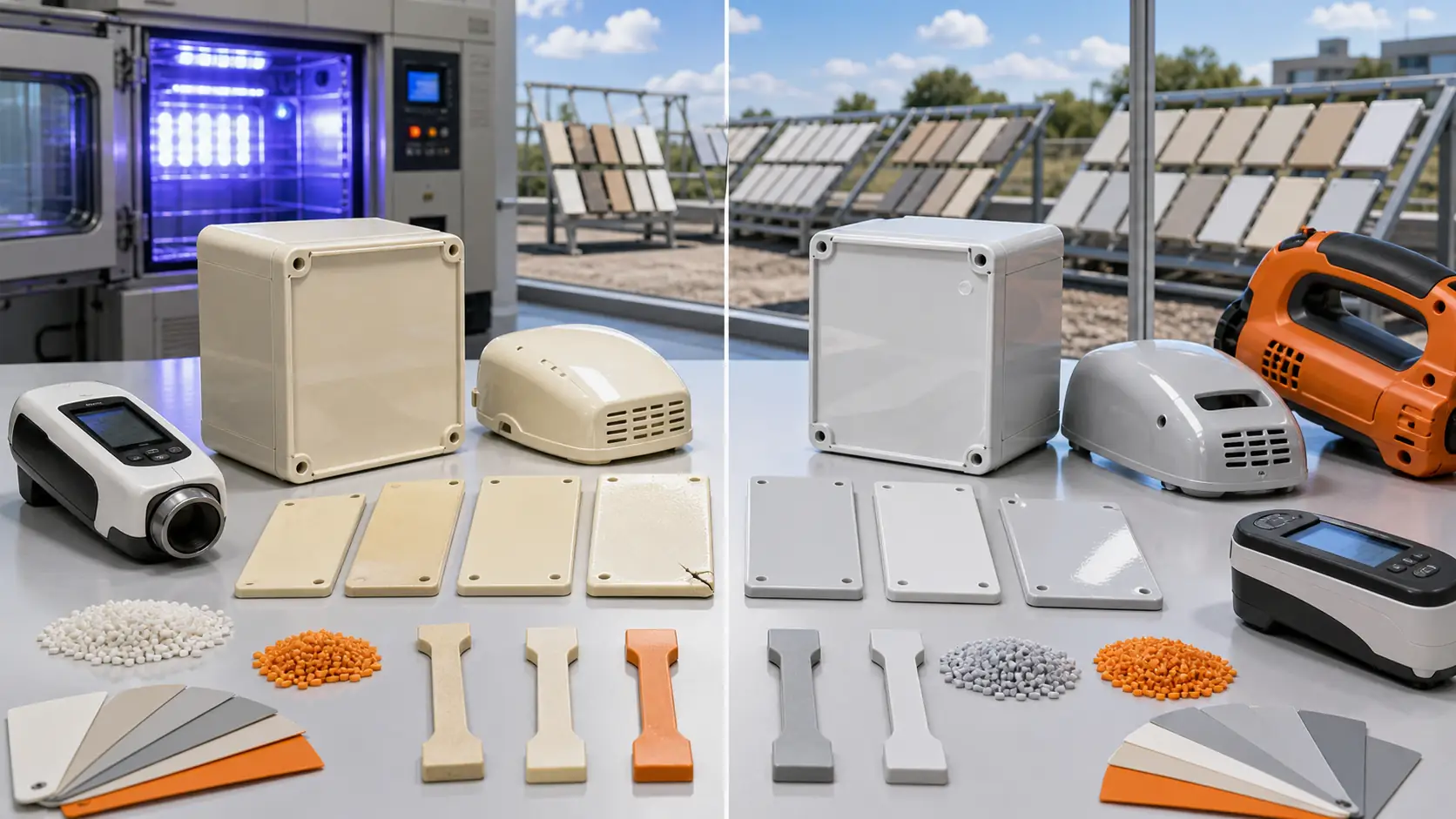
ASA and ABS may look similar in molding and appearance, but their long-term outdoor aging behavior is different.
ABS is often chosen for cost, impact strength and surface quality, while ASA usually performs better in color, gloss and impact retention after UV exposure.
This guide compares the two routes by application risk, weathering test logic, part color, wall thickness and validation method.
DEYU helps buyers choose between UV-modified ABS and ASA based on the real outdoor duty cycle, not only the resin name.
Buyer and engineer FAQ
Questions engineers often ask about this material route
Where can ABS / ASA with a UV-resistant plastic requirement be used?
Typical fields include outdoor clips, covers, housings, liners, sheets, equipment shells and exposed appearance parts. For this article, DEYU would first confirm the working environment, wall thickness, expected lifetime and whether DGK-ABS R165UV UV-resistant ABS, DGK-ASA FR801UV flame-retardant UV-resistant ASA matches the part geometry or needs formulation adjustment.
What are the main performance indicators for the "UV-resistant plastic" target on ABS / ASA?
Focus on color change, gloss retention, tensile retention, impact retention and weathering hours. Buyers should ask for data on molded parts, not only pellet data, because gate position, filler orientation and thickness can change the final value.
What should engineers watch during injection molding or processing?
For ABS / ASA, a practical starting window is 210-245°C melt / 50-80°C mold. Avoid overheating pigments or HALS systems, use stable black or color packages and validate outdoor aging. Final parameters should follow part thickness, gate design and the actual machine.
What details help DEYU recommend DGK-ABS R165UV UV-resistant ABS, DGK-ASA FR801UV flame-retardant UV-resistant ASA more accurately?
Send the current resin or grade, drawing or photo, wall thickness, annual quantity, target standard, failure mode and required color. If a reference grade already passed one test but failed in production, include both data sets.
For a precise recommendation, share the part drawing, base resin, target performance, processing method and test standard with DEYU.
Procurement Summary
ASA and ABS are close in processing and appearance, but their outdoor aging behavior is different.
For related DEYU grades, compare DGK-ABS R165UV UV-resistant ABS with DGK-ASA FR801UV flame-retardant UV-resistant ASA when the part needs outdoor weathering, impact retention, color stability, or electrical housing validation.
ABS is often selected for cost-effective housings, tool shells, appliance parts, industrial covers, and products that require good impact strength, surface quality, and easy injection molding. Its main limitation is UV aging: ordinary ABS may fade, yellow, lose gloss, and become brittle after long sunlight exposure.
ASA is usually selected when the product needs better outdoor weather resistance, color retention, gloss retention, and impact retention after UV exposure. ASA is often used in automotive exterior parts, outdoor electrical housings, garden tools, building components, charging equipment covers, and colored outdoor parts.
UV-resistant ABS can improve aging performance through UV stabilizers, antioxidants, weather-resistant pigments, and rubber phase protection. However, when the product is used outdoors for a long time, especially in light colors or high-appearance applications, ASA usually has a stronger material foundation.
The selection should not be based only on “which material is better.” The correct question is:
Is the part indoor, semi-outdoor, or long-term outdoor? Is color retention more important, or cost and impact strength? Does the product need flame retardancy, antistatic function, high impact, low temperature toughness, or dimensional stability? Will the customer test color difference, gloss retention, impact retention, or real-part cracking after UV aging?
1. Core Difference Between ASA and ABS
The most important difference is the rubber phase.
ABS contains butadiene rubber. Butadiene gives ABS good toughness, but it is more sensitive to UV aging.
ASA uses acrylate rubber. Acrylate rubber has better weather resistance, so ASA usually keeps color, gloss, and impact performance better during outdoor exposure.
| Item | ABS | ASA |
|---|---|---|
| Main advantage | Impact, processability, cost, appearance | Weather resistance, color retention, outdoor durability |
| Rubber phase | Butadiene rubber | Acrylate rubber |
| UV aging resistance | Needs modification for outdoor use | Naturally stronger weathering foundation |
| Color retention | Medium, depends on formulation | Better, especially outdoors |
| Impact strength | Usually strong | Good, but grade-dependent |
| Surface appearance | Good gloss, easy coloring | Good appearance, stable outdoor color |
| Cost | Usually lower | Usually higher |
| Typical use | Indoor housings, tool shells, appliances, industrial covers | Outdoor housings, automotive exterior, building and garden parts |
This does not mean ABS cannot be used outdoors. It means ABS needs stronger UV-resistant formulation and realistic aging validation when used outdoors.
2. UV Aging Risk: Why Ordinary ABS Fails Faster
For ABS, UV aging usually attacks the rubber phase and surface structure. The visible result may start with appearance change, but the deeper problem is mechanical retention.
Common ABS aging symptoms:
yellowing; color fading; gloss loss; surface chalking; corner cracking; screw boss brittleness; drop test failure after aging; impact strength reduction.
ASA has better resistance to these problems because its acrylate rubber phase is more weather-stable.
However, ASA is not automatically perfect. Outdoor ASA still needs proper stabilizer, pigment, processing control, and real-part testing, especially for thin-wall parts, light colors, high-gloss surfaces, and flame-retardant systems.
3. Performance Comparison Before and After UV-Resistant Modification
The following table is a typical engineering comparison direction. Actual data depends on resin grade, color, thickness, aging method, UV exposure time, humidity, pigment system, and molding conditions.
| Item | Ordinary ABS | UV-Resistant ABS | ASA | UV-Resistant ASA |
|---|---|---|---|---|
| Initial notched impact | High | High to medium-high | Medium-high to high | Medium-high to high |
| Impact retention after UV aging | Low to medium | Medium to good | Good | Very good |
| Color difference after aging | High | Medium | Low to medium | Low |
| Gloss retention | Low to medium | Medium to good | Good | Very good |
| Outdoor service suitability | Limited | Semi-outdoor / selected outdoor | Outdoor | Long-term outdoor direction |
| Light-color stability | Weak without modification | Improved | Better | Best among these four directions |
| Cost | Low | Medium | Medium-high | Higher |
| Processing ease | Good | Good | Good | Good, grade-dependent |
For procurement, the most important point is not the initial impact value. It is the retained impact strength after aging.
A material with 25 kJ/m² initial impact but poor aging retention may fail faster outdoors than a material with 20 kJ/m² initial impact but better retention after UV exposure.
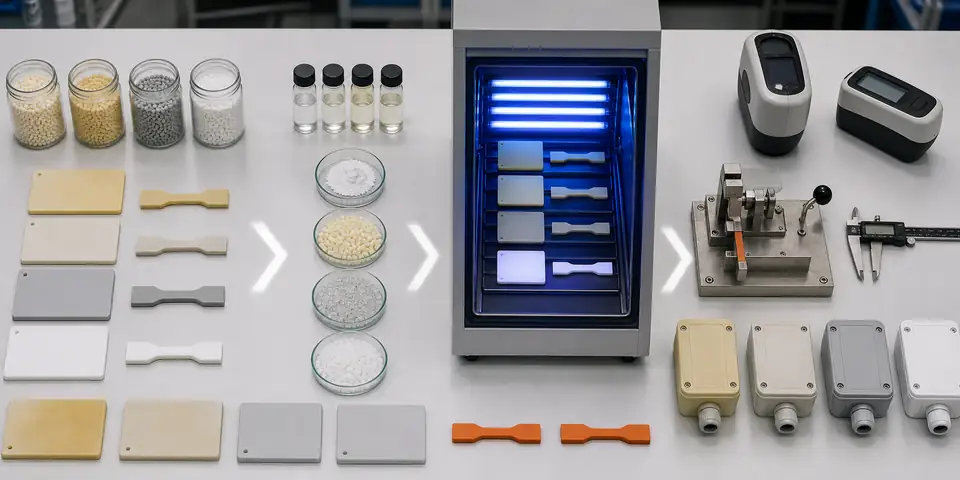
4. Suggested Testing Items for ASA and UV-Resistant ABS
Recommended validation items:
color difference after aging, ΔE; gloss retention; notched impact before and after UV aging; tensile strength retention; elongation retention; surface chalking inspection; drop test after aging; screw boss torque after aging; snap-fit cycle after aging; low-temperature impact after UV exposure.
Common aging directions include:
UV accelerated aging; xenon arc aging; UV-A 340 aging; outdoor exposure comparison; aging followed by mechanical testing.
A good outdoor material should not only keep its color. It should also keep enough toughness, assembly reliability, and part dimensional stability.
5. When to Choose ABS
Choose ABS when the product is mainly indoor or semi-outdoor, and the priority is impact strength, processability, surface quality, cost, and easy color matching.
Suitable Applications
appliance housings; tool shells; industrial covers; electronic device housings; display covers; indoor equipment panels; short-term semi-outdoor products.
Recommended ABS Modification Directions
high-impact ABS; UV-resistant ABS; flame-retardant ABS; antistatic ABS; transparent antistatic ABS; UV + high-impact ABS; UV + antistatic ABS.
Selection Notes
ABS is not the first recommendation for long-term outdoor light-colored parts unless the project has validated UV aging, impact retention, and color difference.
For cost-sensitive semi-outdoor products, UV-resistant ABS can be a practical option.
6. When to Choose ASA
Choose ASA when the product needs better weather resistance, color stability, gloss retention, and outdoor appearance reliability.
Suitable Applications
automotive exterior trim; outdoor electrical housings; charging equipment covers; garden tools; building exterior components; outdoor appliance covers; sports and leisure products; colored outdoor industrial covers.
Recommended ASA Modification Directions
UV-resistant ASA; high-impact ASA; ASA/PC alloy; flame-retardant ASA; ASA with low-warpage modification; ASA antistatic outdoor material; ASA reinforced weather-resistant compound.
Selection Notes
ASA is usually more suitable than ABS for long-term outdoor applications, but it still requires validation when the product needs flame retardancy, high impact, low-temperature toughness, low warpage, or strict color matching.
7. ASA vs UV-Resistant ABS: Practical Selection Guide
| Product Requirement | Recommended Direction | Reason |
|---|---|---|
| Indoor housing, cost-sensitive | ABS | Good appearance and cost control |
| Tool shell with drop requirement | High-impact ABS | Better impact-cost balance |
| Semi-outdoor cover | UV-resistant ABS or ASA | Depends on aging requirement and budget |
| Long-term outdoor colored housing | ASA or UV-resistant ASA | Better color and gloss retention |
| Outdoor electrical housing with FR requirement | FR ASA / FR PC/ABS / UV FR ABS by testing | Need balance between flame retardancy and weathering |
| Outdoor part with high impact after aging | ASA high-impact grade or UV high-impact ABS by validation | Need impact retention data |
| Light-colored outdoor product | ASA preferred | Better aging foundation |
| Powder or dust-sensitive outdoor cover | ASA antistatic or UV antistatic ABS | Need UV + static control |
| Low-cost product with limited exposure | UV-resistant ABS | Cost-effective if validated |
8. Technical Route: How ABS Is Modified for UV Resistance
UV-resistant ABS usually requires a complete weathering package.
Common formulation directions:
UV absorber; hindered amine light stabilizer; antioxidant system; weather-resistant pigment; rubber phase protection; impact modifier balance; surface gloss control; processing stabilizer.
Key Challenge
Improving UV resistance may affect:
impact strength; surface gloss; flowability; color; flame retardancy; cost.
Therefore, UV-resistant ABS should not be developed by adding only one UV additive. It needs a full formulation balance.
9. Technical Route: How ASA Is Further Modified for Outdoor Use
ASA already has a stronger weathering foundation, but outdoor applications may still require additional modification.
Common formulation directions:
UV stabilizer package; anti-yellowing system; weather-resistant pigments; impact enhancement; low-temperature toughness balance; flame-retardant compatibility; low-warpage filler system; antistatic or conductive function if required.
Key Challenge
ASA must balance outdoor appearance with mechanical performance. For large covers or structural housings, dimensional stability and warpage control are also important.
10. Customer Case 1: ABS Outdoor Cover Upgraded to UV-Resistant ABS
Original Situation
A customer used ordinary ABS for a semi-outdoor industrial cover. The part had good molding appearance and acceptable cost, but after outdoor storage and use, the surface faded and the corners became easier to crack.
Original Data
| Item | Ordinary ABS Cover |
|---|---|
| Initial notched impact | 18 kJ/m² |
| Notched impact after UV aging | 9 kJ/m² |
| Color difference after aging | ΔE 5.6 |
| Gloss retention | 54% |
| Drop test after aging | 4 failures / 10 samples |
| Surface appearance before aging | Good |
DEYU Improvement Plan
DEYU recommended a DGK UV-resistant ABS formulation instead of directly switching to ASA, because the customer was cost-sensitive and the product was semi-outdoor rather than continuous outdoor exposure.
The formulation direction included:
UV stabilizer package; rubber phase protection; weather-resistant pigment; impact retention balance; surface gloss control; processing stability.
Debugging Process
First Trial
Color retention improved, but post-aging impact was still not enough.
Adjustment:
optimized rubber phase protection; adjusted antioxidant system; balanced impact modifier dosage.
Second Trial
Impact retention improved, but gloss retention still needed adjustment.
Adjustment:
changed pigment system; improved surface stabilizer; adjusted injection temperature to reduce surface stress.
Final Trial
The part achieved better weathering performance while keeping the ABS cost advantage.
Final Result
| Item | Ordinary ABS | DEYU UV-Resistant ABS |
|---|---|---|
| Initial notched impact | 18 kJ/m² | 21 kJ/m² |
| Notched impact after UV aging | 9 kJ/m² | 16 kJ/m² |
| Color difference after aging | ΔE 5.6 | ΔE 2.4 |
| Gloss retention | 54% | 76% |
| Drop test after aging | 4 failures / 10 samples | 0–1 failure / 10 samples |
| Cost level | Low | Medium |
Case Conclusion
For semi-outdoor parts, UV-resistant ABS can be a practical solution when the customer needs better aging resistance but still wants to control cost. The key is to validate impact retention after aging, not only initial appearance.
11. Customer Case 2: Outdoor Housing Changed from UV-ABS to ASA
Original Situation
A customer used UV-resistant ABS for an outdoor equipment housing. The material was improved compared with ordinary ABS, but after longer outdoor exposure, light gray parts still showed visible color change and gloss loss.
Original Data
| Item | UV-Resistant ABS Housing |
|---|---|
| Initial notched impact | 22 kJ/m² |
| Notched impact after UV aging | 15 kJ/m² |
| Color difference after aging | ΔE 3.8 |
| Gloss retention | 68% |
| Surface chalking | Slight |
| Customer appearance complaint | Medium |
DEYU Improvement Plan
DEYU recommended switching to a DGK weather-resistant ASA compound because the customer’s priority changed from cost control to long-term outdoor appearance stability.
The formulation direction included:
ASA weather-resistant base; weather-resistant pigment; UV stabilizer package; impact retention balance; gloss retention; low-warpage adjustment.
Debugging Process
First Trial
Color retention improved significantly, but molding shrinkage differed from the original ABS part.
Adjustment:
adjusted ASA base resin flow; optimized mold temperature; corrected holding pressure and cooling time.
Second Trial
Dimensional stability improved, but impact after aging needed confirmation.
Adjustment:
balanced impact modifier; optimized pigment dispersion; tested drop performance after aging.
Final Trial
The housing achieved better outdoor appearance stability and acceptable molding performance.
Final Result
| Item | UV-Resistant ABS | DEYU Weather-Resistant ASA |
|---|---|---|
| Initial notched impact | 22 kJ/m² | 20 kJ/m² |
| Notched impact after UV aging | 15 kJ/m² | 18 kJ/m² |
| Color difference after aging | ΔE 3.8 | ΔE 1.6 |
| Gloss retention | 68% | 84% |
| Surface chalking | Slight | Not obvious |
| Customer appearance complaint | Medium | Significantly reduced |
Case Conclusion
When the product is long-term outdoor and light-colored, ASA is usually a stronger material direction than UV-resistant ABS. The final selection should consider aging appearance, impact retention, and molding adjustment together.
12. Customer Case 3: ASA vs ABS for Outdoor Electrical Housing With Flame Retardancy
Original Situation
A customer needed an outdoor electrical housing with both weather resistance and flame retardancy. The first trial used flame-retardant ABS, but UV aging caused color shift and impact reduction.
Original Data
| Item | FR ABS Trial |
|---|---|
| Flame-retardant target | V-0 direction at required thickness |
| Initial notched impact | 16 kJ/m² |
| Notched impact after UV aging | 8 kJ/m² |
| Color difference after aging | ΔE 5.2 |
| Gloss retention | 50% |
| Screw boss cracking after aging | 3 failures / 20 samples |
DEYU Improvement Plan
DEYU compared two routes:
UV flame-retardant ABS; weather-resistant flame-retardant ASA or PC/ABS-based alternative.
Because the customer required outdoor use and electrical safety, DEYU recommended testing both UV FR ABS and FR ASA-type material before final selection.
Debugging Process
UV FR ABS Trial
Color and gloss improved, but impact retention after aging was still limited.
FR ASA Trial
Weathering improved, but flowability and flame-retardant compatibility required adjustment.
Adjustment:
optimized flame-retardant package; improved melt flow balance; adjusted pigment system; tested screw boss strength after aging.
Final Trial
The ASA-based route performed better in weathering, while UV FR ABS remained the lower-cost alternative.
Final Result
| Item | UV FR ABS | DEYU FR ASA-Based Weather-Resistant Material |
|---|---|---|
| Flame-retardant target | V-0 direction | V-0 direction, by required thickness validation |
| Initial notched impact | 18 kJ/m² | 17 kJ/m² |
| Notched impact after UV aging | 12 kJ/m² | 15 kJ/m² |
| Color difference after aging | ΔE 3.1 | ΔE 1.8 |
| Gloss retention | 66% | 81% |
| Screw boss cracking after aging | 1–2 failures / 20 | 0–1 failure / 20 |
| Cost | Medium | Higher |
Case Conclusion
For outdoor electrical housings, flame retardancy and UV resistance must be evaluated together. ABS may meet cost and molding targets, but ASA-based weather-resistant materials often provide better long-term outdoor reliability.
13. Customer Case 4: ASA for Colored Outdoor Garden Tool Housing
Original Situation
A customer used colored ABS for a garden tool housing. The product required orange color, outdoor use, and impact resistance. Ordinary ABS showed fading and brittleness after aging.
Original Data
| Item | Colored ABS Housing |
|---|---|
| Initial notched impact | 20 kJ/m² |
| Notched impact after UV aging | 10 kJ/m² |
| Color difference after aging | ΔE 6.0 |
| Gloss retention | 48% |
| Drop test after aging | 5 failures / 10 samples |
| Color requirement | Orange |
DEYU Improvement Plan
DEYU recommended a DGK UV-resistant ASA high-impact formulation.
The formulation direction included:
ASA weather-resistant base; orange weather-resistant pigment; UV stabilizer package; impact balance; gloss retention; low-temperature impact check.
Debugging Process
First Trial
Color retention improved, but impact at low temperature was not enough.
Adjustment:
added impact balance modifier; optimized ASA base resin; tested low-temperature drop performance.
Second Trial
Impact improved, but color matching needed adjustment.
Adjustment:
modified pigment ratio; tested color difference after aging; optimized processing temperature.
Final Trial
The housing achieved better color stability and post-aging drop performance.
Final Result
| Item | Colored ABS | DEYU UV-Resistant ASA |
|---|---|---|
| Initial notched impact | 20 kJ/m² | 21 kJ/m² |
| Notched impact after UV aging | 10 kJ/m² | 18 kJ/m² |
| Color difference after aging | ΔE 6.0 | ΔE 1.7 |
| Gloss retention | 48% | 83% |
| Drop test after aging | 5 failures / 10 samples | 0–1 failure / 10 samples |
| Color requirement | Orange | Orange matched |
Case Conclusion
For bright-colored outdoor products, ASA is often more reliable than ABS because color fading and rubber phase aging are more visible under sunlight. UV-resistant ASA helped maintain both appearance and impact performance.
14. DEYU DGK ASA and ABS Modification Platform
Yuyao Deyu DEYU plastics provides customized ASA and ABS modified material solutions according to real application conditions.
ABS Solution Directions
DGK-ABS high-impact series; DGK-ABS UV-resistant series; DGK-ABS UV high-impact series; DGK-ABS flame-retardant series; DGK-ABS antistatic series; DGK-ABS UV antistatic series; DGK-transparent antistatic ABS series; DGK-ABS low-warpage housing series.
ASA Solution Directions
DGK-ASA weather-resistant series; DGK-ASA UV-resistant high-impact series; DGK-ASA colored outdoor series; DGK-ASA flame-retardant series; DGK-ASA antistatic outdoor series; DGK-ASA low-warpage series; DGK-ASA/PC alloy weather-resistant series.
Customizable Factors
DEYU can adjust:
UV stabilizer package; weather-resistant pigment; anti-yellowing system; impact strength; gloss retention; color difference direction; flame retardancy; antistatic function; flowability; low-temperature toughness; warpage control; molding shrinkage; surface appearance; cost target.
Information Buyers Should Provide
application environment; indoor, semi-outdoor, or outdoor use; expected exposure time; current material; target color; part thickness; surface gloss requirement; impact requirement; low-temperature requirement; flame retardancy requirement; antistatic or conductive requirement; molding process; current failure mode; aging test method; sample part or drawing; acceptance standard.
Conclusion
ASA and ABS should not be selected only by price or initial impact strength. ABS offers strong cost-performance, good processability, surface quality, and impact performance for indoor and semi-outdoor products. ASA offers better outdoor weather resistance, color retention, gloss retention, and post-aging impact stability because of its acrylate rubber phase.
UV-resistant ABS can be a practical choice for semi-outdoor products or cost-sensitive projects when aging validation confirms sufficient color and impact retention. ASA is usually more suitable for long-term outdoor, light-colored, bright-colored, or appearance-sensitive applications.
For outdoor electrical housings, garden tools, automotive exterior parts, industrial covers, and charging equipment components, the best selection should compare not only initial properties but also color difference, gloss retention, impact retention, screw boss strength, drop performance, and dimensional stability after UV aging.
DEYU plastics can support DGK ASA, UV-resistant ABS, high-impact ABS, weather-resistant ASA, flame-retardant ASA/ABS, antistatic ASA/ABS, and customized outdoor material solutions based on real part requirements and test standards.