
Conductive LDPE / PE Compounds for ESD Films, FIBC Liners and Thermoformed Trays
A practical material-selection guide for conductive polyethylene compounds used in ESD trays, blown films, FIBC liners, cleanroom packaging and thermoformed electronic component packaging.
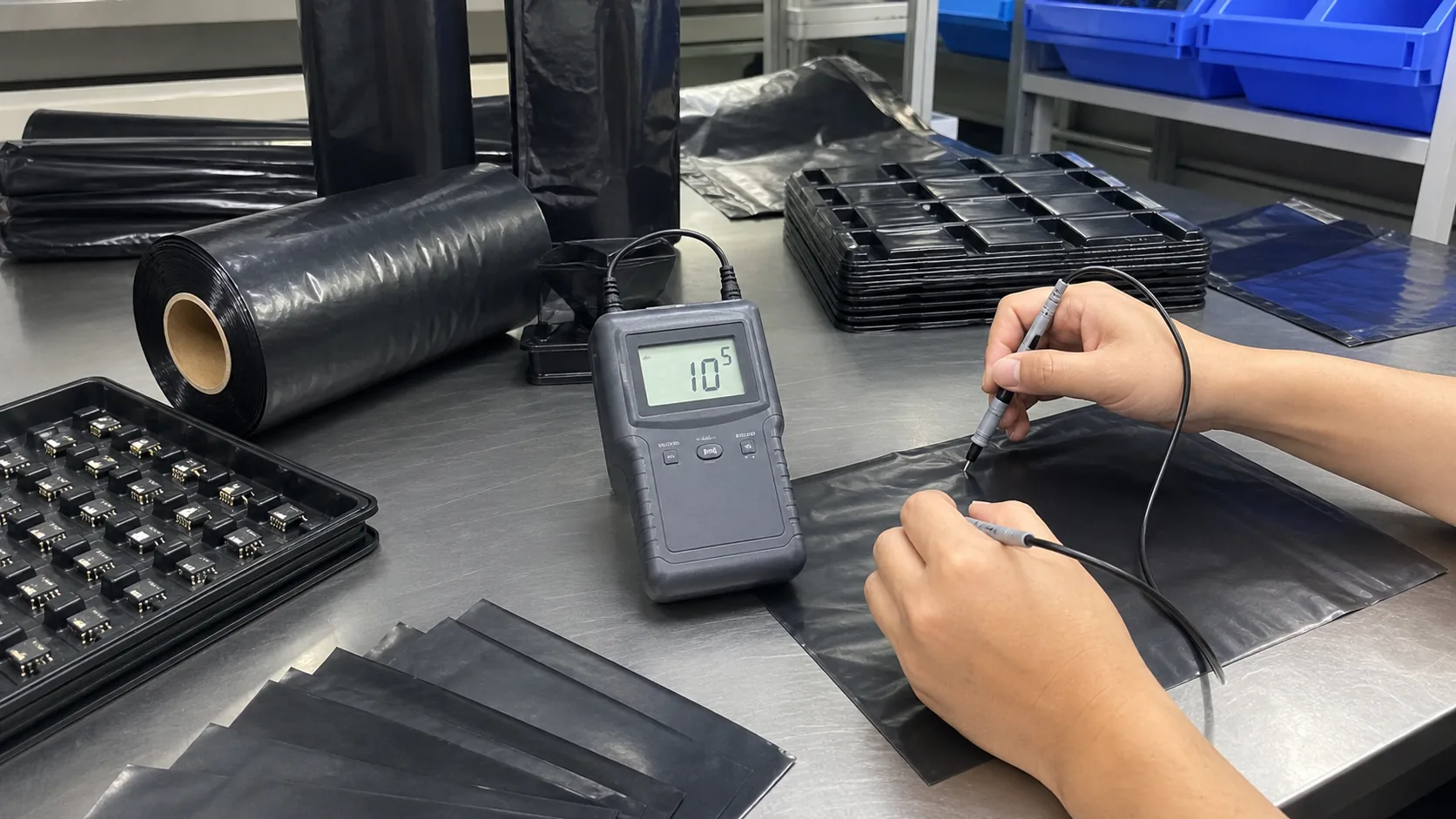
Buyer and engineer FAQ
Questions engineers often ask about this material route
Where can LDPE / PE with a conductive plastic requirement be used?
Typical fields include ESD trays, electronic housings, fixtures, EMI parts and antistatic logistics parts. For this article, DEYU would first confirm the working environment, wall thickness, expected lifetime and whether DGK-LDPE DD4-5 product page matches the part geometry or needs formulation adjustment.
What are the main performance indicators for the "conductive plastic" target on LDPE / PE?
Focus on surface resistance, volume resistance, dispersion uniformity, impact strength and molding stability. Buyers should ask for data on molded parts, not only pellet data, because gate position, filler orientation and thickness can change the final value.
What should engineers watch during injection molding or processing?
For LDPE / PE, a practical starting window is 160-210°C melt / 20-45°C mold. Avoid excessive filler loading, control weld lines and verify resistance on the molded part. Final parameters should follow part thickness, gate design and the actual machine.
What details help DEYU recommend DGK-LDPE DD4-5 product page more accurately?
Send the current resin or grade, drawing or photo, wall thickness, annual quantity, target standard, failure mode and required color. If a reference grade already passed one test but failed in production, include both data sets.
For a precise recommendation, share the part drawing, base resin, target performance, processing method and test standard with DEYU.
Related DEYU references: DGK-LDPE DD4-5 product page and conductive PE/PP ESD packaging guide.
Background / Problem
Polyethylene (PE) is one of the most widely used thermoplastics in packaging and industrial applications. It offers excellent chemical resistance, flexibility, low cost, and easy processability across multiple methods — blown film, cast film, extrusion, thermoforming, and blow molding. In its unfilled state, PE is an excellent electrical insulator with surface resistivity above 10¹² Ω/sq — making it highly susceptible to electrostatic charge accumulation.
The challenge: In electronics packaging, cleanroom environments, and industrial settings, static charge can damage sensitive components, attract dust, or create spark hazards in explosive atmospheres. Adding conductive fillers to PE transforms it from an insulator into a material capable of dissipating static charge — but the choice of filler system, PE grade, and processing method fundamentally changes the material's performance profile.
The market demand is substantial. The global ESD packaging market was valued at approximately USD 5.8 billion in 2025, driven by expanding electronics production, semiconductor manufacturing, and increasing regulatory requirements for static control in hazardous environments. Conductive PE compounds are a key material family serving this market.
Why PE for ESD packaging?
| Advantage | Benefit |
|---|---|
| Flexibility | Thermoformable, extrudable into films and sheets |
| Chemical resistance | Withstands cleaning agents and industrial environments |
| Low cost | Cost-effective compared to engineering plastics |
| Processability | Compatible with blown film, cast film, extrusion, thermoforming |
| Lightweight | Low density reduces shipping costs |
| Recyclability | Environmentally friendly disposal options |
Typical applications for conductive PE compounds:
ESD trays and thermoformed packaging for electronic components
Conductive films and bags for semiconductor handling
FIBC liners for hazardous powders and flammable materials
Anti-static packaging for automotive and aerospace components
Cleanroom liners and waste sacks
ESD shielding layers in multilayer film structures
Conductive foam for component cushioning
PE conductive compounds are available in multiple forms — as fully compounded pellets (ready-to-extrude or mold) or as conductive masterbatch (diluted with natural PE resin at the processor). Grades are available across LDPE, LLDPE, and HDPE base resins.
Technical Difficulty — What Makes Conductive PE Packaging Demanding
1. The Surface Resistivity Range for Packaging Applications
Different packaging applications require different resistivity levels:
| Application | Typical Surface Resistivity | Category |
|---|---|---|
| Conductive trays, FIBC liners | 10³ – 10⁵ Ω/sq | Conductive |
| ESD bags, films | 10⁴ – 10⁶ Ω/sq | Conductive/Dissipative |
| Anti-static packaging | 10⁶ – 10⁹ Ω/sq | Dissipative |
| Cleanroom liners | 10⁶ – 10⁹ Ω/sq | Dissipative |
Conductive PE compounds for packaging typically target surface resistivity of 10³–10⁶ Ω/sq. This range provides effective static dissipation while maintaining the flexibility and processability required for packaging applications.
2. The Thickness Challenge — Thin-Gauge Conductivity
Packaging applications often require thin films and sheets — 0.015 mm to 0.2 mm thickness. Achieving consistent conductivity at thin gauges is challenging because:
The conductive network must form in a very thin cross-section
Filler orientation during extrusion affects conductivity
Stretching during film formation can disrupt the conductive network
Thinner sections have fewer conductive particles per unit area
PE conductive compounds designed for packaging achieve stable electrical properties even at thin gauge levels. The key is optimized filler dispersion and network formation during processing.
3. Filler System Selection — Carbon Black vs. CNT
| Filler Type | Typical Resistivity | Processing Suitability | Key Consideration |
|---|---|---|---|
| Carbon black | 10³–10⁶ Ω/sq | Excellent for extrusion, blow molding | Cost-effective; proven technology |
| Carbon nanotube (CNT) | 10²–10⁵ Ω/sq | Excellent for films, thin sections | Higher conductivity at lower loading |
Carbon black is the most common conductive filler for PE packaging compounds. Special conductive carbon black grades provide stable conductivity with good dispersion. CNT-based compounds offer higher conductivity at lower loadings but at higher cost.
4. Processing Method — The Manufacturing Decision
| Processing Method | Typical Products | Key Considerations |
|---|---|---|
| Blown film | ESD bags, liners, films | Requires compounds with good melt strength |
| Cast film | Thin films, packaging | Requires consistent gauge control |
| Thermoforming | ESD trays, blisters | Requires good formability and heat resistance |
| Injection molding | Trays, containers, components | Requires good flow and dimensional stability |
DEYU's conductive PE- and PP-based compounds are developed to perform in blown film, cast film, and filament extrusion processes. They deliver stable electrical properties with excellent mechanical durability — even at thin gauge levels.
5. Humidity Independence — A Critical Advantage
Unlike ionic antistatic coatings or additives that depend on ambient humidity for performance, carbon black-filled conductive PE provides permanent, volume-conductive ESD protection that is completely independent of ambient humidity. This is a critical advantage for packaging applications where humidity conditions may vary during storage and transport.
DEYU Material Direction — DGK-PE Series
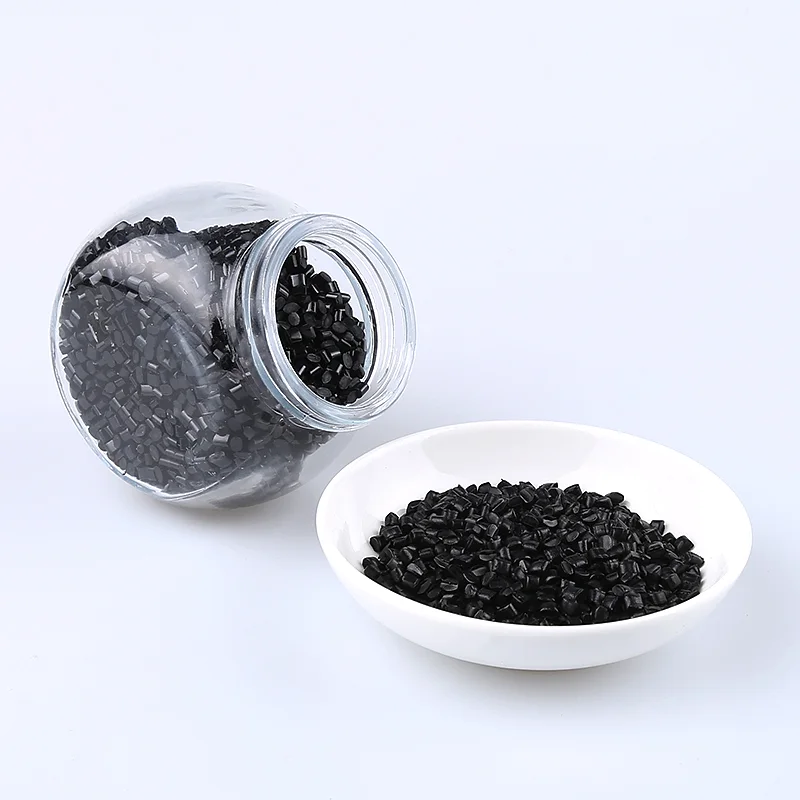
DEYU offers conductive PE compounds across multiple PE grades for ESD packaging and industrial applications. The DGK-PE series includes formulations for blown film, cast film, extrusion, and thermoforming.
DGK-PE Conductive Grades — General Specifications:
| Property | Value (Reference) | Test Method | Notes |
|---|---|---|---|
| Base Resin | LDPE / LLDPE / HDPE | — | Grade-dependent |
| Filler System | Conductive carbon black / CNT hybrid | — | Optimized for packaging applications |
| Surface Resistivity | 10³–10⁶ Ω/sq | ASTM D257 | Range depends on grade and loading |
| Volume Resistivity | 10²–10⁴ Ω·cm | ASTM D257 | — |
| Density | 0.95–1.05 g/cm³ | — | Depends on filler loading |
| Processing Methods | Blown film, cast film, extrusion, thermoforming, injection molding | — | Grade-dependent |
DGK-PE Film Grade — For ESD Bags and Liners:
| Property | Value (Reference) | Test Method |
|---|---|---|
| Base Resin | LDPE/LLDPE blend | — |
| Filler | Conductive carbon black | — |
| Surface Resistivity | 10⁴–10⁶ Ω/sq | ASTM D257 |
| MFR | 1.5–3.0 g/10min | ASTM D1238 |
| Processing | Blown film, cast film | — |
| Typical Film Thickness | 0.015–0.2 mm | — |
DGK-PE Thermoforming Grade — For ESD Trays:
| Property | Value (Reference) | Test Method |
|---|---|---|
| Base Resin | HDPE / LDPE blend | — |
| Filler | Conductive carbon black | — |
| Surface Resistivity | 10³–10⁵ Ω/sq | ASTM D257 |
| Processing | Thermoforming, extrusion | — |
| Typical Sheet Thickness | 0.5–3.0 mm | — |
All values are reference directions and must be confirmed with final grade testing and customer part validation.
Application Deep Dive
1. ESD Trays for Electronic Components
Conductive PE trays provide protection against electrostatic discharge during storage, handling, and transport of sensitive electronic components. These trays can be thermoformed to fit components precisely, ensuring fit and protecting components from sudden movements during transportation.
Typical applications:
IC trays and chip carriers
Component trays for SMT assembly lines
Blister packs and clamshell packaging
Stackable containers for ESD-sensitive parts
Conductive cells and dividers for assembly line use
Why PE for trays:
Thermoformable — can be formed into complex shapes
Good impact resistance — protects components during handling
Lightweight — reduces shipping costs
Recyclable — environmentally friendly
2. Conductive Films and Bags
Conductive PE films and bags are the most common ESD packaging solution for electronic components. Black conductive bags made from blow-molded LDPE with carbon provide light-tight protection and effectively avoid accumulation of electric charge on the bag and its contents.
Typical applications:
ESD bags for ICs and electronic components
Lay-flat tubing for hazardous powders
Conductive reel wrapping for components on reels
Anti-static packaging for semiconductor wafer handling
Inner liners for FIBC bulk bags
Key features:
Permanent conductivity — independent of humidity
Light-tight protection — carbon black blocks light
Heat-sealable — custom-sized bags can be created
Good mechanical properties — tear resistance, puncture resistance
3. FIBC Liners for Hazardous Materials
Conductive liners are essential for packaging and transporting flammable or explosive materials that are sensitive to electrostatic discharge. These liners incorporate conductive materials to dissipate static charges safely.
Typical applications:
Type C FIBC bulk bags
Packaging for explosive powders and pigments
Hazardous chemical transport
Pharmaceutical cleanroom applications
Key requirements:
Surface resistivity 10³–10⁵ Ω/sq for effective grounding
Permanent conductivity — does not degrade over time
Chemical resistance — withstands aggressive materials
Moisture protection — barrier properties
Customer Debugging / Validation Scenario
Context: An electronics contract manufacturer was producing thermoformed ESD trays from a conductive PE sheet. The flat sheet passed surface resistivity testing (5×10⁵ Ω/sq at 1.5 mm thickness). However, after thermoforming, the trays showed inconsistent resistivity — pocket areas measured 10⁵–10⁶ Ω/sq, but deep-draw corner areas measured >10⁹ Ω/sq. The reject rate was 15%.
Problem analysis:
| Location | Sheet Thickness (Initial) | Formed Thickness | Resistivity (Ω/sq) | Status |
|---|---|---|---|---|
| Flat sheet (before forming) | 1.5 mm | — | 5×10⁵ | Pass |
| Pocket bottom | 1.5 mm | ~1.3 mm | 6×10⁵ | Pass |
| Sidewall | 1.5 mm | ~0.8 mm | 8×10⁵ | Pass |
| Corner | 1.5 mm | ~0.5 mm | 5×10⁹ | Fail |
Root cause: The sheet stretching during deep-draw forming increased particle spacing, weakening the conductive network. In the corners (3× stretching), the carbon black network was disrupted beyond the percolation threshold.
DEYU interventions:
Material A — Higher carbon black loading : Increased filler content to maintain conductivity after stretching
Material B — CNT-based compound : Switched to CNT-based PE for more resilient conductive network
Process optimization : Adjusted thermoforming temperature and speed to reduce stretching in critical areas
Validation Data Table (customer internal trial structure):
| Parameter | Existing Material (CB-PE) | Material A (Higher CB) | Material B (CNT-PE) | Target |
|---|---|---|---|---|
| Flat Sheet Resistivity (Ω/sq) | 5×10⁵ | 3×10⁵ | 4×10⁵ | 10³–10⁶ |
| Pocket Resistivity (Ω/sq) | 6×10⁵ | 4×10⁵ | 4×10⁵ | 10³–10⁶ |
| Corner Resistivity (Ω/sq) | 5×10⁹ | 2×10⁷ | 3×10⁶ | <10⁶ |
| Total Reject Rate | 15% | 7% | 3% | <5% |
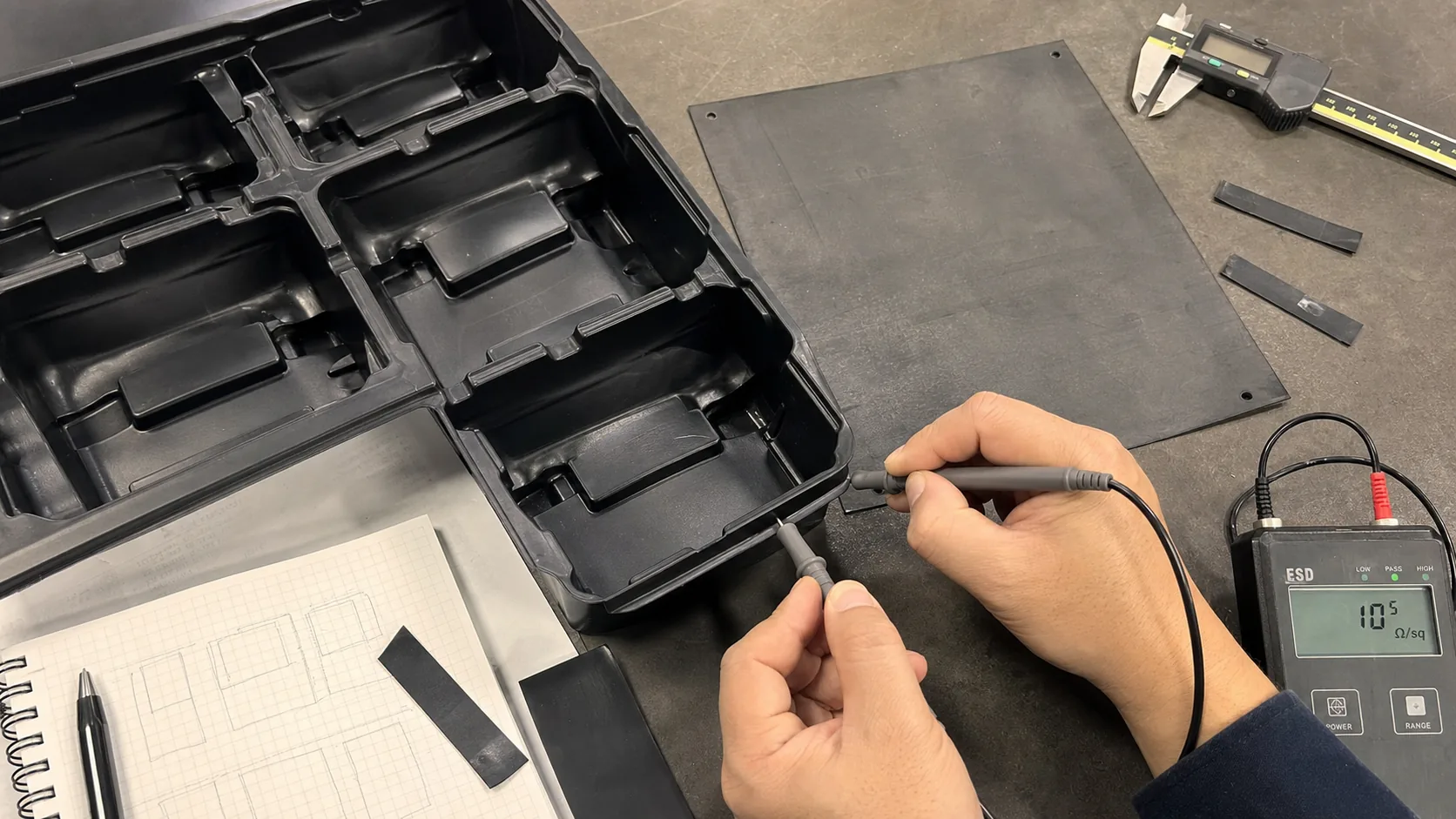
Result Interpretation:
Existing material analysis: The standard carbon black PE lost conductivity in high-stretch areas because the carbon black network could not survive 3× stretching. Particle spacing increased beyond the percolation threshold.
Material A (higher CB loading): Increasing carbon black loading improved corner conductivity but increased material cost and reduced flexibility.
Material B (CNT-based): The CNT network was more resilient to stretching, maintaining conductivity at corners (3×10⁶ Ω/sq). Total reject rate dropped to 3%.
DEYU's contribution: DEYU demonstrated that for thermoformed trays, CNT-based compounds offer better post-forming conductivity retention due to the more resilient nanoscale conductive network.
Next steps: Full production validation of Material B. DEYU can provide ongoing technical support and in-process resistivity monitoring protocols.
Result Interpretation — Selection Framework
Based on the analysis and scenario above, DEYU recommends the following framework for selecting conductive PE compounds for ESD packaging:
Step 1 — Define the Application and Process
| Application Type | Primary Process | Recommended PE Grade | Key Focus |
|---|---|---|---|
| ESD trays, blisters | Thermoforming | LDPE/HDPE blend | Post-forming conductivity retention |
| ESD bags, films | Blown film | LDPE/LLDPE blend | Thin-gauge conductivity |
| FIBC liners | Extrusion (film) | LDPE/LLDPE | Mechanical strength + conductivity |
| Conductive sheets | Extrusion | HDPE/LDPE | Surface resistivity uniformity |
Step 2 — Select the Filler Based on Processing Requirements
| Processing Requirement | Recommended Filler | Rationale |
|---|---|---|
| High stretch (thermoforming) | CNT-based | More resilient network |
| Thin films (<0.05 mm) | CNT-based or high-structure CB | Better network formation at thin gauges |
| Cost-sensitive applications | Carbon black | Most cost-effective |
| Maximum flexibility | Carbon black (LDPE/LLDPE) | Maintains flexibility |
Step 3 — Define the Resistivity Target
| Application | Target Resistivity | Why |
|---|---|---|
| Conductive trays | 10³–10⁵ Ω/sq | Rapid charge dissipation |
| ESD films, bags | 10⁴–10⁶ Ω/sq | Controlled dissipation |
| FIBC liners | 10³–10⁵ Ω/sq | Grounding for hazardous materials |
Step 4 — Optimize Processing for Conductivity
| Processing Method | Key Consideration | Recommended Approach |
|---|---|---|
| Blown film | Filler orientation affects conductivity | Maintain consistent blow-up ratio |
| Thermoforming | Stretching disrupts network | Use CNT-based or higher loading compounds |
| Extrusion | Shear affects dispersion | Optimize screw design and melt temperature |
Suitable Applications — Conductive PE Compounds
| Application | Recommended Grade | Resistivity Target | Key Requirement |
|---|---|---|---|
| IC trays, chip carriers | DGK-PE-Thermoforming | 10³–10⁵ Ω/sq | Post-forming conductivity |
| ESD component trays | DGK-PE-Thermoforming | 10³–10⁵ Ω/sq | Thermoformability + ESD |
| ESD bags (ICs, components) | DGK-PE-Film | 10⁴–10⁶ Ω/sq | Thin-gauge conductivity |
| FIBC liners (hazardous powders) | DGK-PE-Liner | 10³–10⁵ Ω/sq | Mechanical strength + grounding |
| Cleanroom liners, waste sacks | DGK-PE-Film | 10⁶–10⁹ Ω/sq | Dissipative + cleanroom compatibility |
| Conductive reel wrapping | DGK-PE-Film | 10⁴–10⁶ Ω/sq | Flexibility + ESD |
| Anti-static packaging films | DGK-PE-Film | 10⁴–10⁶ Ω/sq | Humidity-independent conductivity |
| Stackable ESD containers | DGK-PE-Thermoforming | 10³–10⁵ Ω/sq | Impact resistance + conductivity |
| Conductive foam (cushioning) | DGK-PE-Foam | 10³–10⁶ Ω/sq | Cushioning + ESD protection |
What Buyers Should Provide for Selection
To receive a precise conductive PE compound recommendation, buyers should provide:
Application description — tray, film, liner, bag, or other?
Resistivity requirement — surface or volume resistivity range (Ω/sq or Ω·cm) with test standard
PE grade preference — LDPE, LLDPE, HDPE, or open to recommendation
Processing method — blown film, cast film, thermoforming, extrusion, injection molding
Part geometry — dimensions, wall thickness, stretch ratio (if thermoforming)
Film/sheet thickness — target thickness range
Mechanical requirements — tear strength, puncture resistance, flexibility
Environmental conditions — temperature range, chemical exposure, humidity
Regulatory requirements — RoHS, REACH, food contact, ATEX
Production volume — annual or monthly quantity
Cost constraints — target material cost per kilogram or per part
Current issues — what problems need solving with the existing material?
DEYU can support with:
PE grade selection based on application and processing requirements
Filler system selection (carbon black, CNT, or hybrid)
Processing recommendations for consistent conductivity
Small-batch validation (25–100 kg) with full electrical and mechanical testing
Technical support during film extrusion, thermoforming, and molding trials
Conclusion
Conductive PE compounds are essential materials for ESD packaging applications — from thermoformed trays and FIBC liners to blown films and anti-static bags. The combination of PE's inherent advantages (flexibility, chemical resistance, low cost, easy processability) with permanent carbon-based conductivity creates a versatile material family for electronics packaging, cleanroom applications, and industrial ESD protection.
Key takeaways:
PE offers unique advantages for packaging — flexibility, chemical resistance, low cost, and compatibility with multiple processing methods (blown film, cast film, thermoforming, extrusion)
Conductive PE provides permanent, humidity-independent conductivity — unlike ionic antistats, carbon black-filled PE maintains stable resistivity regardless of ambient humidity
Different applications require different resistivity targets — conductive trays and FIBC liners typically target 10³–10⁵ Ω/sq; ESD films and bags target 10⁴–10⁶ Ω/sq
CNT-based compounds offer better post-forming conductivity — the nanoscale CNT network is more resilient to stretching during thermoforming, maintaining conductivity in deep-draw areas
Processing method affects conductivity — blown film, cast film, thermoforming, and extrusion each require different compound formulations optimized for the specific process
Validation must be application-specific — for thermoformed trays, test resistivity after forming, not just on flat sheets. For films, test at multiple locations across the roll
DEYU offers a complete range of conductive PE compounds across LDPE, LLDPE, and HDPE grades — with carbon black, CNT, and hybrid filler systems — optimized for blown film, cast film, thermoforming, and extrusion applications. The technical expertise to guide grade selection, optimize processing, and validate performance in production is available to support every ESD packaging application.