
DGK-ABS DD3C Data Sheet Interpretation for Stable Surface Resistance
A data-sheet-focused reading of DGK-ABS DD3C, explaining what each COA value means for conductive ABS parts, why graphite gives stable surface resistance, and how to validate the material before mass production.
Buyer and engineer FAQ
Questions engineers often ask about this material route
Where can ABS with a conductive plastic requirement be used?
Typical fields include ESD trays, electronic housings, fixtures, EMI parts and antistatic logistics parts. For this article, DEYU would first confirm the working environment, wall thickness, expected lifetime and whether DGK-ABS DD3C product page matches the part geometry or needs formulation adjustment.
What are the main performance indicators for the "conductive plastic" target on ABS?
Focus on surface resistance, volume resistance, dispersion uniformity, impact strength and molding stability. Buyers should ask for data on molded parts, not only pellet data, because gate position, filler orientation and thickness can change the final value.
What should engineers watch during injection molding or processing?
For ABS, a practical starting window is 210-245°C melt / 50-80°C mold. Avoid excessive filler loading, control weld lines and verify resistance on the molded part. Final parameters should follow part thickness, gate design and the actual machine.
What details help DEYU recommend DGK-ABS DD3C product page more accurately?
Send the current resin or grade, drawing or photo, wall thickness, annual quantity, target standard, failure mode and required color. If a reference grade already passed one test but failed in production, include both data sets.
For a precise recommendation, share the part drawing, base resin, target performance, processing method and test standard with DEYU.
Related DEYU references: DGK-ABS DD3C product page and conductive ABS application guide.
How to Read the DGK-ABS DD3C Data Sheet
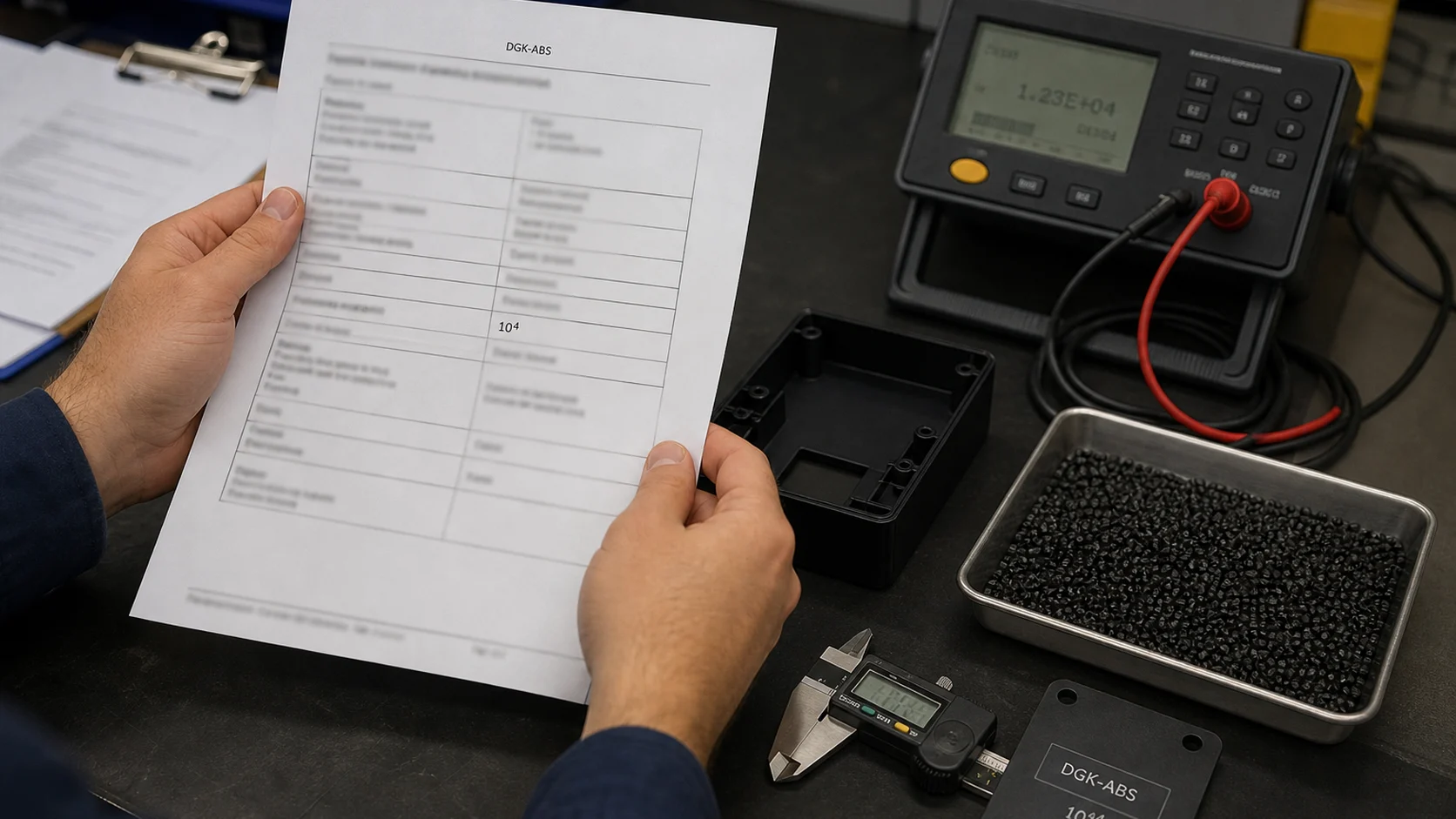
This article uses a data-table reading approach. Instead of treating the COA as a list of isolated numbers, it connects surface resistance, mechanical retention, processing window and customer validation results into one material-selection logic.
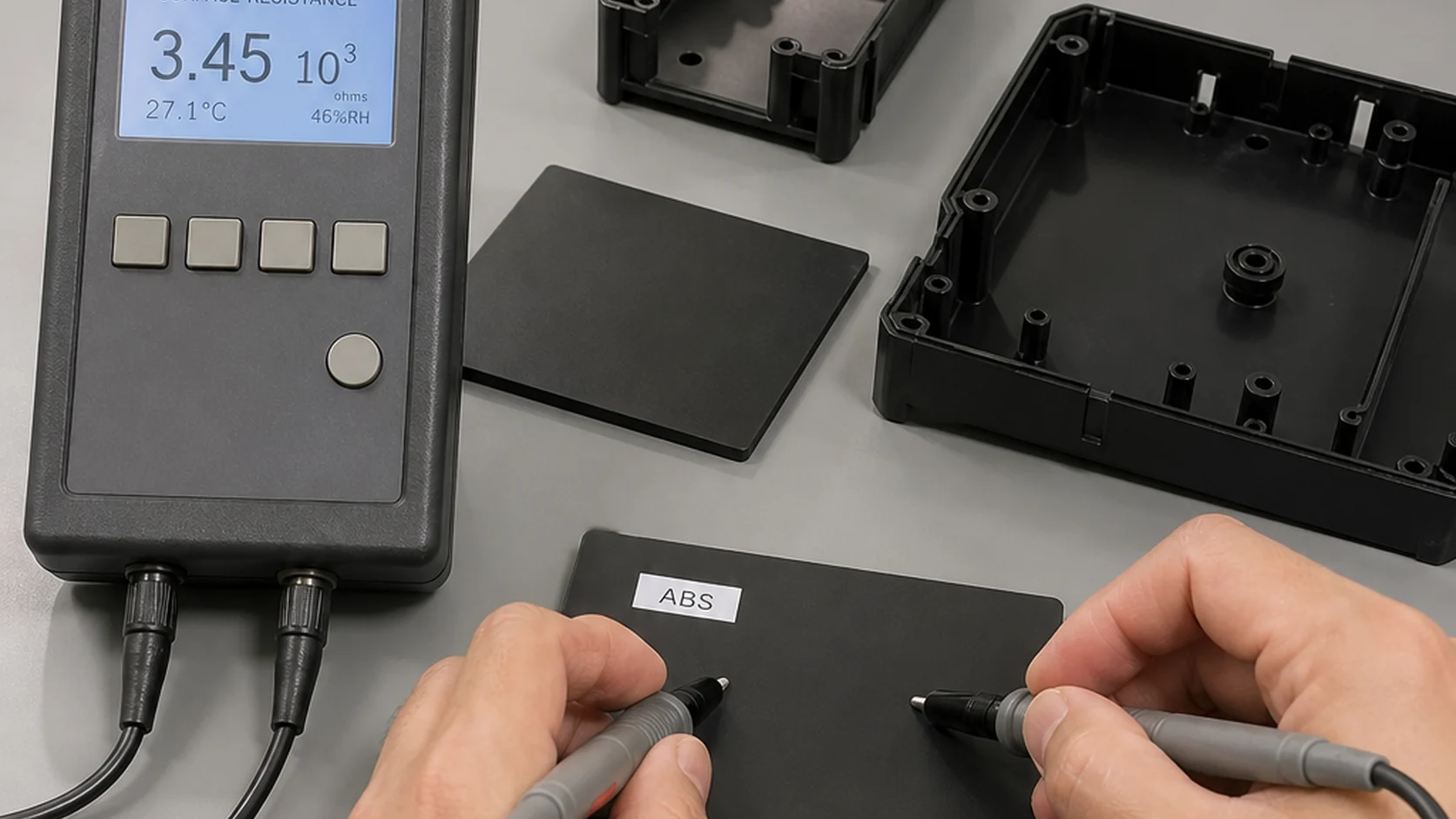
For conductive ABS, the first number to read is not tensile strength or MFR. The first checkpoint is whether the resistivity range matches the ESD risk of the part. DGK-ABS DD3C is positioned at 10³-10⁴ Ω/sq, so the material should be evaluated as a permanently conductive ABS compound, not as a temporary antistatic ABS grade.
The second checkpoint is whether the mechanical data is still sufficient after graphite loading. Flexural strength, flexural modulus, tensile strength, elongation and impact strength should be read together. A lower tensile value than standard ABS is expected; the practical question is whether the molded housing, cover or fixture still passes assembly, drop, screw-boss and dimensional checks.
The third checkpoint is processing. Drying at 90°C for 3-4 hours, injection temperature around 225-235°C and mold temperature around 50-80°C are not decorative data. They explain why resistance stability, surface quality and scrap rate must be validated on the customer's own mold before mass production.
Background / Problem
Acrylonitrile Butadiene Styrene (ABS) is one of the most widely used engineering thermoplastics in the world. The global ABS market stood at approximately 10.69 million tons in 2025 and is projected to grow at a CAGR of 3.30% through 2035. Within this market, anti-static ABS resin alone was valued at USD 1.19 billion in 2024 and is projected to reach USD 1.74 billion by 2032, driven by increasing demand from electronics, automotive, and packaging industries.
The problem: Standard ABS is an excellent electrical insulator, with surface resistivity above 10¹⁴ Ω/sq. In electronics manufacturing environments, static charge accumulates on ABS housings, covers, and component carriers, attracting dust, contaminating sensitive components, and risking electrostatic discharge (ESD) damage. For applications such as floppy disk drives, fax machines, and VCR cassette housings—where sensitive electronics are handled and transported—this creates a serious quality and reliability risk.
The solution: DGK-ABS DD3C is a graphite-filled conductive ABS compound that provides stable, permanent surface resistivity in the 10³–10⁴ Ω/sq range. Unlike migratory antistatic additives that depend on humidity and deplete over time, graphite-filled compounds offer permanent conductivity that does not degrade with handling, cleaning, or environmental changes.
Graphite as a conductive filler in ABS has been well-studied: research shows that graphite can significantly improve the conductive ability of the compound system. At graphite volume fractions of 13.21%–16.36%, ABS/graphite composites exhibit a sharp drop in DC resistivity by six orders of magnitude, indicating electrical percolation.
Technical Difficulty / Why Graphite-Filled ABS Requires Careful Formulation
The Percolation Challenge
Achieving stable conductivity in graphite-filled ABS requires creating a percolation network of graphite particles throughout the polymer matrix. The graphite particles must be in sufficient proximity to allow electron tunneling or direct contact, creating continuous conductive pathways.
For graphite-filled ABS, the percolation threshold typically occurs at 13–16 vol% graphite loading. Below this threshold, the composite behaves as an insulator. Above it, conductivity increases sharply—often by several orders of magnitude—but mechanical properties begin to change.
Graphite vs. Carbon Black: The Filler Trade-off
Graphite offers distinct advantages over carbon black for certain conductive ABS applications:
| Aspect | Graphite-Filled ABS | Carbon Black-Filled ABS |
|---|---|---|
| Conductivity mechanism | Plate-like particles create network | Spherical aggregates create network |
| Percolation threshold | 13–16 vol% | 8–20 wt% |
| Surface resistivity | 10³–10⁴ Ω/sq (stable) | 10³–10⁵ Ω/sq (can vary) |
| Mechanical impact | Moderate (tensile drops above 9 wt%) | Significant (strength compromised) |
| Dispersion | Requires careful compounding | Well-established compounding routes |
| Surface quality | Generally good | Can be affected by agglomerates |
Carbon black-filled ABS composites can achieve excellent electrical performance with conductivity as high as 10⁻¹ S/m, but their mechanical strength is often compromised. Graphite-filled compounds offer a different balance—stable conductivity with better retention of mechanical properties at optimized loadings.
Research has shown that tensile strength in ABS/graphite composites increases up to approximately 6 wt% graphite and then drops at higher filler content. DGK-ABS DD3C is formulated within the optimized loading range to balance conductivity with mechanical integrity.
Processing Sensitivity
Conductive ABS compounds are processing-sensitive. Both ABS and graphite absorb moisture, which can affect both conductivity and mechanical properties. Drying removes moisture and results in improvements in both conductivity and tensile strength. DGK-ABS DD3C requires drying at 90°C for 3–4 hours before processing.
Surface Resistivity Stability
The key advantage of DGK-ABS DD3C is stable surface resistivity (10³–10⁴ Ω/sq). Unlike surface-coated or migratory antistatic systems, graphite-filled compounds do not depend on:
Humidity — performance does not drop in dry environments
Surface condition — abrasion exposes fresh conductive material
Additive migration — the conductive network is permanent
Cleaning — conductivity is not affected by solvents or detergents
DEYU Material Direction — DGK-ABS DD3C
DGK-ABS DD3C is a graphite-filled conductive ABS compound designed for applications requiring stable, permanent surface resistivity in the 10³–10⁴ Ω/sq range.
Key Design Features
| Feature | Benefit |
|---|---|
| Graphite conductive network | Stable surface resistivity 10³–10⁴ Ω/sq — independent of humidity |
| ABS base resin | Good impact resistance, surface quality, and processability |
| Optimized graphite loading | Balances conductivity with mechanical properties |
| Permanent conductivity | No migratory additives — performance does not degrade over time |
| Black color | Standard appearance for ESD applications |
| Injection moldable | Standard ABS processing conditions |
Target Applications
DGK-ABS DD3C is specifically designed for electronics housing and component applications where stable ESD protection is required:
Floppy disk drive housings — protects sensitive magnetic media from ESD
Fax machine components — prevents static-related paper feed and electronic issues
VCR cassette housings — protects recording media and electronics
General electronics enclosures — where stable surface resistivity is critical
Reference Product Data
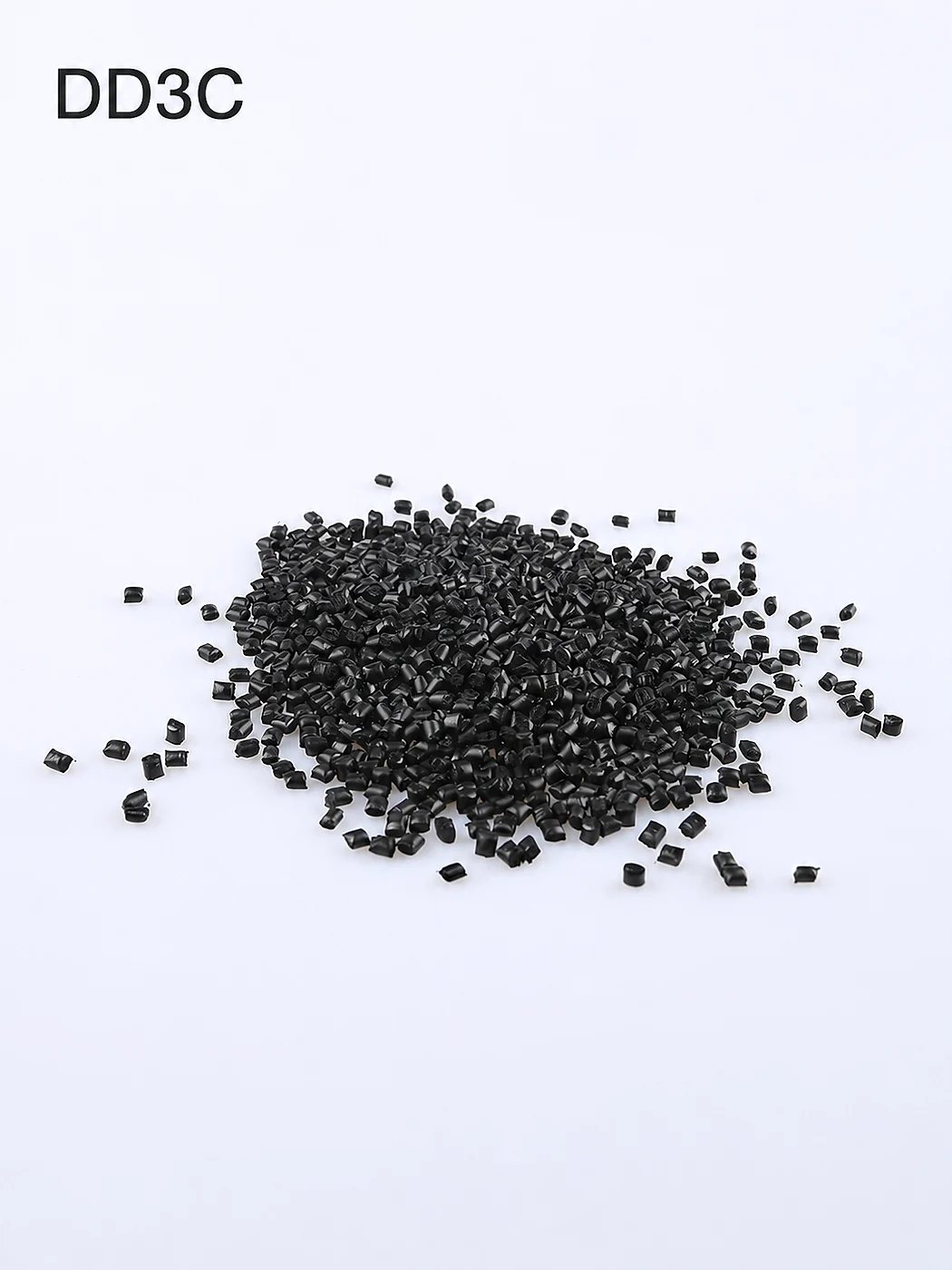
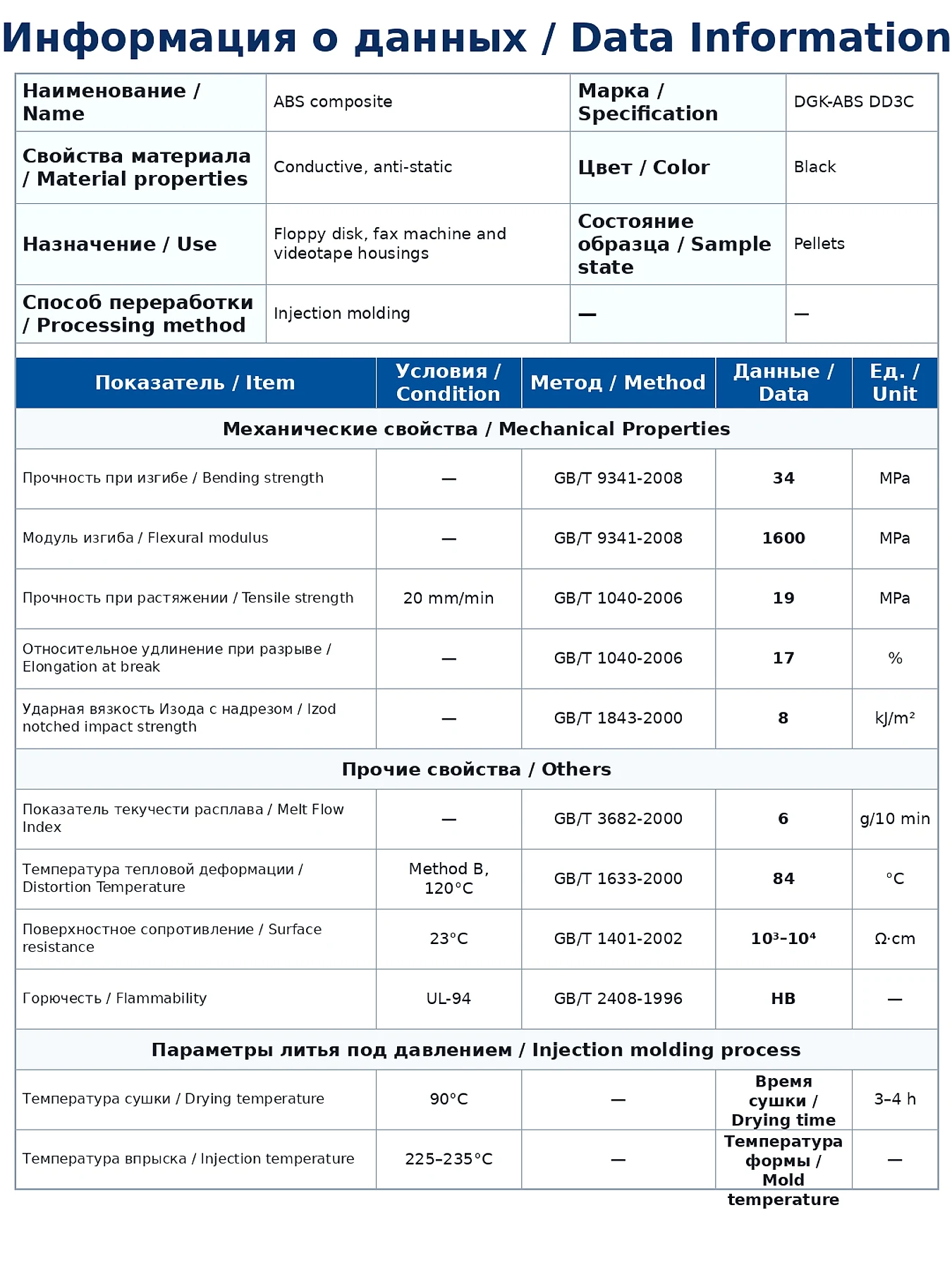
DGK-ABS DD3C — Certificate of Analysis
| Property | Test Method | DGK-ABS DD3C | Unit |
|---|---|---|---|
| General Information | |||
| Name | — | ABS Compound | — |
| Specification | — | DGK-DD3C | — |
| Material Properties | — | Conductive, anti-static | — |
| Color | — | Black | — |
| Form | — | Pellets / Granules | — |
| Typical Applications | — | Floppy disk drives, fax machines, VCR cassette housings | — |
| Processing Method | — | Injection molding | — |
| Mechanical Properties | |||
| Bending Strength | GB/T9341-2008 | 34 | MPa |
| Flexural Modulus | GB/T9341-2008 | 1600 | MPa |
| Tensile Strength (20mm/min) | GB/T1040-2006 | 19 | MPa |
| Elongation at Break | GB/T1040-2006 | 17 | % |
| Izod Notched Impact Strength | GB/T1843-2000 | 8 | kJ/m² |
| Other Properties | |||
| Melt Flow Rate (220°C/10kg) | GB/T3682-2000 | 6 | g/10min |
| Heat Distortion Temperature (B method, 120°C) | GB/T1633-2000 | 84 | °C |
| Surface Resistivity (23°C) | GB/T1401-2002 | 10³–10⁴ | Ω·cm |
| Flammability | UL-94 / GB/T2408-1996 | HB | — |
Interpretation of Key Properties
Surface Resistivity (10³–10⁴ Ω·cm): This places DGK-ABS DD3C firmly in the conductive category. The material provides rapid static charge dissipation, making it suitable for ESD-sensitive electronics handling applications. The resistivity is stable and does not depend on humidity or surface condition.
Bending Strength (34 MPa): Good flexural strength for a conductive ABS compound. The graphite loading has been optimized to maintain mechanical integrity while achieving target conductivity.
Flexural Modulus (1600 MPa): Typical for filled ABS compounds. This modulus provides good stiffness for housing and enclosure applications while maintaining some flexibility.
Tensile Strength (19 MPa): The graphite loading reduces tensile strength compared to unfilled ABS (typically 40–50 MPa), but this is within the expected range for conductive ABS compounds. Research indicates that tensile strength in ABS/graphite composites drops at higher filler loadings—DGK-ABS DD3C is formulated to balance this trade-off.
Elongation at Break (17%): Reduced compared to unfilled ABS (typically 50–100+%), which is expected with graphite loading. This indicates the material is more rigid and less ductile—acceptable for housing applications where flexibility is not the primary requirement.
Heat Distortion Temperature (84°C): Adequate for most electronics housing applications. Parts can withstand moderate heat exposure during use and assembly.
Melt Flow Rate (6 g/10min): Good flow characteristics suitable for injection molding of complex geometries.
Recommended Processing Parameters
| Parameter | DGK-ABS DD3C |
|---|---|
| Drying Temperature | 90°C |
| Drying Time | 3–4 hours |
| Injection Molding Temperature | 225–235°C |
| Mold Temperature | 50–80°C (typical for ABS) |
Important notes:
Drying is essential — moisture affects both conductivity and mechanical properties
The actual processing parameters may require adjustment based on the specific machine, mold design, and part geometry
Values above are laboratory reference values — production-scale validation is recommended
Customer Debugging / Validation Scenario
Validation Scenario: Electronics Component Manufacturer — Static-Related Failures in Floppy Disk Drive Housings
Background: An electronics manufacturer producing floppy disk drive housings from standard ABS reported that during assembly and testing, static charge accumulation on the housings was attracting dust to the magnetic read/write heads. This resulted in read/write errors and a field failure rate of approximately 5%. The housings were also difficult to handle in automated assembly equipment due to static cling.
The manufacturer evaluated DEYU DGK-ABS DD3C for the housing application, tracking surface resistivity, dust adhesion, and assembly yield.
Trial Protocol:
| Parameter | Detail |
|---|---|
| Trial quantity | 2,000 housings |
| Monthly production volume | 50,000 housings |
| Material | DGK-ABS DD3C |
| Processing method | Injection molding |
| Drying | 3–4 hours at 90°C |
| Melt temperature | 225–235°C |
| Target surface resistivity | <10⁶ Ω/sq |
| Test method | GB/T1401-2002 |
| Measurement locations | 5 locations per housing |
Validation Data:
| Metric | Standard ABS (Control) | DEYU DGK-ABS DD3C |
|---|---|---|
| Surface resistivity | >10¹⁴ Ω/sq | 10³–10⁴ Ω/sq |
| Static charge (after handling) | 2,000–5,000 V | <100 V |
| Dust particles on housing surface | Significant accumulation | Minimal — visually clean |
| Read/write errors (assembly test) | 3.5% | <0.5% |
| Field failure rate | 5% | <1% |
| Assembly pass rate | 92% | 98% |
| Molding scrap rate | 2.8% | 3.5% |
| Surface quality | Excellent | Good |
Direction After Trial:
DGK-ABS DD3C demonstrated stable surface resistivity of 10³–10⁴ Ω/sq, eliminating static charge accumulation on the housings. Dust adhesion was significantly reduced, and read/write errors dropped from 3.5% to <0.5%. The field failure rate improved from 5% to <1%.
Areas for further refinement identified:
DGK-ABS DD3C required drying (3–4 hours at 90°C) which added a process step — DEYU recommends evaluating pre-dried material supply options
Slightly higher molding scrap rate (3.5% vs. 2.8%) was observed — DEYU is optimizing the processing window to improve yield
The material is black, which was acceptable for this application where function outweighs aesthetics
Long-term (>12 months) resistivity stability in storage conditions is being monitored
Result Interpretation:
This validation scenario illustrates the critical advantage of graphite-filled conductive ABS: stable, permanent surface resistivity that eliminates static-related failures. The 10³–10⁴ Ω/sq resistivity provides rapid static dissipation without creating an overly conductive surface that could cause Charged Device Model (CDM) risks.
The 6-percentage-point improvement in assembly pass rate (from 92% to 98%) and the reduction in field failures from 5% to <1% demonstrate the commercial value of converting to DGK-ABS DD3C for electronics housing applications.
Suitable Applications
| Application | Why DGK-ABS DD3C Is Suitable |
|---|---|
| Floppy disk drive housings | Stable 10³–10⁴ Ω/sq resistivity protects sensitive magnetic media |
| Fax machine components | Prevents static-related paper feed and electronic issues |
| VCR cassette housings | Protects recording media and sensitive electronics |
| Electronics enclosures | Permanent ESD protection for sensitive components |
| Computer peripheral housings | Static control without sacrificing ABS processability |
| Instrument panels and bezels | Surface quality + ESD protection |
| ESD-safe production fixtures | Dimensional stability + permanent conductivity |
| Component shipping trays | Surface resistivity <10⁶ for ESD-sensitive parts |
DGK-ABS DD3C is particularly well-suited for applications where:
Stable surface resistivity (10³–10⁴ Ω/sq) is required
Permanent ESD protection is needed (not dependent on humidity or surface coatings)
Good mechanical properties are required (34 MPa flexural strength, 1600 MPa modulus)
Standard ABS processing is desired
Comparison: DGK-ABS DD3C vs. Other Conductive ABS Approaches
| Aspect | DGK-ABS DD3C (Graphite) | Carbon Black Conductive ABS | Migratory Antistatic ABS |
|---|---|---|---|
| Surface Resistivity | 10³–10⁴ Ω/sq (stable) | 10³–10⁵ Ω/sq (can vary) | 10⁹–10¹² Ω/sq (humidity-dependent) |
| Humidity Dependence | None | None | High |
| Permanence | Permanent | Permanent | Depletes over time |
| Mechanical Properties | Good (34 MPa flexural) | Moderate to good | Excellent (unfilled) |
| Surface Quality | Good | Good (with good dispersion) | Excellent |
| Cost | Moderate | Low-Moderate | Low-Moderate |
| Typical Applications | Electronics housings, ESD components | General ESD parts | Temporary ESD packaging |
What Buyers Should Provide
To ensure proper evaluation and validation of DGK-ABS DD3C for your specific application, please provide the following information to DEYU:
| Information Needed | Why It Matters |
|---|---|
| Part drawing / 3D model | Identifies wall thickness, flow length, gate locations—affects mold design and filler orientation |
| Target surface resistivity range | Defines whether DD3C (10³–10⁴ Ω/sq) is appropriate for your application |
| Application type | Housing, component, fixture, or packaging—determines mechanical and surface requirements |
| Processing method | Injection molding (primary)—determines parameter recommendations |
| Operating temperature range | Verifies HDT (84°C) meets application requirements |
| Environmental exposure | Chemicals, UV, cleaning agents—affects stabilizer requirements |
| Handling frequency (cycles) | Determines whether permanent conductivity is required vs. temporary solutions |
| Current material and failure mode | Helps diagnose whether DD3C addresses the specific issue |
| Monthly / annual production volume | Determines commercial viability and potential for custom formulation |
| Regulatory requirements | RoHS, REACH—affects compliance verification |
Conclusion
DGK-ABS DD3C is a graphite-filled conductive ABS compound that delivers stable, permanent surface resistivity in the 10³–10⁴ Ω/sq range while maintaining the mechanical properties and processability that make ABS the material of choice for electronics housing applications.
Key specifications:
Surface Resistivity: 10³–10⁴ Ω/sq (conductive, stable)
Bending Strength: 34 MPa
Flexural Modulus: 1600 MPa
Tensile Strength: 19 MPa
Elongation at Break: 17%
HDT: 84°C
MFR: 6 g/10min
Processing: Injection molding
Key advantages:
Stable, permanent conductivity — 10³–10⁴ Ω/sq, independent of humidity
Graphite conductive network — reliable ESD protection without migratory additives
Good mechanical properties — 34 MPa flexural strength, 1600 MPa modulus
Standard ABS processing — familiar injection molding parameters
Target applications: Floppy disk drives, fax machines, VCR cassette housings, and general electronics enclosures requiring stable ESD protection.
Validation data from an electronics component trial demonstrated that DGK-ABS DD3C reduced static charge from 2,000–5,000V to <100V, reduced read/write errors from 3.5% to <0.5%, and improved field failure rates from 5% to <1%.
For applications requiring stable, permanent ESD protection with the familiar properties of ABS, DGK-ABS DD3C offers a proven, reliable solution.
DEYU can provide small-batch validation quantities for process optimization and in-plant testing. Contact DEYU's technical team with your part drawings, performance requirements, and production volume for a customized material recommendation.