
Low-Temperature Resistant PP DGK-PP 66D: Toughened Polypropylene for Cold-Impact Parts
DGK-PP 66D is a toughened low-temperature resistant PP compound developed by DEYU for molded parts that need better flexibility and impact resistance under cold conditions.
Buyer and engineer FAQ
Questions engineers often ask about this material route
Where can PP with a low-temperature resistant plastic requirement be used?
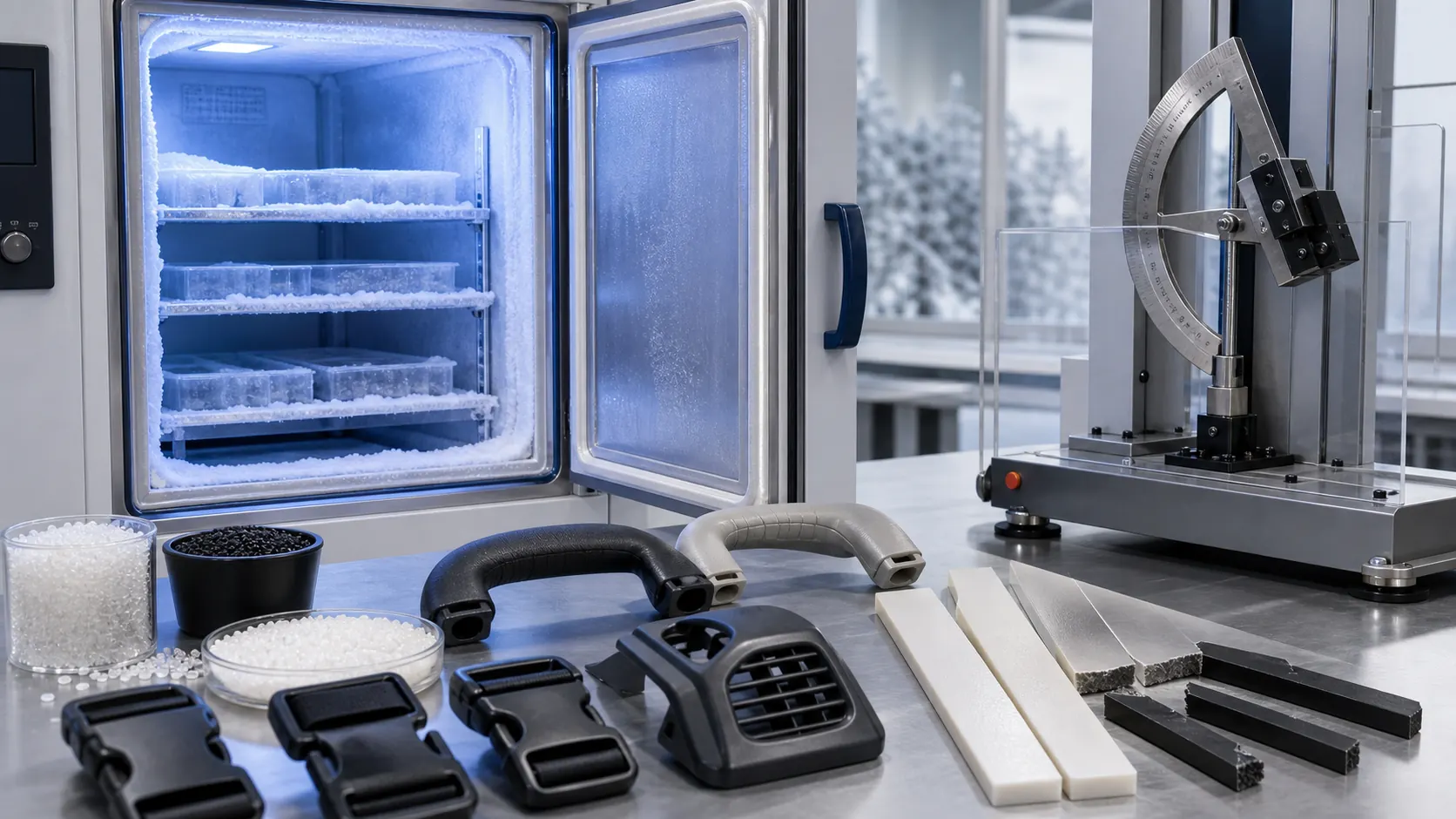
Typical fields include cold-chain containers, outdoor buckles, freezer parts, winter equipment and impact-prone housings. For this article, DEYU would first confirm the working environment, wall thickness, expected lifetime and whether DGK-PP 66D impact modified low-temperature resistant PP matches the part geometry or needs formulation adjustment.
What are the main performance indicators for the "low-temperature resistant plastic" target on PP?
Focus on notched impact at the service temperature, ductile-brittle transition, flexibility and dimensional change. Buyers should ask for data on molded parts, not only pellet data, because gate position, filler orientation and thickness can change the final value.
What should engineers watch during injection molding or processing?
For PP, a practical starting window is 190-230°C melt / 30-60°C mold. Avoid sharp gates and high residual stress; validate parts at -20°C, -30°C or the real service temperature. Final parameters should follow part thickness, gate design and the actual machine.
What details help DEYU recommend DGK-PP 66D impact modified low-temperature resistant PP more accurately?
Send the current resin or grade, drawing or photo, wall thickness, annual quantity, target standard, failure mode and required color. If a reference grade already passed one test but failed in production, include both data sets.
For a precise recommendation, share the part drawing, base resin, target performance, processing method and test standard with DEYU.
Product Summary
DGK-PP 66D is a toughened low-temperature resistant PP compound developed by DEYU for molded parts that need better flexibility and impact resistance under cold conditions.
For molded parts exposed to winter transport, outdoor use, or cold assembly stress, review DGK-PP 66D impact modified low-temperature resistant PP when cold-impact resistance, high elongation, and stable injection molding performance must be balanced.
Ordinary PP is lightweight and economical, but it can become brittle at low temperature. For parts exposed to winter transport, outdoor use, cold storage, repeated bending, impact, or assembly stress, toughness retention becomes more important than only looking at room-temperature strength.
DGK-PP 66D is positioned for applications where the material needs:
good low-temperature impact performance; high elongation and flexibility; lightweight PP base; stable injection molding process; balanced stiffness and toughness; practical use in sports equipment and automotive parts.
1. Key Performance Direction
| Item | DGK-PP 66D Typical Data |
|---|---|
| Base material | Toughened PP compound |
| Color | Natural |
| Processing method | Injection molding |
| Tensile strength | 27.5 MPa |
| Elongation at break | 450% |
| Flexural modulus | 1100 MPa |
| Notched impact strength at 23℃ | 49 kJ/m² |
| Notched impact strength at -23℃ | 13 kJ/m² |
| Density | 0.90 g/cm³ |
| Melt flow index | 2 g/10 min |
| Rockwell hardness | 95 R |
| Heat distortion temperature | 110℃ |
| Vicat softening point | 145℃ |
| Flammability | UL94 HB |
The value of this material is not only one single impact number. The more practical point is the balance between flexibility, low-temperature toughness, stiffness, and injection molding stability.
For buyers, this means DGK-PP 66D is more suitable for parts that must resist cracking in cold conditions than ordinary PP grades.
2. Technical Route: How Low-Temperature PP Is Improved
Low-temperature resistant PP is usually not achieved by one additive. It needs a formulation balance between PP base resin, elastomer toughening system, compatibility, crystallization control, and processing stability.
2.1 Toughened PP Base
The first step is selecting a PP system that does not become too brittle under low temperature. A toughened PP base improves energy absorption during impact.
2.2 Elastomer Toughening
Elastomer modification helps improve flexibility, elongation, and impact resistance. This is important for parts that bend, snap, absorb impact, or work in cold environments.
2.3 Stiffness Balance
Too much toughening can make PP too soft. DGK-PP 66D keeps a flexural modulus direction of 1100 MPa, which means it is not only soft, but still has usable structural support for molded parts.
2.4 Injection Molding Stability
The melt flow index direction of 2 g/10 min indicates that the material is more suitable for parts that need strength and toughness rather than extremely high-flow thin-wall molding. Gate design, holding pressure, and cooling time should be adjusted according to part structure.
3. Where DGK-PP 66D Is Suitable
3.1 Sports Equipment Parts
Sports equipment often needs lightweight, impact resistance, flexibility, and cold-weather reliability.
Suitable parts may include:
protective shells; handles; buckles; support parts; outdoor sports components; impact-resistant molded parts.
Why DGK-PP 66D fits:
PP is lighter than many engineering plastics; high elongation helps absorb deformation; low-temperature toughness reduces cracking risk during winter use or transport.
3.2 Automotive Components
Automotive PP parts may experience cold assembly, winter impact, vibration, and repeated stress.
Suitable parts may include:
interior clips; protective covers; brackets with moderate load; under-seat or trunk components; cold-region molded parts; lightweight functional components.
Why DGK-PP 66D fits:
better cold-impact direction than ordinary PP; balanced modulus for molded structures; natural-color base allows further color adjustment; low density supports lightweight design.
3.3 Outdoor and Cold-Region Plastic Parts
For outdoor products, the material may face low temperature, drop impact, transportation vibration, and repeated handling.
Suitable parts may include:
tool boxes; outdoor covers; logistics components; cold-storage auxiliary parts; winter-use molded products.
For outdoor long-term sunlight exposure, DEYU can further adjust the formulation with UV-resistant additives if required.
4. Selection Guide: When to Choose DGK-PP 66D
Choose DGK-PP 66D when the part has one or more of these problems:
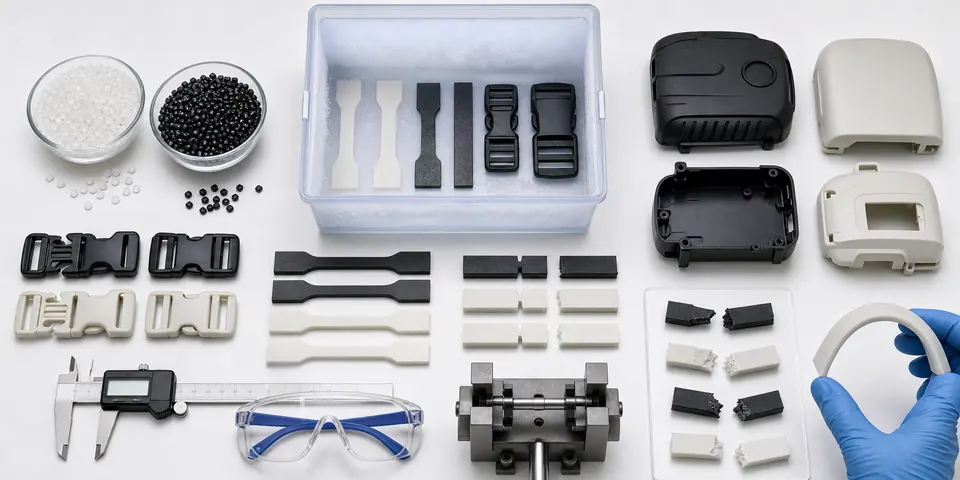
ordinary PP cracks in winter; parts break during cold transport; snap-fit or buckle areas whiten or crack; the product needs both flexibility and stiffness; the customer wants a lighter alternative to some tougher engineering plastics; the part needs injection molding and practical cost control; impact resistance at room temperature alone is not enough.
Do not select by room-temperature impact only. For cold-region parts, the buyer should test the final molded part after low-temperature conditioning.
5. Customer Case 1: Outdoor Sports Buckle Cracking in Winter
Original Situation
A sports equipment customer used ordinary PP for a molded buckle. The part worked normally at room temperature, but during winter transport and outdoor use, some buckles cracked near the snap-fit area.
Original Data
| Item | Ordinary PP |
|---|---|
| Room-temperature assembly | Acceptable |
| Low-temperature cracking | Frequent |
| Snap-fit whitening | Obvious |
| Drop test after -20℃ conditioning | 5 failures / 10 samples |
| User complaint | Winter cracking |
DEYU Improvement Plan
DEYU recommended DGK-PP 66D.
Technical focus:
improve low-temperature impact; increase elongation and deformation absorption; reduce snap-fit cracking; keep enough stiffness for buckle locking; adjust molding temperature and holding pressure.
Final Result
| Item | Ordinary PP | DGK-PP 66D |
|---|---|---|
| Low-temperature cracking | Frequent | Significantly reduced |
| Snap-fit whitening | Obvious | Reduced |
| Drop test after -20℃ conditioning | 5 failures / 10 | 0–1 failure / 10 |
| Assembly performance | Acceptable | Stable |
| Weight | Low | Low |
Case Conclusion
The customer did not need a heavier engineering plastic first. A toughened low-temperature PP route solved the cracking problem while keeping PP’s lightweight and cost advantages.
6. Customer Case 2: Automotive Protective Cover With Cold Impact Requirement
Original Situation
An automotive parts customer used standard PP for a protective cover. The cover had acceptable stiffness, but after cold storage and assembly, corner cracking appeared.
Original Data
| Item | Standard PP |
|---|---|
| Tensile strength | Acceptable |
| Low-temperature impact | Weak |
| Corner cracking after cold assembly | 4 failures / 20 samples |
| Part weight | Low |
| Molding stability | Good |
DEYU Improvement Plan
DEYU recommended DGK-PP 66D as a low-temperature resistant PP solution.
Technical focus:
low-temperature toughness; impact retention; controlled stiffness; reduced corner cracking; process adjustment for stress reduction.
Final Result
| Item | Standard PP | DGK-PP 66D |
|---|---|---|
| Corner cracking after cold assembly | 4 / 20 | 0–1 / 20 |
| Low-temperature impact direction | Weak | Improved |
| Flexibility | Medium | Better |
| Stiffness | Higher | Balanced |
| Molding process | Stable | Stable after adjustment |
Case Conclusion
For automotive covers used in cold environments, material toughness after low-temperature conditioning is more important than only initial stiffness. DGK-PP 66D provides a balanced route between impact resistance and molded-part stability.
7. Processing and Validation Advice
For DGK-PP 66D, DEYU recommends validating:
low-temperature impact after conditioning; drop test on final molded parts; snap-fit cycle test; corner cracking after assembly; mold shrinkage and warpage; long-term outdoor aging if used outside; color matching and surface appearance.
Processing reference:
injection molding is suitable; melt flow direction is not high-flow thin-wall type; mold temperature, gate design, holding pressure, and cooling time should be adjusted according to part thickness; avoid excessive internal stress around snap-fit, corner, and screw boss areas.
8. DEYU Low-Temperature PP Platform
DEYU can further develop low-temperature PP materials based on customer requirements.
Possible directions:
DGK-PP 66D low-temperature toughened PP; low-temperature PP + UV resistance; low-temperature PP + flame retardancy; low-temperature PP + anti-static performance; low-temperature PP + low warpage; low-temperature PP + reinforced stiffness balance; custom colored low-temperature PP compound.
Information buyers should provide:
application; current material; failure temperature; part thickness; drop test condition; impact requirement; stiffness requirement; color; processing method; sample part or drawing; whether UV, flame retardancy, or antistatic function is required.
Conclusion
DGK-PP 66D is a DEYU low-temperature resistant PP compound designed for parts that need toughness, flexibility, and cold-impact reliability. Its 450% elongation direction, -23℃ notched impact data, 1100 MPa flexural modulus, and low-density PP base make it suitable for sports equipment, automotive parts, outdoor components, and cold-region molded products.
For buyers, the main value is not a single property, but the balance: low-temperature toughness, lightweight PP structure, usable stiffness, and injection molding processability. When ordinary PP becomes brittle in winter or cracks during cold assembly, DGK-PP 66D is a practical material direction worth testing on final molded parts.