
How Can Plastics Achieve Both UV Resistance and Low-Temperature Toughness?
Technical routes for plastics that need both UV resistance and low-temperature toughness, covering resin selection, UV stabilization, impact modification, pigment balance, fillers and real-part validation.
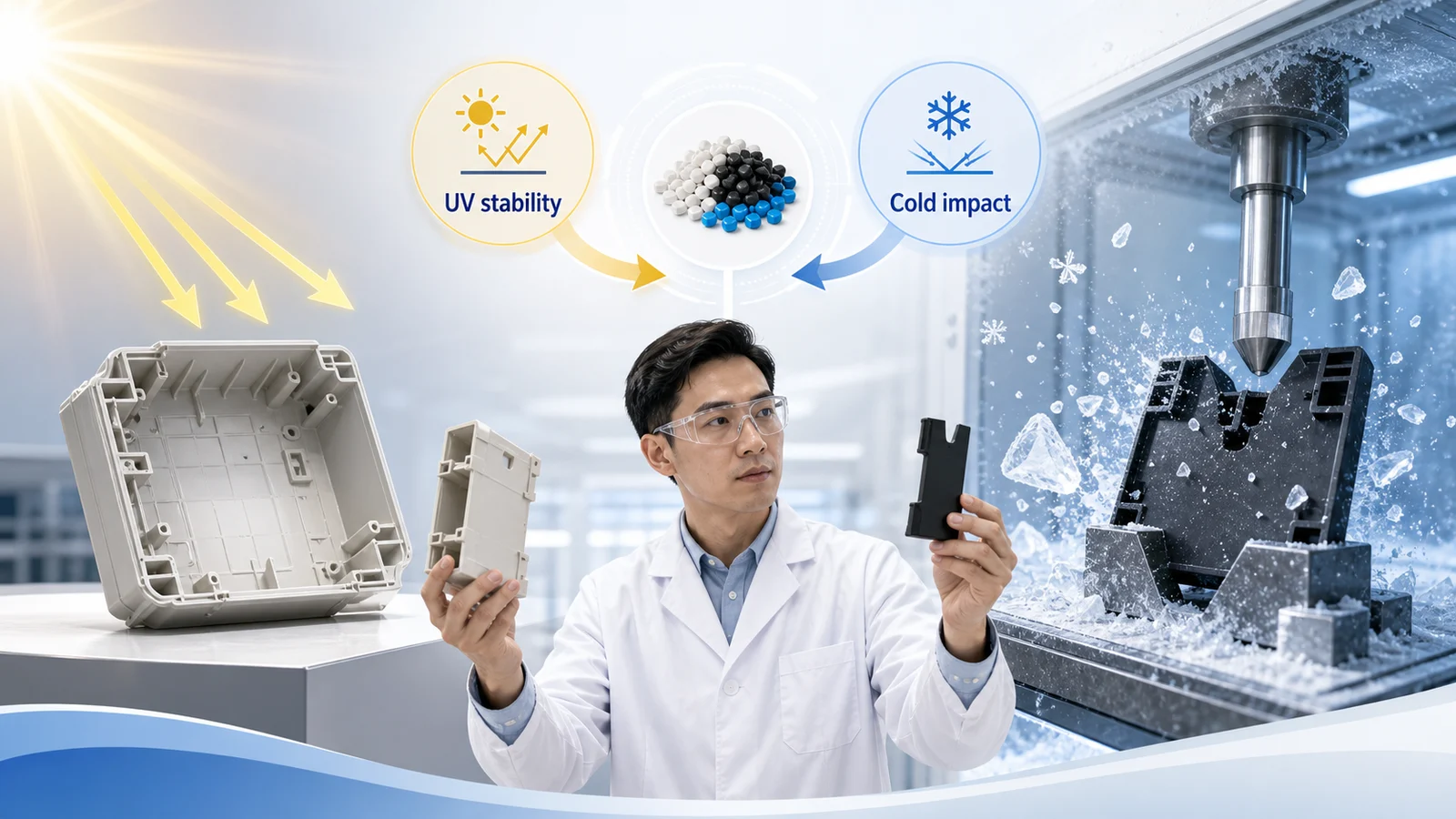
Buyer and engineer FAQ
Questions engineers often ask about this material route
Where can PE with a UV-resistant plastic requirement be used?
Typical fields include outdoor clips, covers, housings, liners, sheets, equipment shells and exposed appearance parts. For this article, DEYU would first confirm the working environment, wall thickness, expected lifetime and whether DGK-ABS R165UV UV-resistant ABS, DGK-ABS NDW140U low-temperature weather-resistant ABS, Flame-Retardant UV-Resistant ASA Pellets DGK-ASA FR801UV matches the part geometry or needs formulation adjustment.
What are the main performance indicators for the "UV-resistant plastic" target on PE?
Focus on color change, gloss retention, tensile retention, impact retention and weathering hours. Buyers should ask for data on molded parts, not only pellet data, because gate position, filler orientation and thickness can change the final value.
What should engineers watch during injection molding or processing?
For PE, a practical starting window is 170-220°C melt / 20-50°C mold. Avoid overheating pigments or HALS systems, use stable black or color packages and validate outdoor aging. Final parameters should follow part thickness, gate design and the actual machine.
What details help DEYU recommend DGK-ABS R165UV UV-resistant ABS, DGK-ABS NDW140U low-temperature weather-resistant ABS, Flame-Retardant UV-Resistant ASA Pellets DGK-ASA FR801UV more accurately?
Send the current resin or grade, drawing or photo, wall thickness, annual quantity, target standard, failure mode and required color. If a reference grade already passed one test but failed in production, include both data sets.
For a precise recommendation, share the part drawing, base resin, target performance, processing method and test standard with DEYU.
Short Answer
UV resistance and low-temperature toughness can coexist in plastics, but they must be designed as one formulation system rather than two separate additives. UV resistance requires light stabilizers, UV absorbers, antioxidants, pigment stability and surface aging control. Low-temperature toughness requires the correct base resin, impact modifier, elastomer phase, rubber phase control, crystallization control and real-part validation.
The main difficulty is interaction. Some impact modifiers improve cold impact but reduce heat resistance, weathering stability, surface hardness or long-term appearance. Some pigments, flame retardants and fillers improve color, stiffness or safety, but reduce toughness. A practical material must keep performance after sunlight aging, winter storage, temperature cycling and real molded-part stress.
Yuyao Deyu DEYU plastics develops DGK UV-resistant and low-temperature toughened materials by balancing resin, stabilizer package, toughening system, color, filler content and processing stability. Existing related product directions include DGK-ABS R165UV UV-resistant ABS, DGK-ABS NDW140U low-temperature weather-resistant ABS, DGK-PP 66D impact modified low-temperature PP and DGK-ASA FR801UV flame-retardant UV-resistant ASA.
Why UV Resistance and Cold Resistance Are Increasingly Required Together
Many plastic products are no longer used only indoors or at room temperature. They may be exposed to sunlight in summer, cold impact in winter, outdoor storage, transportation, rain, temperature cycling and long-term weathering.
Common examples include:
- outdoor electrical housings
- automotive exterior and interior components
- charging pile parts
- outdoor equipment covers
- solar equipment accessories
- cold-chain logistics parts
- garden tools and winter-use appliances
- traffic facilities and construction accessories
- agricultural equipment parts
In these applications, UV resistance alone is not enough. A material may resist color fading under sunlight but still crack in winter. Low-temperature toughness alone is also not enough. A material may survive impact at -20 C, but after UV aging its surface may become brittle, yellowed, cracked or chalked.
The real requirement is combined performance:
- resist sunlight aging
- retain color and surface quality
- maintain impact strength in cold conditions
- avoid brittle cracking after outdoor aging
- survive temperature cycling
- remain moldable and cost-effective
This is why UV resistance and low-temperature toughness must be developed together.
1. What Is UV Resistance in Plastics?
UV resistance is the ability of a plastic material to resist degradation caused by ultraviolet light, oxygen, heat, moisture and outdoor exposure.
When plastics are exposed to UV light for a long time, polymer chains may degrade. This can cause:
- yellowing
- color fading
- surface chalking
- gloss loss
- micro-cracking
- embrittlement
- impact strength reduction
- loss of elongation
- surface powdering
- shortened service life
For engineering plastics, UV aging is not only an appearance issue. It can also reduce mechanical reliability. A part that looks acceptable at the beginning may become brittle after outdoor exposure. Screw bosses, clips, thin-wall corners and weld lines may crack more easily after aging.
UV-resistant plastic development usually involves:
- UV absorbers
- HALS light stabilizers
- antioxidants
- weather-resistant pigments
- carbon black or selected color systems
- base resin selection
- processing stability control
- surface protection design
A good UV-resistant formulation should consider both appearance retention and mechanical property retention.
2. What Is Low-Temperature Toughness in Plastics?
Low-temperature toughness is the ability of a plastic material to resist brittle cracking under cold conditions.
At low temperature, polymer chain movement becomes more restricted. Many plastics become harder, less ductile and more likely to crack under impact.
Typical low-temperature failure modes include:
- housing cracking during winter transport
- clips breaking during cold assembly
- screw bosses cracking after tightening
- snap-fits losing flexibility
- outdoor parts becoming brittle after storage
- cold-chain containers cracking during drop tests
- automotive parts failing low-temperature impact tests
Low-temperature toughening usually involves:
- selecting a tougher base resin
- using impact copolymer systems
- adding suitable elastomers
- optimizing rubber phase structure
- controlling crystallization in PP
- reducing brittle fillers
- improving weld-line strength
- validating real-part impact
Low-temperature toughness should not be judged only by standard test bars. Real parts often fail at thin walls, ribs, gates, screw bosses, corners and weld lines.
3. Why UV Resistance and Low-Temperature Toughness Are Difficult to Combine
3.1 Impact Modifiers May Affect Weathering Stability
Low-temperature toughening often uses elastomers, rubber phases or flexible modifiers. These systems help absorb impact energy at low temperature.
However, some toughening systems may be more sensitive to UV aging or oxidation. If they are not protected by a suitable stabilization package, the material may lose toughness after outdoor exposure.
Possible issues include surface whitening, gloss reduction, yellowing, rubber phase aging, impact strength loss after UV exposure and surface micro-cracking. The impact modifier must be selected not only for cold impact, but also for long-term weathering compatibility.
3.2 UV Stabilizers Alone Cannot Solve Cold Brittleness
Adding UV absorbers or light stabilizers can help reduce photo-aging, but they do not automatically improve cold impact resistance.
A material may have good UV aging performance but still become brittle at -20 C or -30 C if the base resin and toughening system are not suitable. UV resistance and cold resistance require two different mechanisms: the UV system protects against sunlight aging, while the toughening system protects against low-temperature brittle failure.
3.3 Fillers and Reinforcements Can Increase Brittleness
Many outdoor materials contain glass fiber, mineral filler, talc, calcium carbonate, flame retardants or color pigments. These additives may improve stiffness, cost, heat resistance, flame retardancy or appearance, but they may also reduce low-temperature impact strength.
For example, glass fiber improves stiffness but may weaken weld lines. Talc-filled PP improves rigidity but may reduce cold impact. Flame retardants may reduce toughness. High pigment loading may affect impact performance. Carbon black improves UV resistance but changes color and may affect formulation balance.
3.4 Color Stability and Toughness Must Be Balanced
Outdoor plastic products often require specific colors. However, pigments influence UV stability and heat aging.
Black materials are often easier to stabilize because carbon black can provide strong UV protection, but black is not always acceptable. White, gray, blue, green, orange and custom colors require careful pigment selection. Some pigments may fade, yellow or interact with stabilizers. At the same time, adding too much pigment or filler to achieve color may affect low-temperature toughness.
4. Technical Route 1: Base Resin Selection
The first step is selecting the correct base resin.
PP
PP is lightweight, cost-effective and chemically resistant. Standard homopolymer PP may have poor low-temperature impact. For UV + cold-resistant PP, impact copolymer PP or elastomer-modified PP is usually more suitable.
Suitable directions include UV-resistant impact copolymer PP, PP + POE low-temperature toughened systems, UV-stabilized outdoor PP, talc-filled PP with low-temperature balance and colored UV-resistant PP for outdoor parts.
ABS
ABS has good impact strength, appearance and processability. Standard ABS may not be enough for outdoor UV exposure and cold environments.
Suitable directions include UV-stabilized ABS, high-impact ABS, low-temperature toughened ABS, weather-resistant ABS and ABS/ASA or PC/ABS alloy routes when needed.
PC/ABS
PC/ABS is suitable for parts requiring better impact strength, heat resistance and structural performance. It is often used in housings and electrical components.
Suitable directions include UV-resistant PC/ABS, low-temperature impact PC/ABS, flame-retardant weather-resistant PC/ABS and outdoor electrical housing materials.
PA6 / PA66
Nylon has good strength and heat resistance, but moisture absorption and low-temperature toughness must be carefully evaluated.
Suitable directions include UV-stabilized PA6/PA66, impact-modified PA, glass fiber reinforced PA with cold-impact balance and outdoor structural PA compounds.
TPU / TPE
TPU and TPE have flexibility and cold resistance advantages. For outdoor applications, UV stabilization and hydrolysis resistance may be important.
5. Technical Route 2: UV Stabilization Package
A UV stabilization package usually includes more than one additive. The goal is to reduce sunlight damage and maintain color, surface and mechanical properties.
Common design directions include:
- UV absorbers
- HALS light stabilizers
- antioxidants
- processing stabilizers
- weather-resistant pigments
- carbon black for black outdoor materials
- anti-yellowing systems
- surface aging control
The stabilizer package must match the resin and the toughening system. PP needs protection against oxidation and UV chain scission. ABS needs protection of rubber phase and color stability. PC/ABS needs balance between PC stability, ABS phase aging and flame-retardant compatibility if required. PA needs protection against heat, UV and moisture-related property changes.
A poor UV package may pass initial aging but fail after longer exposure or temperature cycling.
6. Technical Route 3: Low-Temperature Toughening System
The low-temperature toughening system must be selected according to the base resin.
For PP, common routes include impact copolymer PP, POE toughening, EPDM toughening, controlled crystallization and balanced talc or filler content. The main focus is cold impact, stiffness retention, flowability, warpage control and UV stabilizer compatibility.
For ABS, common routes include high-rubber ABS, MBS or acrylic impact modification, rubber phase optimization and ABS/PC or PC/ABS alloy design. The main focus is low-temperature impact, surface gloss, color stability, UV aging resistance and heat resistance.
For PA, common routes include nylon impact modifiers, rubber toughening, glass fiber balance, moisture-conditioning evaluation and cold impact retention. The main focus is strength, impact toughness, moisture absorption, dimensional stability, UV aging and heat aging.
7. Technical Route 4: Color and Pigment System
For outdoor UV + cold-resistant materials, color is not only visual. It is part of performance.
A good color system should consider pigment UV stability, thermal stability, resin compatibility, interaction with stabilizers, effect on toughness, batch consistency, surface gloss and color change after aging.
Black materials are usually easier for UV resistance because carbon black provides strong UV shielding. They are suitable for outdoor structural parts, industrial covers, automotive parts and functional components.
White, gray and light colors are more challenging. They require careful pigment selection and anti-yellowing design. Low-temperature toughness must also be checked because pigment and filler systems may affect impact strength.
Bright colors such as orange, blue, green, red and yellow are often used for warning parts, outdoor tools and product identification. These colors require weather-resistant pigments and real aging validation.
8. Technical Route 5: Real-Part Validation
A material that passes standard tests may still fail in a real part. UV resistance and low-temperature toughness should be validated together.
Recommended evaluation directions include:
- UV aging before low-temperature impact
- low-temperature impact after outdoor aging
- color difference after UV exposure
- gloss retention
- surface cracking inspection
- screw boss testing after cold conditioning
- snap-fit assembly after cold storage
- drop testing at target temperature
- thermal cycling tests
- weld-line impact after aging
- real outdoor exposure when possible
The key is combined testing. A material may pass UV aging and low-temperature impact separately, but fail after UV aging followed by low-temperature impact. For outdoor materials, the sequence matters.
9. Application Outlook
Outdoor Electrical and Electronic Housings
Outdoor electrical housings must resist sunlight, rain, dust and winter cold. UV + low-temperature materials can be used in control boxes, sensor housings, communication equipment covers, charging equipment housings, outdoor switch housings and industrial monitoring equipment.
Future requirements include better color retention, flame retardancy, ESD performance, thin-wall toughness and longer outdoor service life. DEYU can develop UV-resistant cold-toughened PC/ABS, ABS, PP and PA materials for these applications.
Charging Piles and New Energy Equipment
Charging piles, battery peripheral parts, solar equipment and outdoor energy storage systems are exposed to sunlight and winter temperature changes.
Material requirements include UV resistance, low-temperature impact, flame retardancy, dimensional stability, color stability, electrical safety and weather resistance. Potential materials include UV-resistant flame-retardant PC/ABS, weather-resistant PP, impact-modified PA and UV-stabilized engineering plastics.
Automotive Exterior and Interior Components
Automotive parts must handle sunlight, temperature cycling, low-temperature impact and long service life.
Possible applications include exterior trims, mirror housings, battery covers, sensor brackets, interior air outlet parts, under-hood covers, functional clips and fasteners. Material requirements include UV aging resistance, cold impact retention, low warpage, dimensional stability, heat resistance and appearance stability.
Cold-Region Outdoor Products
Products used in northern regions, high-altitude areas or winter outdoor environments need both sunlight resistance and cold toughness.
Applications include snow equipment accessories, outdoor tool housings, garden tool parts, traffic warning parts, construction accessories, agricultural equipment covers and cold-region appliance parts. These products often fail because of winter brittleness after outdoor exposure.
Logistics, Storage and Cold-Chain Components
Cold-chain boxes, transport trays, storage bins and logistics parts may be exposed to outdoor light and low-temperature impact during transport.
Material requirements include low-temperature drop resistance, UV resistance during storage, impact toughness, dimensional stability, cost control and recyclability where required. PP is often a good base, but it needs impact copolymer selection, elastomer toughening and UV stabilization.
10. DEYU DGK UV + Low-Temperature Material Platform
Yuyao Deyu DEYU plastics provides customized DGK UV-resistant and low-temperature toughened material solutions.
DEYU can support:
- DGK-PP UV cold-resistant series
- DGK-ABS UV low-temperature toughened series
- DGK-PC/ABS weather-resistant cold-toughened series
- DGK-PA UV impact-modified series
- DGK-POM outdoor stability series
- DGK-TPU UV cold-resistant series
- DGK-TPE weather-resistant flexible series
- flame-retardant UV cold-resistant materials
- colored UV-resistant low-temperature materials
- outdoor ESD and weather-resistant materials where applicable
Customizable factors include base resin, UV stabilizer package, impact modifier, elastomer system, rubber phase, pigment system, carbon black level, filler content, flame retardancy, surface gloss, color stability, low-temperature impact target, processing flowability, part thickness and application environment.
To develop a suitable material, DEYU recommends customers provide the target resin, product application, outdoor exposure condition, target low temperature, impact test method, UV aging requirement, color requirement, part thickness, molding process, flame-retardancy requirement, ESD or conductivity requirement, current material, failure mode, sample part or drawing and acceptance standard.
Conclusion
UV resistance and low-temperature toughness can coexist in plastics, but they cannot be achieved by simply adding a UV agent and an impact modifier separately. The correct solution requires a complete formulation system.
UV resistance protects the material from sunlight aging, color fading, surface cracking, gloss loss and mechanical degradation. Low-temperature toughness protects the part from brittle cracking, drop failure, screw boss cracking and snap-fit breakage in cold conditions. When the two requirements appear together, base resin, toughening system, UV stabilizer package, pigment, filler, processing and part structure must all be balanced.
Yuyao Deyu DEYU plastics can develop DGK UV-resistant and low-temperature toughened materials for PP, ABS, PC/ABS, PA, POM, TPU, TPE and other systems. Future applications will expand in outdoor electrical housings, charging piles, new energy equipment, automotive parts, cold-chain logistics, cold-region products, smart outdoor devices and industrial components.
A successful UV + cold-resistant plastic should not only survive sunlight or cold impact separately. It should maintain appearance, toughness, dimensional stability, molding reliability and service performance under real outdoor aging and winter-use conditions.