
Impact Strength vs Low-Temperature Toughness: What Buyers Should Know
A material-selection guide for buyers comparing room-temperature impact strength with real low-temperature toughness in PP, ABS, PC, PA, POM and elastomer-modified plastics.
Buyer and engineer FAQ
Questions engineers often ask about this material route
Where can PE with a low-temperature resistant plastic requirement be used?
Typical fields include cold-chain containers, outdoor buckles, freezer parts, winter equipment and impact-prone housings. For this article, DEYU would first confirm the working environment, wall thickness, expected lifetime and whether DGK-PP 66D low-temperature PP product page matches the part geometry or needs formulation adjustment.
What are the main performance indicators for the "low-temperature resistant plastic" target on PE?
Focus on notched impact at the service temperature, ductile-brittle transition, flexibility and dimensional change. Buyers should ask for data on molded parts, not only pellet data, because gate position, filler orientation and thickness can change the final value.
What should engineers watch during injection molding or processing?
For PE, a practical starting window is 170-220°C melt / 20-50°C mold. Avoid sharp gates and high residual stress; validate parts at -20°C, -30°C or the real service temperature. Final parameters should follow part thickness, gate design and the actual machine.
What details help DEYU recommend DGK-PP 66D low-temperature PP product page more accurately?
Send the current resin or grade, drawing or photo, wall thickness, annual quantity, target standard, failure mode and required color. If a reference grade already passed one test but failed in production, include both data sets.
For a precise recommendation, share the part drawing, base resin, target performance, processing method and test standard with DEYU.
Related DEYU references: DGK-PP 66D low-temperature PP product page and DGK-PP 66D cold-impact parts solution.
Background / Problem
A buyer reviews a material data sheet. The impact strength number looks good —high enough to meet the specification. The part is approved, molded, and shipped. But when winter arrives, the parts crack. The material that passed the impact test failed in the field. What went wrong?
The answer lies in a critical distinction that many buyers overlook: general impact strength measured at room temperature and low-temperature toughness measured at the actual service temperature are fundamentally different properties. A material that absorbs energy well at 23°C may shatter at -20°C. The data sheet impact number may be meaningless for a cold-weather application.
This guide explains the difference between these two properties, why temperature matters, and what buyers should look for when specifying materials for cold-service applications.
What Is General Impact Strength?
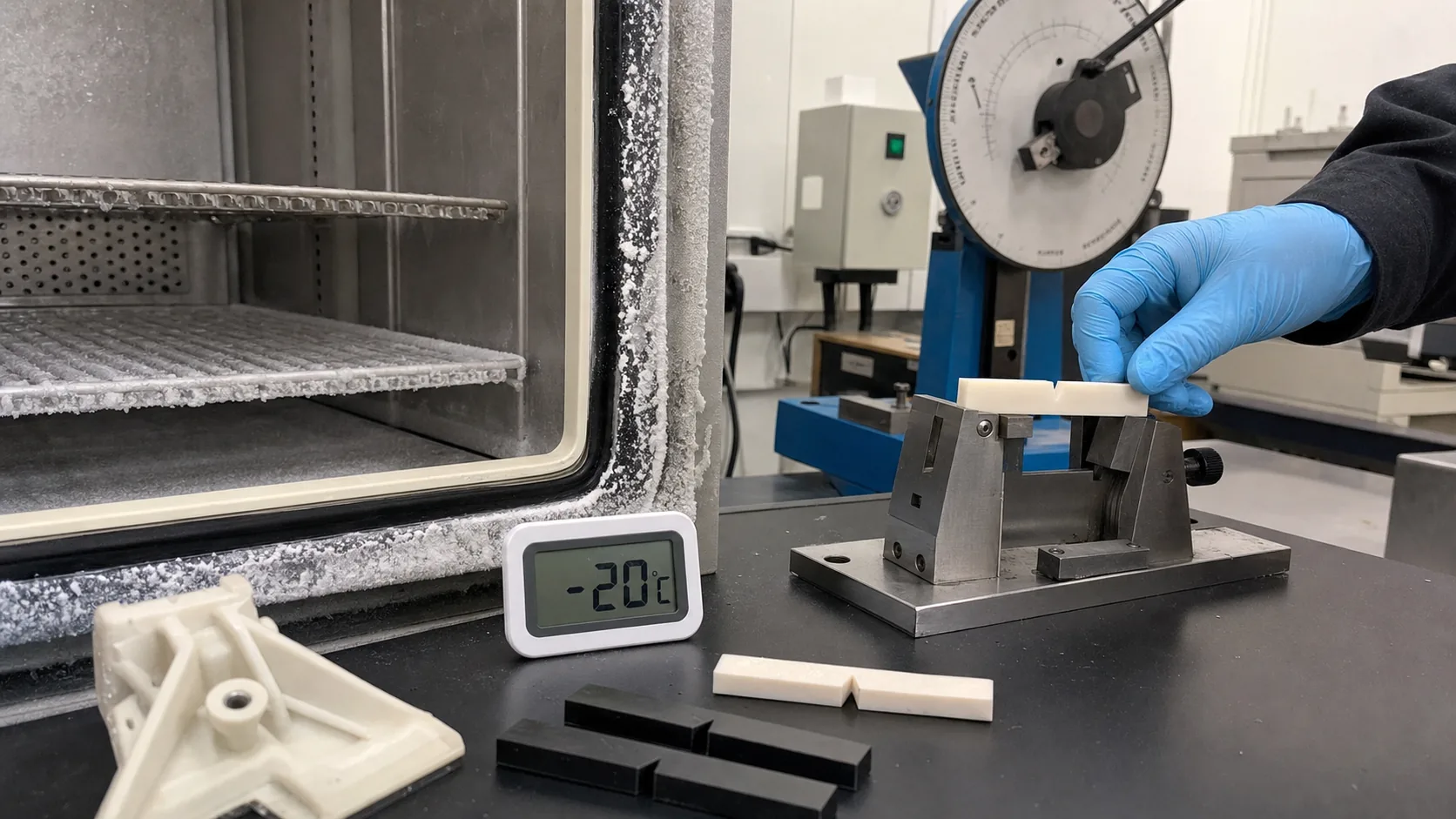
General impact strength is the ability of a material to absorb energy during sudden loading at room temperature, typically 23°C. It is measured using standardized tests such as:
Izod impact test (ASTM D256): a pendulum swings and strikes a notched, cantilevered plastic sample. The energy lost in breaking the sample is measured. The V-notch creates a controlled stress concentration that simulates real-world flaws like sharp corners or molding gates.
Charpy impact test (ISO 179): similar principle, but the sample is held horizontally as a simply supported beam.
Impact test results are expressed as energy absorbed per unit cross-sectional area (kJ/m²) or energy lost per unit specimen thickness (J/m). Higher values indicate greater toughness and resistance to sudden failure.
What it tells you: how the material performs under impact at room temperature. This is useful for comparing materials in general, but it does not predict performance in cold environments.
What Is Low-Temperature Toughness?
Low-temperature toughness is the ability of a material to absorb impact energy at sub-zero temperatures —typically the actual service temperature of the application, which may be -20°C, -30°C, -40°C, or lower.
Low-temperature impact tests use the same basic methods, Izod or Charpy, but with one critical difference: the specimens are conditioned at the specified low temperature before testing. Tests are commonly run down to -40°F (-40°C) or occasionally lower. The test temperature range can cover -196°C to +25°C depending on the standard.
What it tells you: how the material performs under impact at the actual temperature where the part will be used. This is the data that matters for cold-service applications.
The Critical Difference: Temperature Dependence
The key distinction is that impact strength is temperature-dependent. Most plastics show a ductile-to-brittle transition at lower temperatures, resulting in dramatically reduced impact values.
| Temperature | Material Behavior | Impact Performance |
|---|---|---|
| Room temperature (23°C) | Ductile, energy-absorbing | High impact values |
| Below transition temperature | Brittle, crack-propagating | Dramatically reduced impact values |
A real-world example: unmodified polycarbonate compositions show a decrease from notched Izod values at room temperature of about 80% when tested at about -20°C. A material that looks tough at 23°C becomes brittle at -20°C.
Another example: polypropylene specimens change from ductile to brittle at -25°C. Commercial PP is deficient in resistance to impact at low temperatures, including 0°C and below, for example -30°C. This is why standard PP fails in cold applications.
Why the Difference Matters for Buyers
1. Room-Temperature Data Is Misleading
A material data sheet that reports “impact strength: 50 kJ/m²—without specifying the test temperature is incomplete. If that value was measured at 23°C, it tells you nothing about how the material performs at -20°C.
The risk: you select a material based on room-temperature data, mold parts, and discover field failures when cold weather arrives.
2. The Ductile-Brittle Transition Is Not Gradual
The transition from ductile to brittle is often sharp, not gradual. A small temperature drop can cause a dramatic reduction in impact strength. This is why testing at the actual service temperature is essential —not just a temperature close to it.
3. Different Applications Require Different Levels of Modification
The level of impact modification required depends on the application:
| Modification Level | Typical Loading | Application |
|---|---|---|
| General-purpose | <10% | Reasonable room-temperature impact; does not address low-temperature requirements |
| Low-temperature impact | 5-15% | Applications requiring low-temperature flexibility and resistance to break |
| Super-tough impact | 20-25% | Applications that must not fail even if hit at -30°C to -40°C under high speed |
4. Material Behavior Varies by Polymer Type
Different polymers respond differently to temperature:
| Material | Room-Temperature Impact | Low-Temperature Toughness | Key Consideration |
|---|---|---|---|
| PP Homopolymer | Moderate | Poor | Becomes brittle below 0°C |
| PP Impact Copolymer | Good | Good (to -30°C) | Requires impact modification for cold |
| ABS (Standard) | Good | Moderate | Rubber phase loses effectiveness below -20°C |
| ABS (High-Impact) | Excellent | Good (to -30°C) | Higher rubber content for cold toughness |
| PA6/66 (Dry) | Poor | Poor | Brittle when dry |
| PA6/66 (Conditioned) | Good | Good | Moisture improves toughness |
| PC (Unmodified) | Excellent | Poor at -20°C | 80% reduction at -20°C |
| PC (Impact-Modified) | Excellent | Good | Modification required for cold |
5. Low-Temperature Toughness Is Not the Same as Flexibility
A common misconception is that a flexible material is automatically tough at low temperatures. While rubbery character generally gives higher elongation at break and better impact resistance, such materials have lower stiffness. Low-temperature toughness is about energy absorption without fracture —not just flexibility.
What Buyers Should Look For
1. Request Impact Data at the Actual Service Temperature
Do not accept room-temperature impact data as sufficient. Specify that impact testing must be performed at the minimum expected service temperature, such as -20°C, -30°C, or -40°C.
2. Understand the Test Method
Know which test method was used, Izod or Charpy, notched or unnotched, and at what temperature. Results from different methods are not directly comparable.
3. Look for the Ductile-Brittle Transition Temperature
Ask for data on the material ductile-brittle transition temperature. This is the temperature below which the material becomes brittle. The service temperature must be above this transition for reliable performance.
4. Specify the Modification Level
For cold applications, specify that the material must have low-temperature impact modification or super-tough impact modification, not just general-purpose impact modification.
5. Consider the Full Service Environment
Temperature is not the only factor. Moisture, chemical exposure, UV radiation, and other environmental conditions can all affect low-temperature toughness.
Reference Product Data
Reference direction: typical impact strength comparison at different temperatures:
| Material | Impact Test | 23°C (Reference) | -20°C (Reference) | -30°C (Reference) |
|---|---|---|---|---|
| PP Homopolymer | Notched Izod (kJ/m²) | 3-5 | 1-2 | <1 |
| PP Impact Copolymer | Notched Izod (kJ/m²) | 25-35 | 8-12 | 5-9 |
| High-Impact ABS | Notched Izod (kJ/m²) | 15-25 | 10-18 | 8-14 |
| Impact-Modified PA6 | Notched Izod (kJ/m²) | 18-30 | 12-20 | 10-18 |
| Impact-Modified POM | Notched Izod (kJ/m²) | 6-8 | 5-7 | 4-6 |
| Polyether TPU | Notched Izod (kJ/m²) | No break | No break | No break |
Note: data shown as reference direction. Actual values vary by grade and formulation.
Customer Debugging / Validation Scenario
Scenario: Cold-Storage Container —Room-Temperature Data vs Field Performance
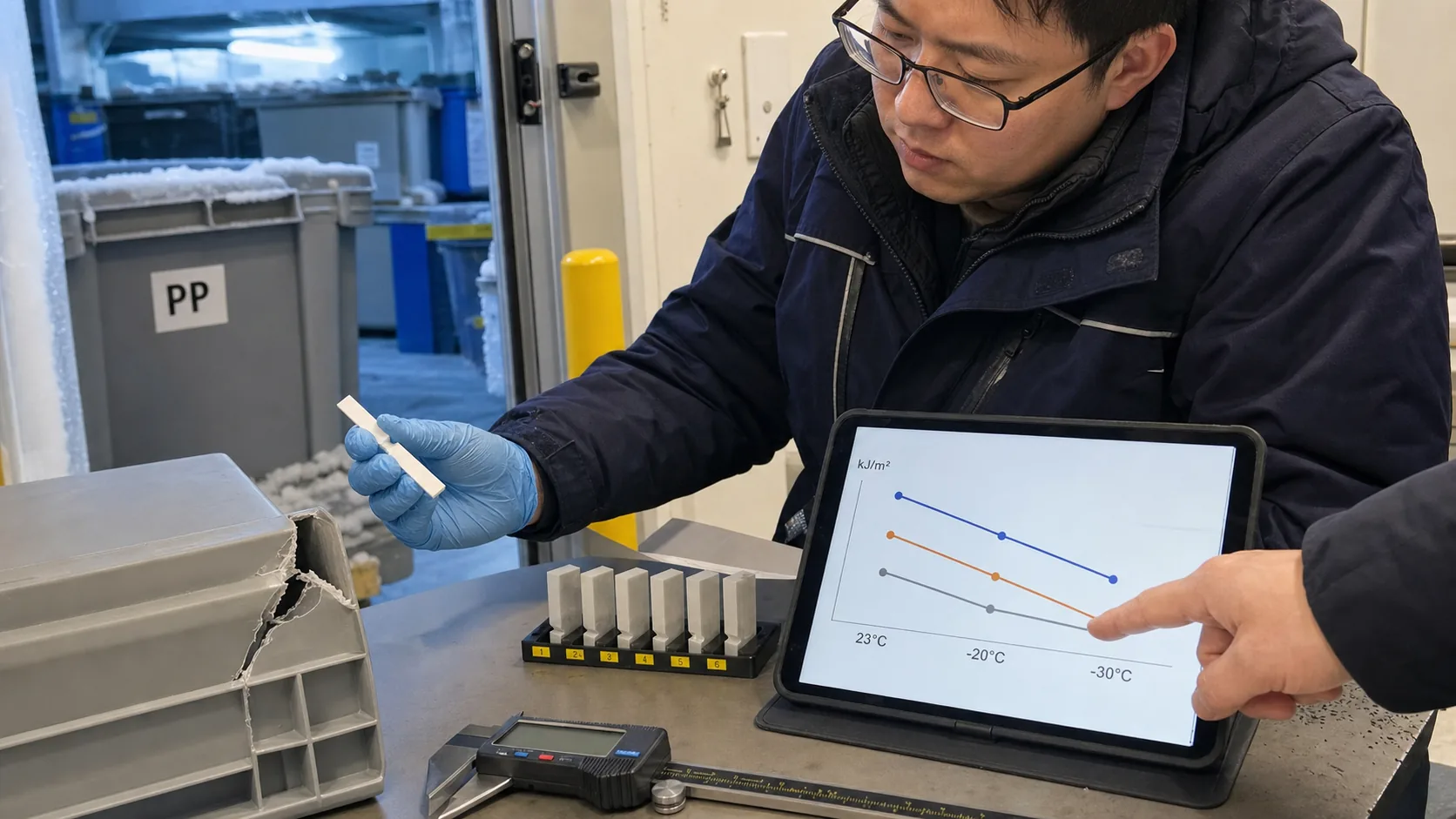
Background: a logistics provider selected a PP grade based on room-temperature impact data showing 25 kJ/m². The material passed the lab impact test and was approved for production. However, at -20°C in the cold storage facility, containers cracked at a 9% rate during handling.
Initial observation: the impact data on the data sheet was measured at 23°C. The material impact strength at -20°C was less than 3 kJ/m² —an 88% reduction. The material had a ductile-brittle transition above the service temperature.
Root cause analysis: the buyer had specified “impact-modified PP—but had not specified the test temperature. The supplier provided a general-purpose impact-modified grade that performed well at room temperature but lacked low-temperature toughness.
Corrective action: DEYU recommended DGK-66D, a low-temperature PP compound with notched impact of 13 kJ/m² at -23°C. The new material reduced the field failure rate from 9% to 1.2%.
What Buyers Should Provide
For DEYU to recommend the optimal material for cold-service applications, buyers should provide:
Service temperature: minimum expected temperature, such as -20°C, -30°C, or -40°C.
Impact test requirement: test method, Izod or Charpy; specimen type, notched or unnotched; and minimum acceptable value at the service temperature.
Failure mode: what type of impact, such as drop, handling, or assembly, causes failures.
Part geometry: stress concentration areas such as corners, bosses, and snap-fits that may increase notch sensitivity.
Environmental factors: moisture, chemical exposure, UV, or other conditions.
Current material: grade, supplier, and known failure data.
Conclusion
General impact strength and low-temperature toughness are fundamentally different properties. Impact strength is temperature-dependent, and most plastics show a dramatic reduction in impact performance at sub-zero temperatures. Room-temperature data is not a reliable predictor of cold-weather performance.
Buyers must specify impact testing at the actual service temperature and understand the ductile-brittle transition behavior of the material. General-purpose impact modification is insufficient for cold applications —low-temperature or super-tough modification levels are required.
DEYU offers a range of low-temperature compounds with validated impact data at -20°C, -30°C, and -40°C. Each grade is tested at the service temperature to ensure reliable performance in cold environments.
Contact DEYU: market@deyuplastics.com
Website: www.deyuplast.com