
Why Do Outdoor Plastic Parts Fade After Sunlight Exposure?
A problem-solving guide to UV-driven fading, yellowing, gloss loss and chalking in outdoor PP, PE, ABS, PC, PMMA and ASA parts. It connects pigment degradation, polymer photo-oxidation, UVA/HALS stabilizer strategy, polymer selection and QUV / ΔE validation so engineers can separate a cosmetic color issue from the early signs of material aging.
Buyer and engineer FAQ
Questions engineers often ask about this material route
Where can PP / PE / ABS / PC / PMMA / ASA / PVC / PS with a UV-resistant plastic requirement be used?
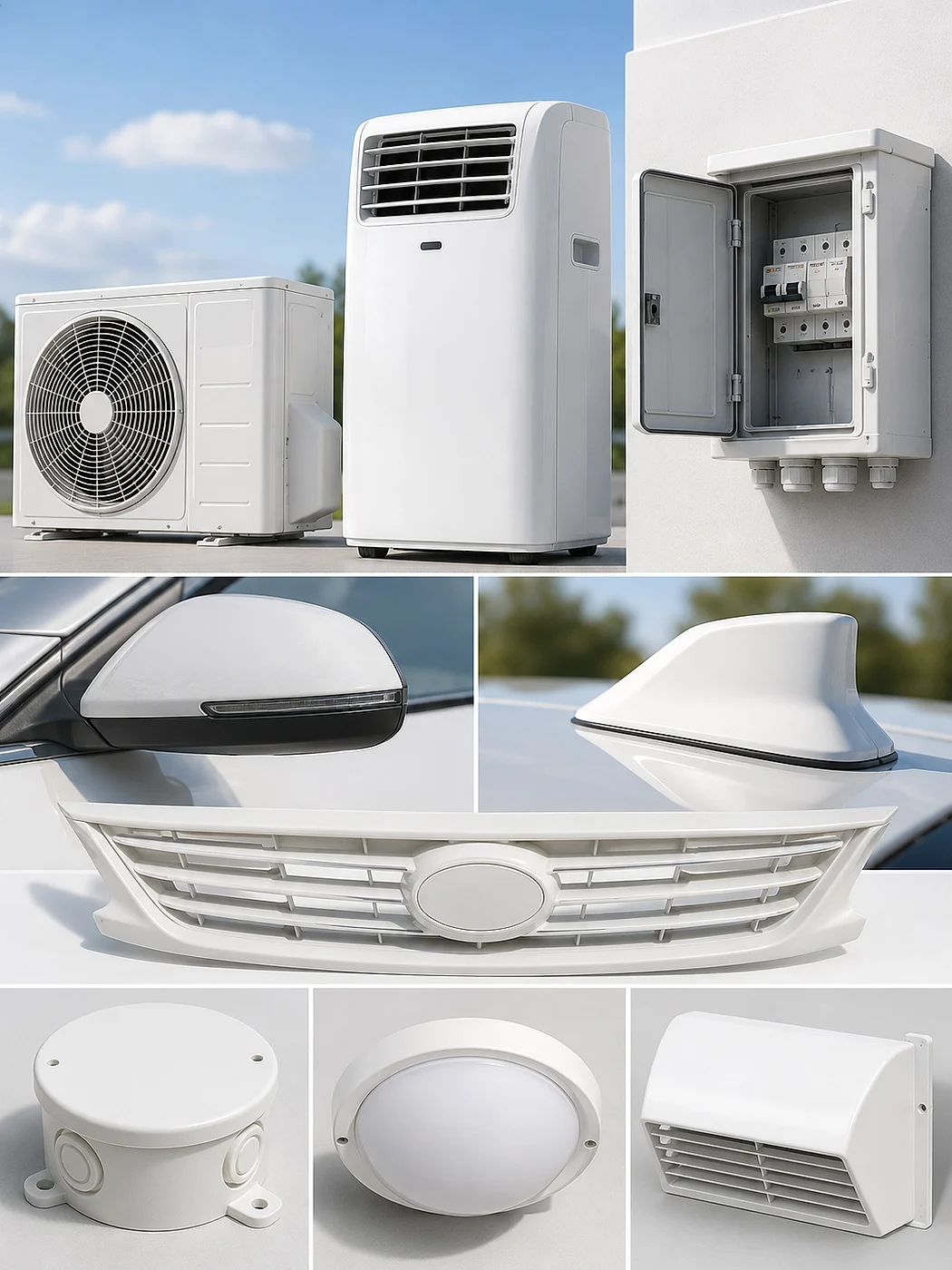
Typical fields include outdoor clips, covers, housings, liners, sheets, equipment shells and exposed appearance parts. For this article, DEYU would first confirm the working environment, wall thickness, expected lifetime and whether UV-resistant plastics product list matches the part geometry or needs formulation adjustment.
What are the main performance indicators for the "UV-resistant plastic" target on PP / PE / ABS / PC / PMMA / ASA / PVC / PS?
Focus on color change, gloss retention, tensile retention, impact retention and weathering hours. Buyers should ask for data on molded parts, not only pellet data, because gate position, filler orientation and thickness can change the final value.
What should engineers watch during injection molding or processing?
For PP / PE / ABS / PC / PMMA / ASA / PVC / PS, a practical starting window is 190-230°C melt / 30-60°C mold. Avoid overheating pigments or HALS systems, use stable black or color packages and validate outdoor aging. Final parameters should follow part thickness, gate design and the actual machine.
What details help DEYU recommend UV-resistant plastics product list more accurately?
Send the current resin or grade, drawing or photo, wall thickness, annual quantity, target standard, failure mode and required color. If a reference grade already passed one test but failed in production, include both data sets.
For a precise recommendation, share the part drawing, base resin, target performance, processing method and test standard with DEYU.
Background / Problem
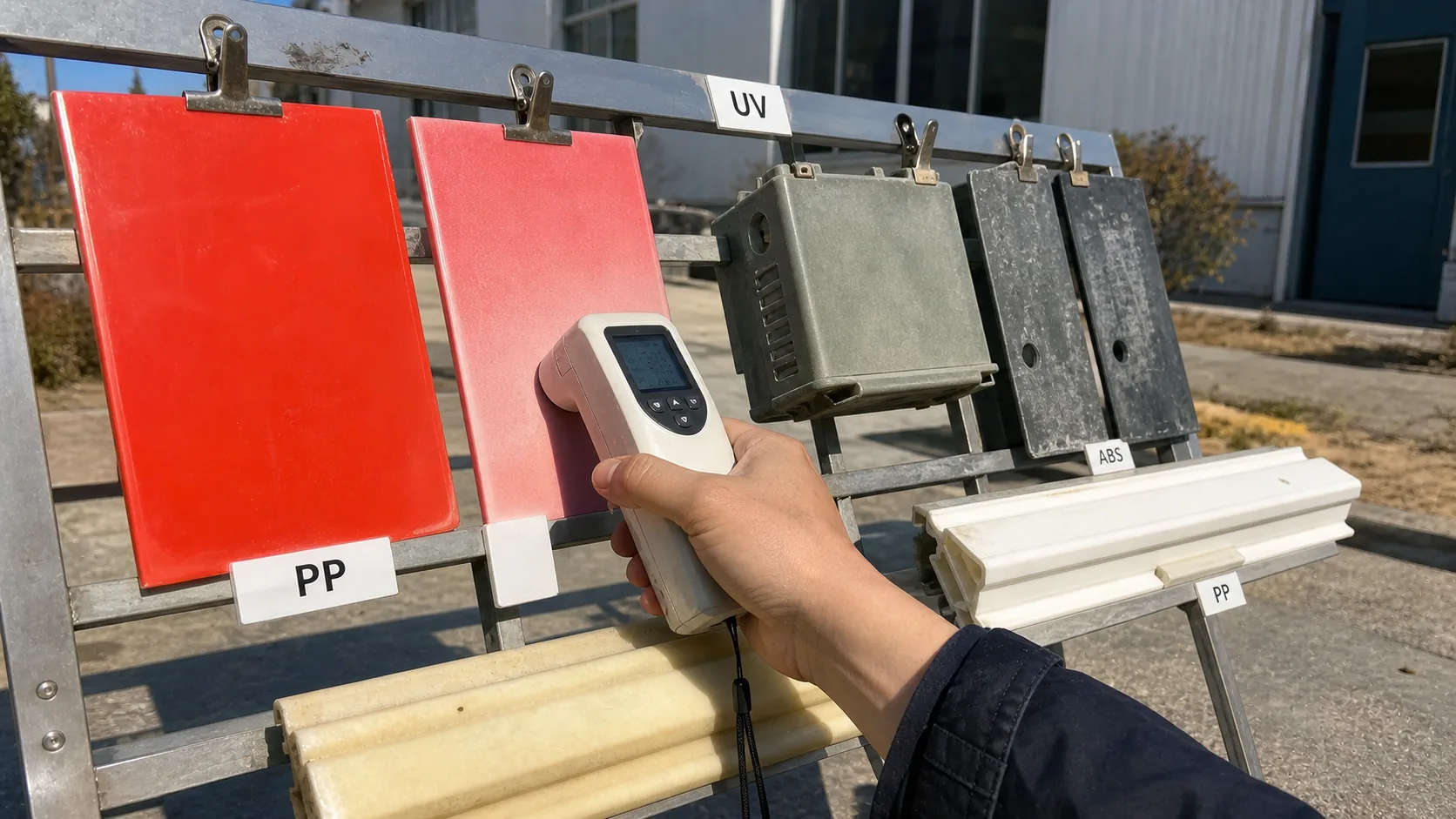
A bright red plastic component is installed outdoors. Within months, it turns pink. A dark gray enclosure fades to a washed-out greenish-gray. A white window profile develops a yellow tint. These color changes are not merely cosmetic; they are early warning signs of material degradation that can signal deeper structural problems.
Related DEYU references: UV-resistant plastics product list and weathering-grade testing guide.
Fading is one of the most visible and frustrating failures of outdoor plastic parts. For appearance-critical applications such as automotive exterior trim, outdoor signage, consumer goods and building products, fading is unacceptable because it creates customer complaints, warranty claims and premature replacement.
The root cause is almost always ultraviolet (UV) radiation from sunlight. Fading occurs through two different pathways that often operate at the same time: pigment degradation and polymer yellowing.
Technical Difficulty / Why It Happens
When high-energy UV photons strike a plastic part, they initiate photo-oxidation. UV radiation breaks chemical bonds, forms free radicals and lets those radicals react with oxygen. This causes chain scission, lower molecular weight, surface cracking, discoloration, chalking and loss of mechanical properties. The degradation is cumulative and irreversible.
Pigments produce color through chromophores. UV photons can break the conjugated double-bond systems that create color, so the pigment loses its ability to absorb those wavelengths. Organic pigments such as phthalocyanine blues, quinacridone reds and azo yellows are particularly vulnerable; inorganic pigments are usually more stable but still need validation. TiO?can reduce UV penetration, yet residual photoactivity may still generate radicals that attack the polymer.
Even without pigment degradation, the polymer itself can change color. PC can yellow through Photo-Fries rearrangement, PE through surface chiral nanostructures, ABS through photo-oxidation of the butadiene rubber phase, and unstabilized PMMA through a high yellowness index after UV exposure.
Fading is rarely caused by one mechanism. The polymer yellows, the pigment fades, and the combined color shift can be worse than either effect alone. Fading often precedes or accompanies chalking, gloss loss and a powdery oxidized surface layer.
Why Some Polymers Are More Vulnerable
| Polymer | UV Sensitivity | Fading/Yellowing Risk | Key Vulnerability |
|---|---|---|---|
| PP | High | High | Tertiary carbon atoms susceptible to oxidation |
| PE | Medium | Moderate | Surface chiral structures cause yellowing |
| ABS | High | Very high | Unsaturated butadiene phase photo-oxidizes |
| PC | Medium | Moderate | Photo-Fries rearrangement causes yellowing |
| PMMA | Low–Medium | Low with stabilization | Can yellow without UV absorbers |
| ASA | Low | Low | Acrylate rubber is UV-stable |
DEYU Material Direction
DEYU typically recommends a combined route rather than a single additive answer: UV-stable pigment, UVA, HALS, appropriate polymer selection and validation on molded parts.
1. Select the Right Pigment System
| Pigment Type | UV Stability | Best Use |
|---|---|---|
| Inorganic pigments (iron oxides, mixed metal oxides) | Excellent | Long-term outdoor, dark or earthy colors |
| High-performance organics (phthalocyanine, quinacridone) | Good | Bright colors with UV protection |
| Standard organics (azo, conventional) | Poor | Indoor or short-term outdoor only |
| Carbon black | Excellent | Black parts; also provides UV shielding |
2. Use UV Absorbers (UVA)
UV absorbers intercept UV photons before they reach the polymer or pigment and convert harmful energy into heat. Colored parts normally need a higher UVA loading because both the polymer and pigment system require protection.
3. Add Hindered Amine Light Stabilizers (HALS)
HALS do not absorb UV radiation. They scavenge free radicals formed during photo-oxidation and interrupt the degradation chain reaction.
4. Combine Stabilizers for Synergy
UVA intercepts photons; HALS captures the radicals that escape. This two-part defense is important for demanding outdoor applications.
5. Consider Polymer Selection
For appearance-critical outdoor parts, ASA is often preferred because it replaces the UV-sensitive butadiene phase of ABS with acrylate rubber. For cost-sensitive semi-outdoor parts, UV-stabilized ABS or PP may still be appropriate after QUV and real-part validation.
Customer Debugging / Validation Scenario
A manufacturer of outdoor signage used UV-stabilized ABS with an organic red pigment and one UV absorber, but no HALS. After 12 months of full sun exposure, red areas faded to pink, white areas yellowed, gloss dropped and the surface became dull and rough.
Root Cause Analysis
| Observation | Root Cause |
|---|---|
| Red faded to pink | Organic red pigment degraded under UV; the UVA package did not protect the pigment enough |
| Yellowing in white areas | ABS butadiene phase photo-oxidized; no HALS to scavenge radicals |
| Gloss loss | Surface photo-oxidation eroded the smooth surface layer |
Corrective Actions
| Issue | Corrective Action |
|---|---|
| Insufficient pigment protection | Increase UVA loading; consider inorganic red pigment |
| No radical scavenging | Add HALS (0.3—.5%) |
| ABS vulnerability | Switch to ASA for premium outdoor appearance |
Trial Results
| Metric | Original Formulation | Corrected Formulation | Acceptance |
|---|---|---|---|
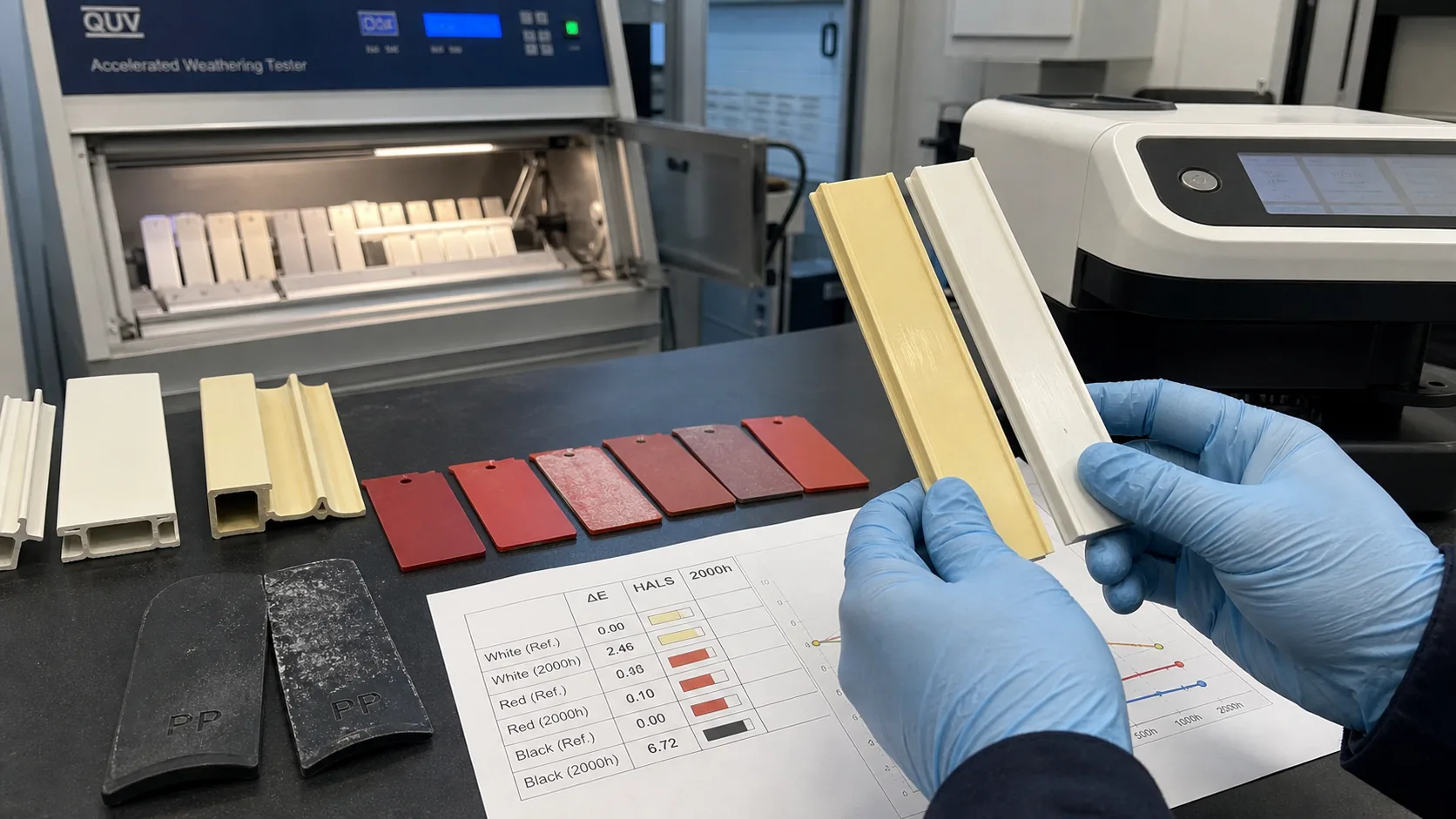
| ΔE after 2000h QUV | 4.8 | 1.5 | <3.0 |
| Gloss Retention | 45% | 82% | >70% |
| Surface Yellowing | Present | None | None |
| Field Pass Rate (24 months) | 78% | 99% | >97% |
This is a composite validation scenario based on common industry experience. Actual values depend on application, geography, exposure angle and processing.
Validation Data Table
| Parameter | Test Method | Poor Formulation | Good Formulation | Acceptance |
|---|---|---|---|---|
| Color Change (ΔE) after 2000h QUV | ASTM G154 | >4.0 | <2.0 | <3.0 |
| Gloss Retention | ASTM D523 | <50% | >75% | >70% |
| Yellowing Index | ASTM D1925 | >15 | <5 | <10 |
| Pigment Retention | Spectrophotometry | <60% | >90% | >85% |
| Surface Chalking | ASTM D4214 | 3— | 0— | <2 |
Result Interpretation
Diagnosing the Cause of Fading
| Symptom | Likely Primary Cause | Corrective Action |
|---|---|---|
| Color fades but no yellowing | Pigment degradation | Increase UVA; switch to more stable pigment |
| Yellowing but color intensity maintained | Polymer yellowing | Add HALS; consider more UV-stable polymer |
| Both fading and yellowing | Combined pigment + polymer degradation | Full stabilizer package; consider ASA |
| Fading worse on one surface | Uneven UV exposure | Design for UV shielding; use UV-stabilized all surfaces |
| Gloss loss before fading | Surface degradation | Add HALS; increase surface protection |
Prevention Priorities
| Priority | Action | Impact on Fading |
|---|---|---|
| 1 | Use UV-stable pigments | Prevents pigment degradation |
| 2 | Add UV absorber (0.2—.5% depending on pigment) | Protects pigment and polymer |
| 3 | Add HALS (0.3—.6%) | Scavenges radicals; prevents yellowing |
| 4 | Consider ASA over ABS | Eliminates butadiene yellowing |
| 5 | Use carbon black for black parts | Provides inherent UV shielding |
Suitable Applications
| Application | Primary Fading Risk | Recommended Prevention |
|---|---|---|
| Automotive exterior trim | UV + thermal cycling | ASA or PC/ASA + UVA + HALS |
| Outdoor signage | High UV exposure | Inorganic pigments + UVA + HALS |
| Window profiles | UV + moisture | Coated TiO?+ HALS |
| Outdoor furniture | UV + cleaning agents | HALS + UVA + inorganic pigments |
| Agricultural equipment | UV + chemical exposure | High-performance organics + full stabilizer |
| Telecom enclosures | UV + thermal cycling | ASA or UV-stabilized PC/ABS |
What Buyers Should Provide
To enable accurate fading prevention, buyers should provide target color specification, pigment type, allowed ΔE, climate zone, direct sunlight hours, part orientation, humidity, surface temperature, service-life target, mechanical requirements, surface finish, processing method, processing temperature, residence time, annual volume and sample part or drawing.
Conclusion
Fading of outdoor plastic parts is caused by two different but often simultaneous mechanisms: pigment degradation and polymer yellowing. Both are driven by UV radiation and accelerated by heat and moisture.
Key Takeaways
| Factor | Impact on Fading |
|---|---|
| Pigment type | Organic pigments fade faster than inorganic; selection is critical |
| UV absorber loading | Higher loading protects pigments; essential for colored parts |
| HALS presence | Prevents polymer yellowing; essential for long-term color stability |
| Polymer choice | ASA > PC/ABS > ABS for UV stability |
| Synergy | UVA + HALS together outperform either alone |
The most important rule is simple: color stability requires protecting both the pigment and the polymer. UV absorbers protect the pigment; HALS protect the polymer. DEYU can support pigment selection, stabilizer package design, small-batch validation and formulation recommendations.